Entirely New Species of Human Ancestor Discovered

Ancient teeth found in Ethiopia belong to a never-before-seen species in the Australopithecus genus of human ancestors

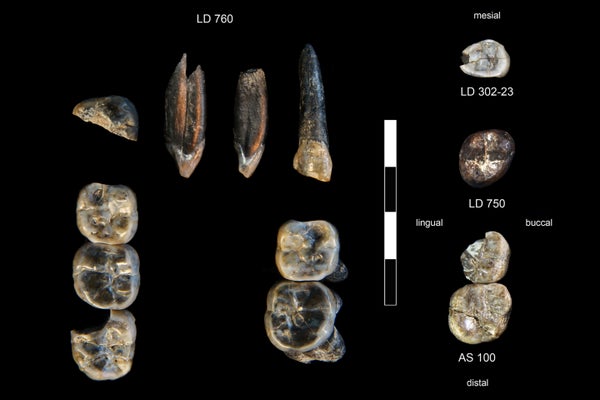
The 13 fossil teeth collected in the Ledi-Geraru Research Area from 2015-2018 on black background

Thirteen fossilized teeth were collected in the Ledi-Geraru Research Area from 2015 to 2018. The collections at LD 750 and LD 760 localities represent a newly discovered species of Australopithecus. LD 302 and AS 100 represent early Homo already known from the LD 350 mandible discovered in 2013.

Brian Villmoare/University of Nevada, Las Vegas

Join Our Community of Science Lovers!

Researchers working in northeastern Ethiopia have discovered remains of a previously unknown branch of humanity. The fossils, which include teeth that date to between 2.8 million and 2.6 million years ago, belong to a never-before-seen member of the genus Australopithecus—the same genus to which the famous Lucy fossil belongs. They show that this newly identified member of the human family lived alongside early representatives of our own genus, Homo. The findings were published in Nature on August 13.

The discovery team, led by investigators at Arizona State University, has yet to name the new species because the researchers need more fossils from other parts of the body to do so. But comparisons of the teeth with other fossils from the same site—Ledi-Geraru in the Afar Region of Ethiopia—as well as with other hominin fossils, revealed that they are distinctive enough to represent a species of Australopithecus that is new to science.

Photo of Ledi-Geraru paleontological team searching for fossils in the Lee Adoyta Basin where the genera Homo and Australopithecus have been recovered

The Ledi-Geraru paleontological team searches for fossils in the Lee Adoyta Basin in Ethiopia, where the genera Homo and Australopithecus have been recovered.

Kaye Reed/Arizona State University


On supporting science journalism

If you're enjoying this article, consider supporting our award-winning journalism by subscribing. By purchasing a subscription you are helping to ensure the future of impactful stories about the discoveries and ideas shaping our world today.


Together with previous finds, the new fossils demonstrate that at least four lineages of hominins (creatures more closely related to us than to our closest living relatives, the chimpanzees and bonobos) lived in eastern Africa between three million and 2.5 million years ago.

How these hominins were able to share the landscape is a question the team is working to answer. One possible explanation is that they preferred different foods. Studies of the enamel of their fossilized teeth may yield clues to what they were eating.

Once upon a time, scholars thought that human evolution was a march of progress in which our forebears evolved in linear fashion from an apelike ancestor to a series of increasingly humanlike forms. The new find underscores the complexity of human origins. Although Homo sapiens is the only hominin species on Earth today, for the vast majority of humanity’s existence, multiple hominin species shared the planet. Our family tree is more like a bush, with lots of twigs that were dead ends—failed evolutionary experiments that occurred outside of our direct line of ancestry.

Kate Wong is an award-winning science writer and senior editor for features at Scientific American, where she has focused on evolution, ecology, anthropology, archaeology, paleontology and animal behavior. She is fascinated by human origins, which she has covered for nearly 30 years. Recently she has become obsessed with birds. Her reporting has taken her to caves in France and Croatia that Neandertals once called home to the shores of Kenya’s Lake Turkana in search of the oldest stone tools in the world, as well as to Madagascar on an expedition to unearth ancient mammals and dinosaurs, the icy waters of Antarctica, where humpback whales feast on krill, and a “Big Day” race around the state of Connecticut to find as many bird species as possible in 24 hours. Wong is co-author, with Donald Johanson, of Lucy’s Legacy: The Quest for Human Origins. She holds a bachelor of science degree in biological anthropology and zoology from the University of Michigan. Follow her on Bluesky @katewong.bsky.social

More by Kate Wong

It’s Time to Stand Up for Science

If you enjoyed this article, I’d like to ask for your support. Scientific American has served as an advocate for science and industry for 180 years, and right now may be the most critical moment in that two-century history.

I’ve been a Scientific American subscriber since I was 12 years old, and it helped shape the way I look at the world. SciAm always educates and delights me, and inspires a sense of awe for our vast, beautiful universe. I hope it does that for you, too.

If you subscribe to Scientific American, you help ensure that our coverage is centered on meaningful research and discovery; that we have the resources to report on the decisions that threaten labs across the U.S.; and that we support both budding and working scientists at a time when the value of science itself too often goes unrecognized.

In return, you get essential news, captivating podcasts, brilliant infographics, can't-miss newsletters, must-watch videos, challenging games, and the science world's best writing and reporting. You can even gift someone a subscription.

There has never been a more important time for us to stand up and show why science matters. I hope you’ll support us in that mission.

Thank you,

David M. Ewalt, Editor in Chief, Scientific American

Subscribe