
Researchers are preparing to scrutinize nature on tiny scales by stretching supercooled atoms into room-length waves as they drop them down a 100-meter vacuum tube. The experiment will seek ripples in the bizarre quantum realm: potential fingerprints of missing dark matter and, in future iterations, new frequencies of gravitational waves.
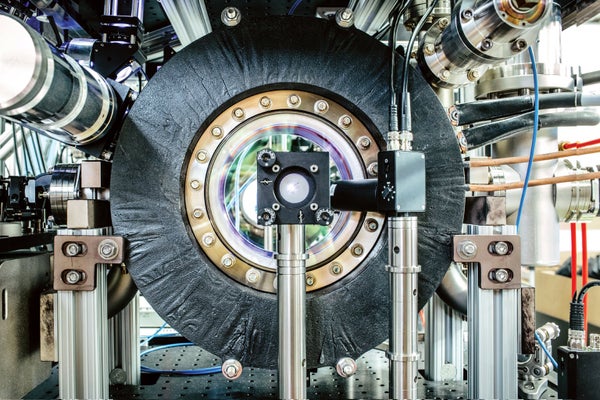
Collaborators have raised $12.3 million to turn an Illinois mine shaft into the world's largest atom interferometer—the Matter-wave Atomic Gradiometer Interferometric Sensor, or MAGIS-100. The instrument will manipulate falling atoms with lasers. A laser pulse can tickle a single atom in such a way that, because of its quantum properties, it both absorbs and does not absorb the laser's energy. In terms of quantum mechanics, everything from a photon to a baseball has wavelike qualities—although they are imperceptible for large objects. When the MAGIS laser excites an atom, its wavelike nature lets it stretch out in space, the laser-absorbing part racing ahead.
After these atom waves, which measure several meters long, fall down the shaft, a second laser pulse will reunite the excited part of each wave with its slower counterpart. Researchers will then precisely determine the acceleration of the falling atom by measuring interference between the two parts of the wave. By simultaneously dropping a million such atom waves along the shaft's upper and lower sections, physicists will check more interference patterns—those between the top and bottom clouds of atoms—for minuscule contradictions to the known laws of physics. “The longer you watch [the atoms] fall, the more accurately you can measure them,” says Stanford University physicist Jason Hogan, who has developed a 10-meter prototype.
On supporting science journalism
If you're enjoying this article, consider supporting our award-winning journalism by subscribing. By purchasing a subscription you are helping to ensure the future of impactful stories about the discoveries and ideas shaping our world today.
Dark matter, which scientists suspect makes up much of the cosmos but which cannot be detected by conventional means, could cause noticeable effects in this experiment. Dark matter has many possible candidates, but ultralight particles—which Rob Plunkett, principal investigator at Fermilab, where MAGIS-100 will reside, calls “a whole unexplored continent”—are gaining prominence. If these phantasms meddle with MAGIS-100's atom waves, nudging them or tweaking fundamental constants, researchers just might catch the lightweights in the act.
And if dark matter remains dark to MAGIS-100, the apparatus doubles as a pathfinding gravitational-wave detector. It probably will not sense the subtle ripples in spacetime itself, but its technologies may enable a future kilometer-long “MAGIS-1000,” which would be more sensitive to both gravitational waves and novel particles.