
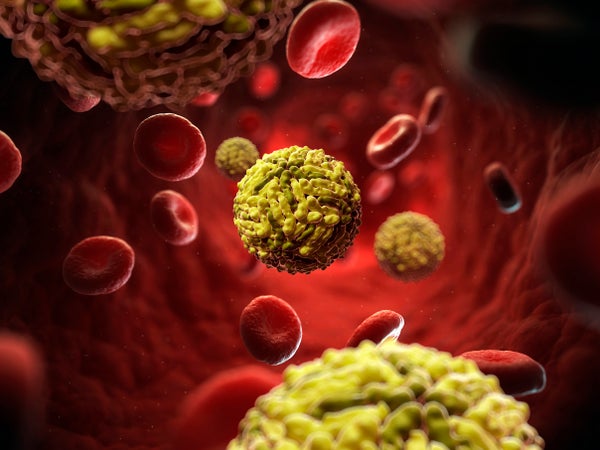
Scientists have crafted a trap for the dengue virus using a scaffold made from fragments of DNA. The star-shaped structure is engineered to single out the virus in the bloodstream and latch on to it with precision, providing a powerful yet simple test to detect the mosquito-transmitted disease.
Dengue is the world's fastest-growing vector-borne disease, with multiple serious outbreaks in 2019. In its severe forms, it can cause internal bleeding and is sometimes fatal. There is no widely accepted vaccine or targeted treatment for dengue, so accurate early detection is crucial.
The spherical surface of the dengue virus is peppered with antigens, special proteins the virus uses to attach to the cells it infects. Scientists led by Xing Wang, a biochemist at the University of Illinois at Urbana-Champaign, constructed a flexible scaffold using DNA nanotechnology to mirror the proteins' arrangement on a hemisphere of the viral surface. The tips and vertices of this five-pointed “DNA star” align with the antigens and carry molecules that they glom on to. The multiple attachment points make the binding strong and very precise, the researchers say: the DNA star targets only viruses with that particular pattern. Once binding occurs, the star fluoresces, or lights up, signaling the presence of the virus.
On supporting science journalism
If you're enjoying this article, consider supporting our award-winning journalism by subscribing. By purchasing a subscription you are helping to ensure the future of impactful stories about the discoveries and ideas shaping our world today.
“This is a great example of how DNA nanotechnology can solve real biological problems,” says Mingxu You, who leads a nucleic acid chemistry research group at the University of Massachusetts Amherst and was not involved in the study. “Compared with current [dengue-detection] techniques, this DNA probe exhibits exciting sensitivity and simplicity.”
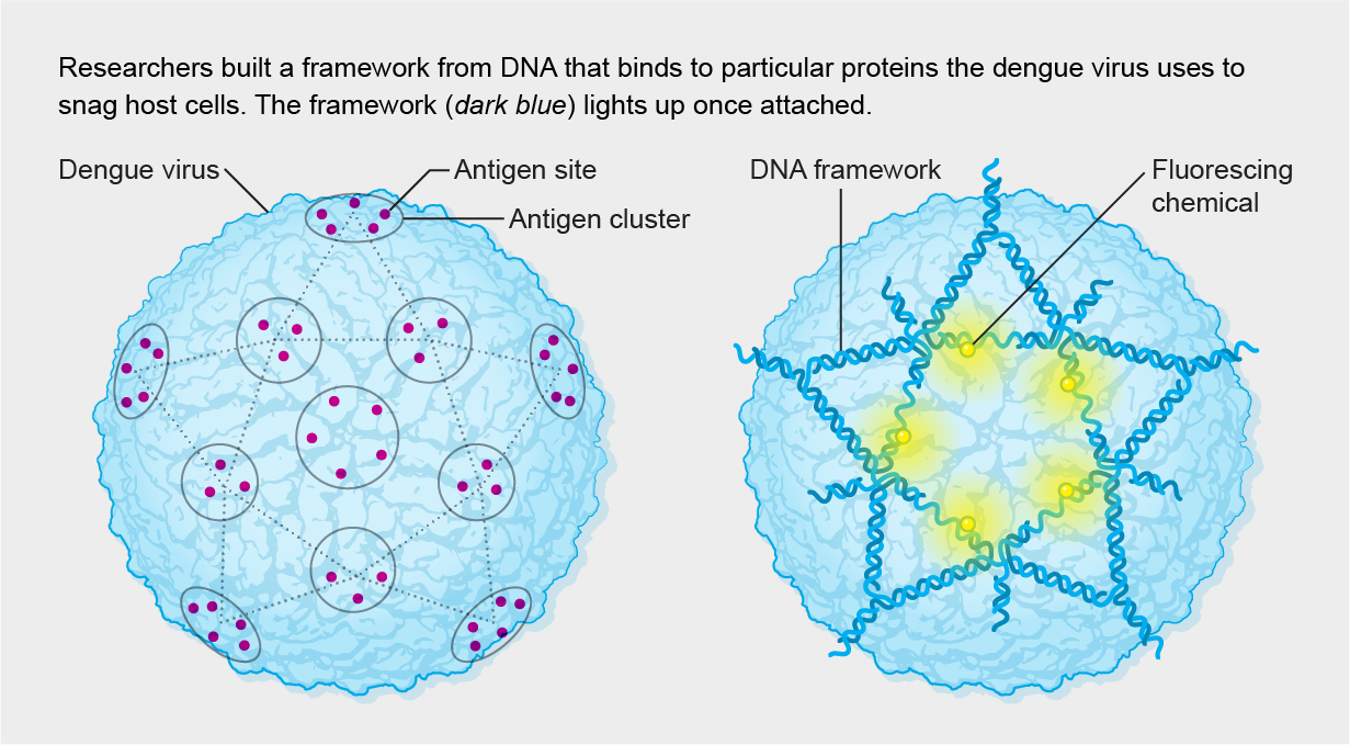
Credit: Tami Tolpa; Source: “Designer DNA Architecture Offers Precise and Multivalent Spatial Pattern-Recognition for Viral Sensing and Inhibition,” by Paul S. Kwon et al., in Nature Chemistry, Vol. 12; January 2020
Current gold-standard dengue tests require sophisticated laboratory set-ups and training. “Our technology is very simple; we need only one to two minutes, and the cost is only 50 cents for each test,” Wang says. In their Nature Chemistry paper, published in January, the researchers compare their technology with current clinical tests and make a case for its superior sensitivity and accuracy. It should work before symptoms appear, and the DNA nanostructures are nontoxic and friendly to human tissue, the researchers say.
Dengue's surface pattern is complex, Wang adds, so DNA nanostructures must be molded into complicated geometric shapes to match. Simpler viruses would require simpler designs.
Wang is now collaborating with Sherwood Yao, CEO of Atom Bioworks in North Carolina, to expand the same principle to other viruses such as Zika and influenza—and beyond, to bacteria and perhaps even cancer cells. Yao has a background in AI and was intrigued by the method's pattern-recognition approach, which he compared with facial-recognition techniques. The technology provides “a programmable interface into biology,” Yao says. “Our solution could become a fundamental vehicle not only to detect a pathogen but also to inhibit it.”