On Kindness and Grief

Scientific American MIND, Sept-Oct 202

Scientific American MIND, Sept-Oct 2021; Jonathan Knowles Getty Images (background)

Join Our Community of Science Lovers!

After a large portion of a Miami-area apartment building spontaneously collapsed in June, Scientific American contributor Katherine Harmon Courage sat down with social scientist and clinician Pauline Boss to learn about the particular sort of grief that comes with ambiguous loss. Such losses occur when, for example, a relative’s remains cannot be recovered from an accident or when a child goes missing. Chances are that the person is gone, but there is no certainty. Something about that kind of uncertainty rings very true amid the stress and anxiety of the pandemic—not knowing if you or a loved one will get sick, or if your job is secure, or how to balance child care and COVID restrictions. Boss tells our reporter how humans can build their tolerance for living with ambiguity. But I imagine it doesn’t make it any less difficult (see “Ambiguous Loss from Miami-Area Condo Collapse Makes Grieving Harder”). As numerous psychological studies have shown, no matter the flavor, grief requires patience and compassion—especially toward the self.

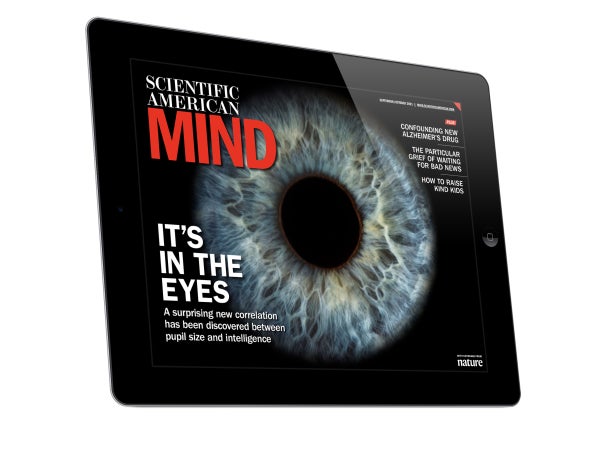
This issue is full of other fascinating findings. Research now suggests that human smarts may be gleaned by, of all things, certain dimensions of the eyeball (see “Pupil Size Is a Marker of Intelligence”). And senior editor Clara Moskowitz picks the brain of Melinda Wenner Moyer, whose new book details the scientific ways to teach children to be generous, honest, helpful and kind (see “How to Raise Kids Who Don’t Grow Up to Be Jerks (or Worse)”). Kindness sometimes feels in short supply in today’s world. Best we nurture it in our own homes.

Andrea Gawrylewski is chief newsletter editor at Scientific American. She writes the daily Today in Science newsletter and oversees all other newsletters at the magazine. In addition, she manages all special editions and in the past was the editor for Scientific American Mind, Scientific American Space & Physics and Scientific American Health & Medicine. Gawrylewski got her start in journalism at the Scientist magazine, where she was a features writer and editor for "hot" research papers in the life sciences. She spent more than six years in educational publishing, editing books for higher education in biology, environmental science and nutrition. She holds a master's degree in earth science and a master's degree in journalism, both from Columbia University, home of the Pulitzer Prize.

More by Andrea Gawrylewski
SA Mind Vol 32 Issue 5This article was published with the title “On Kindness and Grief” in SA Mind Vol. 32 No. 5 (), p. 2
doi:10.1038/scientificamericanmind0921-2

It’s Time to Stand Up for Science

If you enjoyed this article, I’d like to ask for your support. Scientific American has served as an advocate for science and industry for 180 years, and right now may be the most critical moment in that two-century history.

I’ve been a Scientific American subscriber since I was 12 years old, and it helped shape the way I look at the world. SciAm always educates and delights me, and inspires a sense of awe for our vast, beautiful universe. I hope it does that for you, too.

If you subscribe to Scientific American, you help ensure that our coverage is centered on meaningful research and discovery; that we have the resources to report on the decisions that threaten labs across the U.S.; and that we support both budding and working scientists at a time when the value of science itself too often goes unrecognized.

In return, you get essential news, captivating podcasts, brilliant infographics, can't-miss newsletters, must-watch videos, challenging games, and the science world's best writing and reporting. You can even gift someone a subscription.

There has never been a more important time for us to stand up and show why science matters. I hope you’ll support us in that mission.

Thank you,

David M. Ewalt, Editor in Chief, Scientific American

Subscribe