If you're enjoying this article, consider supporting our award-winning journalism by subscribing. By purchasing a subscription you are helping to ensure the future of impactful stories about the discoveries and ideas shaping our world today.
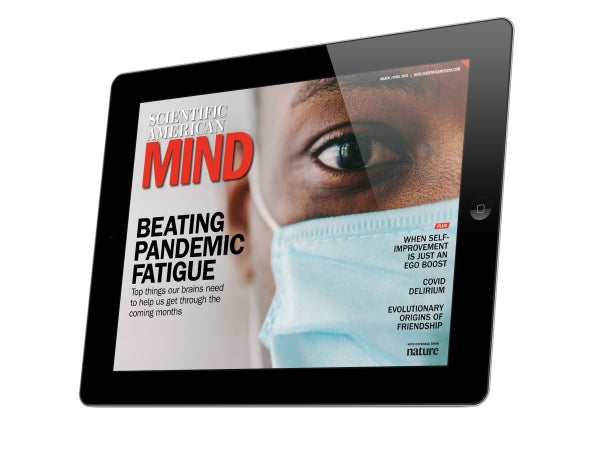
As I write this, it’s been nearly one year since our editorial team decided to start working from home out of concern for the novel coronavirus sweeping the country. To say that we’re living in a so-called new normal is a gross misnomer. The realities of social isolation, virtual remote learning, rolling lockdowns, and nearly half a million dead in the U.S. are as far from normal as one could imagine. As the virus and its toll continue to deplete us, mental exhaustion has started to kick in, as neuroscientist David Badre writes in this issue’s cover story (see “How We Can Deal with ‘Pandemic Fatigue’”). He has some insight into how behavioral science might help us get across the pandemic end zone. The sooner the better.
Elsewhere in this collection, psychologist Scott Barry Kaufman explores a new phenomenon whereby self-improvement efforts—yoga, smoothies, meditation—end up feeding the ego rather than engendering enlightenment (see “The Science of Spiritual Narcissism”). And reporter Carrie Arnold investigates cases of COVID delirium and what they might mean for future mental health (see “The Link between Delirium and Dementia”). Thanks for reading, get some rest, and carry on.
Subscribe to Support Independent Journalism
Great science journalism requires human expertise, time, effort and creativity. And it costs money. That’s why I and the journalists here at Scientific American hope you’ll join our community.
When you subscribe, you are supporting staff and freelance journalists who are passionate about telling science stories that are true, important and compelling. Our editors and reporters are often experts in their fields, which means they understand the nuances of big discoveries and can untangle the breakthroughs from the hype. With a subscription, you are also supporting rigorous fact-checking to ensure the words we publish are precise and accurate. And you’re supporting original illustrations, graphics and photos that bring you closer to an advanced laboratory, an ice sheet in Antarctica or a space mission in orbit. You’re helping us craft other types of high-quality journalism as well: Our newsletters are carefully written, edited and curated by staffers you have or will come to know and love. Our Science Quickly podcast is based on original reporting, collaboration with editors and scientists and exacting production.
Subscriptions keep this engine running so we can continue to deliver thoughtful, rigorous and independent science journalism to you. In an era of viral misinformation, this work is crucial. If you value what we do, I hope you’ll consider joining us as a subscriber
Thank you,
Jeanna Bryner, Editor in Chief, Scientific American