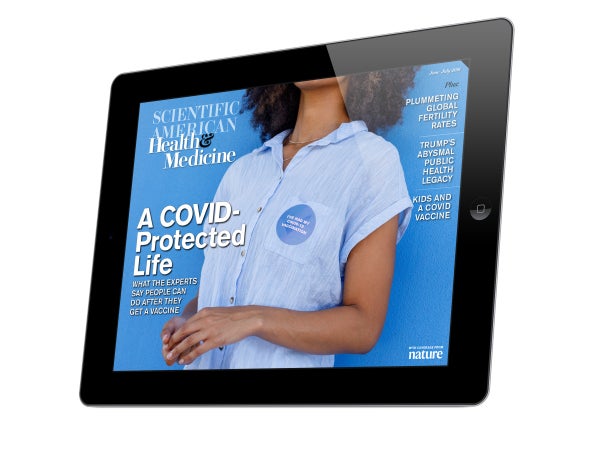
Scientific American Health & Medicine, Vol. 3, Issue No. 3
Join Our Community of Science Lovers!
Just before this issue went to press, Scientific American published a news story describing a new condition coined by psychologists: cave syndrome. Uniquely relevant to the COVID world, those who experience it fear leaving home and interacting as they did before the pandemic, even though they have been fully vaccinated. Several members of my close circle could easily fit this description—despite having gotten their shots, they can’t imagine doing all the things they once did, like going into their friends’ apartments, meeting dates unmasked or eating indoors at a restaurant.
In this collection’s cover story, physician Carolyn Barber surveys the experts about how much freedom a vaccination truly confers (see “So What Can People Actually Do after Being Vaccinated?”). As she discovers, the science is young and constantly changing, giving cave syndromers a steady stream of variables and guidance to contend with.
COVID has other strange lingering effects: writer Claudia Wallis investigates the link between the disease and the onset of diabetes (see “Unraveling the Complex Link between COVID and Diabetes”). And journalist Mike May details all the other viral and bacterial threats lurking in the wings for humans to contend with (see “Tomorrow’s Biggest Microbial Threats”). But for now let’s all get out the door and begin healing from COVID-19 as best we can.
Subscribe to Support Independent Journalism
Great science journalism requires human expertise, time, effort and creativity. And it costs money. That’s why I and the journalists here at Scientific American hope you’ll join our community.
When you subscribe, you are supporting staff and freelance journalists who are passionate about telling science stories that are true, important and compelling. Our editors and reporters are often experts in their fields, which means they understand the nuances of big discoveries and can untangle the breakthroughs from the hype. With a subscription, you are also supporting rigorous fact-checking to ensure the words we publish are precise and accurate. And you’re supporting original illustrations, graphics and photos that bring you closer to an advanced laboratory, an ice sheet in Antarctica or a space mission in orbit. You’re helping us craft other types of high-quality journalism as well: Our newsletters are carefully written, edited and curated by staffers you have or will come to know and love. Our Science Quickly podcast is based on original reporting, collaboration with editors and scientists and exacting production.
Subscriptions keep this engine running so we can continue to deliver thoughtful, rigorous and independent science journalism to you. In an era of viral misinformation, this work is crucial. If you value what we do, I hope you’ll consider joining us as a subscriber
Thank you,
Jeanna Bryner, Editor in Chief, Scientific American