
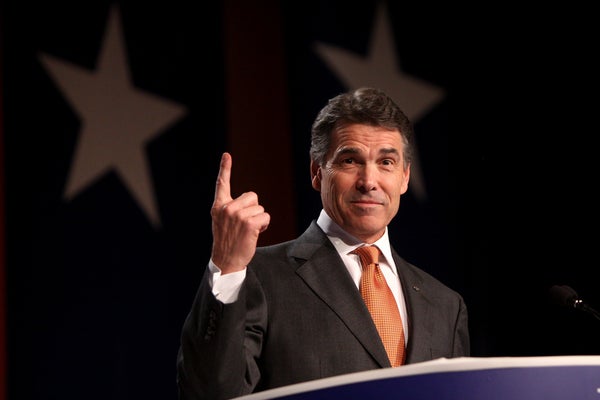
Former Texas governor Rick Perry says that he will defend scientists at the US Department of Energy (DOE) if confirmed as its next leader.
Perry, president-elect Donald Trump's pick for energy secretary, also says that he would base decisions on “sound science”. And he disavowed a questionnaire from the Trump transition team that sought the names of DOE employees who had worked on climate policy.
“I am going to protect all of the science, whether it’s related to the climate or other aspects of what we’re going to be doing,” Perry told a Senate committee during a 19 January hearing on his nomination. “I am going to protect the men and women of the scientific community from anyone that would attack them, no matter what their reason may be, at the Department of Energy.”
On supporting science journalism
If you're enjoying this article, consider supporting our award-winning journalism by subscribing. By purchasing a subscription you are helping to ensure the future of impactful stories about the discoveries and ideas shaping our world today.
Perry also said that he regrets calling to abolish the DOE in 2012, when he was vying for the Republican presidential nomination. He told lawmakers that he is “excited and passionate” about advancing the core missions of the department, from maintenance and modernization of the nuclear weapons stockpile to the advancement of modern energy technologies.
On the hot seat
Democrats on the Senate committee pressed Perry about past statements in which he questioned mainstream climate science. The nominee told them that he thinks global warming is happening.
“I believe some of it is naturally occurring, but some of it is caused by manmade activity,” Perry said. “The question is how we address it in a thoughtful way that doesn’t compromise economic growth.”
That did not entirely satisfy Democrats, including Senator Maria Cantwell of Washington state. “I guarantee you today that we are compromising economic growth because of our overdependence on fossil fuels,” she told Perry.
Cantwell said that the science underway at DOE will be critical to understanding the impacts of the rising greenhouse-gas levels in the atmosphere—from Arctic sea-ice melt to ocean acidification—and maintaining US leadership in clean-energy technologies.
Perry cited his own record from 2000-2015 as governor of Texas, a period in which he supported oil and gas development while leading the nation in the expansion of wind energy. Perry said that as energy secretary, he would advocate for all forms of energy, including renewable sources.
Reaction
Perry also seemed to acknowledge concerns from researchers who say he has no experience with basic science or nuclear weapons, both of which are at the core of the department’s mission. “My desire is to lead this agency in a thoughtful manner, surrounding myself with expertise on the core functions of this department,” he said, promising to “protect and modernize” the nation’s nuclear-weapons arsenal.
Aside from waffling a bit on questions about the wisdom of nuclear-weapons testing and whether climate change represents a global crisis, Perry generally said the right things, says Michael Lubell, a physicist at the City College of New York. Most importantly, Lubell says, Perry backtracked on his own statements that the DOE should be abolished and disavowed the Trump transition team’s questionnaire.
But given his lack of experience, Lubell said much will depend on whom Perry surrounds himself with and how much freedom Trump gives him to make decisions on budgetary and programmatic issues. “He may be constrained by the White House,” Lubell says. “It’s too early to tell.”
This article is reproduced with permission and was first published on January 19, 2017.