
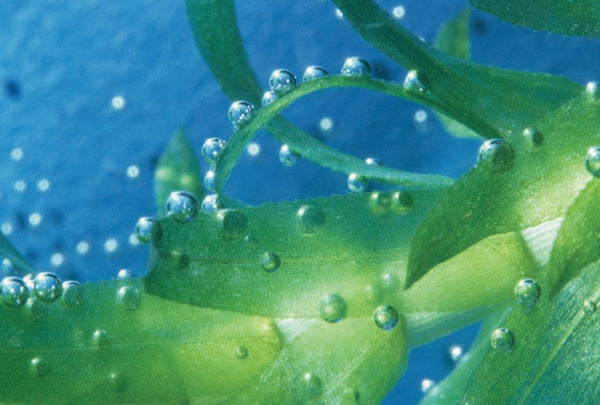
Plants are active life-forms down to their very cells. Within seconds of light exposure, some plants' chloroplasts—the cellular organs that convert light to energy—will begin to scramble around and then congeal again in a flat layer when the light dims.
“They make this mesmerizing, nice building behavior,” says Nico Schramma, a physicist at the University of Amsterdam. In a new study, he and his colleagues found that chloroplasts, when they cram together against the cell wall in low lighting, actually become a type of “glass.” The study results help to explain how chloroplasts can flip-flop between a rigid solid and a flowing liquid to best soak up the sun.
Glass, to a physicist, is a broad category of solid matter. Hard candy can be glass. Same with plastic—and even spreadable mayonnaise, by some measures. Unlike crystalline structures such as ice, which are solid because of their particles' orderliness, the disordered particles of a liquid transition to glass when they get jammed together so tightly that they can barely move.
On supporting science journalism
If you're enjoying this article, consider supporting our award-winning journalism by subscribing. By purchasing a subscription you are helping to ensure the future of impactful stories about the discoveries and ideas shaping our world today.
Schramma's team found that chloroplasts can undergo a similar process. The physicists tracked chloroplasts in the aquatic plant Elodea densa in different light conditions to build a model of their movement, and they soon recognized hallmarks of a glassy system in the data. The results, published recently in the Proceedings of the National Academy of SciencesUSA, show that instead of individual chloroplasts slowing in low light, they were clustering and trapping one another.
The findings are “very compelling evidence of a glass transition,” says Lisa Manning, a biological physicist at Syracuse University, who was not involved in the work. Recognizing this process will let physicists study chloroplasts' complex dynamics as a familiar type of system, the researchers say.
The results also reveal hidden parallels to other glassy living systems. These glass transitions serve an important purpose: flexibility. Developing embryos, for example, move between fluid and rigid. And hard tumors spread across the body by behaving like liquids.
In scarce light, chloroplasts' glassy state lets them form a flat layer to soak up as much light as possible, like a cat in a patch of sun. But too much light is damaging, so in strong light conditions the chloroplasts weave and dodge to minimize exposure. “We often think of plants as not being very dynamic, but at the cellular level, they're as dynamic as any other living thing,” says Roger Hangarter, a plant biologist at Indiana University Bloomington, who was not involved in the study.
Hangarter questions whether studies in E. densa can be generalized to other plants, whose chloroplasts' shape, size and movement vary. The authors plan to collaborate with molecular biologists in future studies to integrate that level of biological detail into their physics-inspired models.