
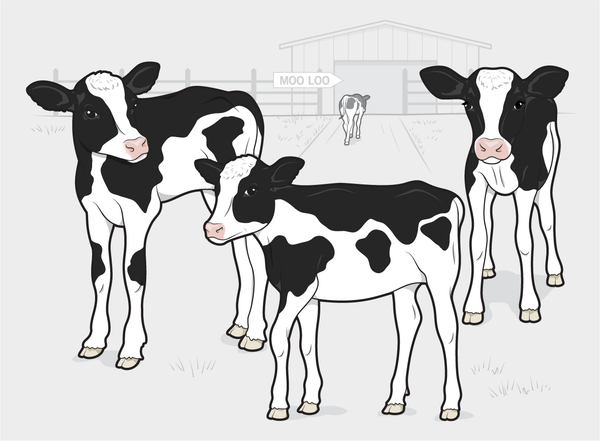
Urinating is easy. Holding it in, however, is tough. While some animals, such as wolves, control their bladders to selectively mark their territories, cattle roam blithely around pastures peeing with abandon. “You get the impression that these animals have no control over their urination,” says Jan Langbein, an animal psychologist at the Research Institute for Farm Animal Biology in Germany. “But you can train dogs, and you can train horses. So we thought, why not cattle?”
For a study in Current Biology, Langbein and his colleagues worked on potty training 16 calves for 45 minutes every other day. They first restricted the animals within a specially designed latrine (called a MooLoo), offering food through a hole in the wall when the calves urinated. After the animals learned they would receive a reward for making use of the setup, they were allowed outside. If the calves voluntarily reentered the latrine and urinated, they were again rewarded—but if they relieved themselves outside, they were sprayed with water for three seconds.
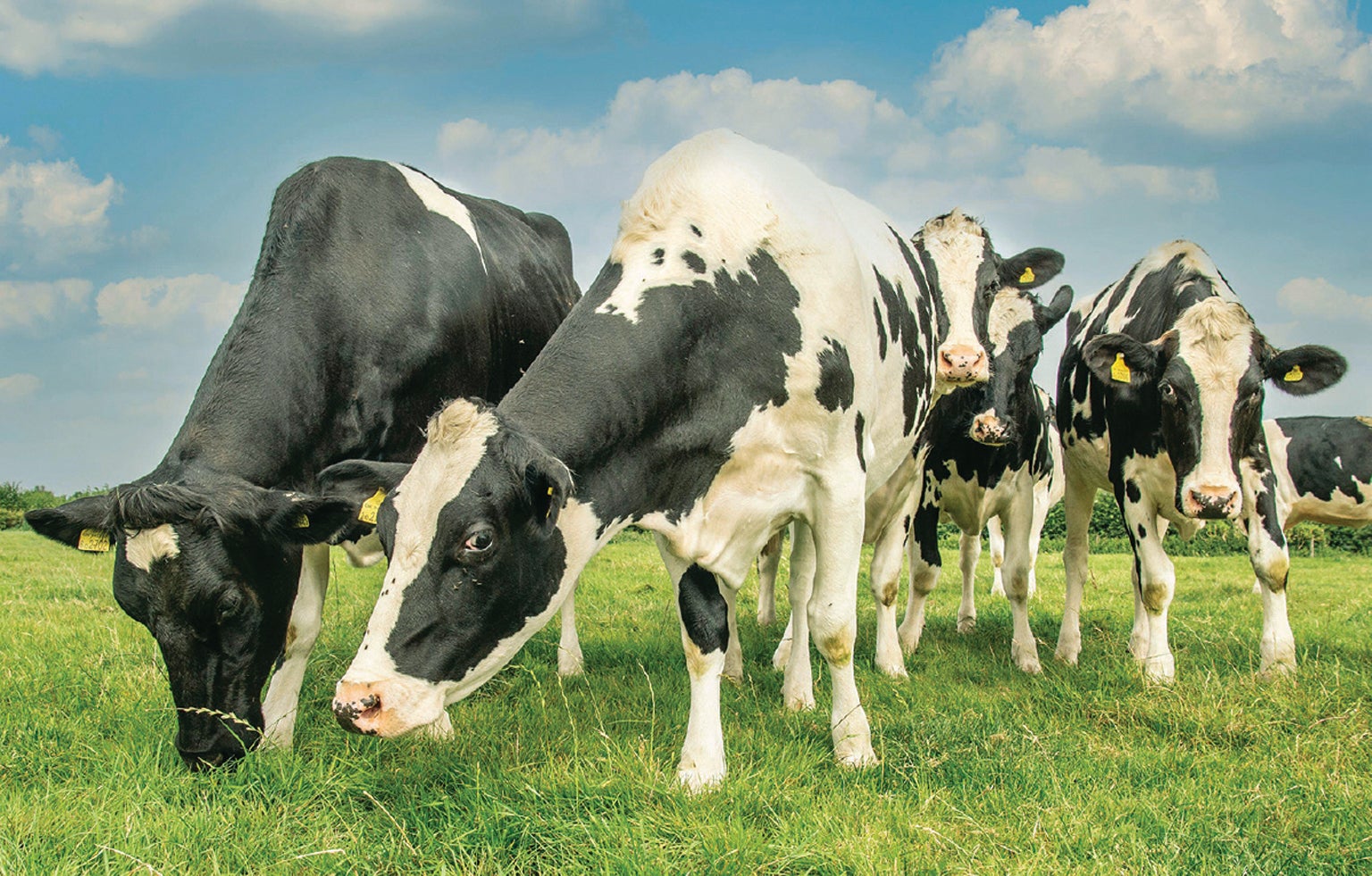
Cows can learn to use a latrine. Credit: Farlap/Alamy Stock Photo
On supporting science journalism
If you're enjoying this article, consider supporting our award-winning journalism by subscribing. By purchasing a subscription you are helping to ensure the future of impactful stories about the discoveries and ideas shaping our world today.
After 10 days of training, 11 of the calves were using the latrine about 77 percent of the time—demonstrating that cattle can indeed quickly learn to urinate in a lavatory. The team now aims to automate the system for farm use with less monitoring.
Capturing cattle urine in latrines could help mitigate pollution, greenhouse gas emissions and the spread of diseases to humans, says Patricia Yang, a mechanical engineer at the National Tsing Hua University in Taiwan who was not involved in the study. “If we can manage animal waste as well as we manage human waste,” she says, “then we can eliminate these diseases.”

Credit: Brown Bird Design
Wombats poo cubes, and for a long time no one knew why. Puzzled by the seemingly sculpted scat— the animals deposit up to 100 cubes a day—Yang and her colleagues examined roadkill wombats and found their intestinal walls formed grooves, or corners, when contracting, producing the cubic geometry. The odd shape keeps the excrement from rolling away, which may help the creatures stake their territory.

Credit: Brown Bird Design
Pee speaks, at least for some fish. Curious about communication using nonvisual cues, researchers separated cichlids in a tank with a transparent barrier and injected the fish with dye to observe their urine. When the fish saw one another, they approached the barrier and urinated. And when urine was allowed through holes in the barrier, the fish behaved differently: the smaller fish acted more submissively toward the bigger ones.

Credit: Brown Bird Design
Horse manure is a favorite of pandas—the fluffy creatures have been observed slathering the waste on their bodies. Curious about this odd behavior, researchers conducted experiments and found that two compounds in fresh horse dung quieted a mammalian protein known to warn the body of cold, suggesting that the messy manure might help the pandas numb themselves when exposed to chilly weather.