
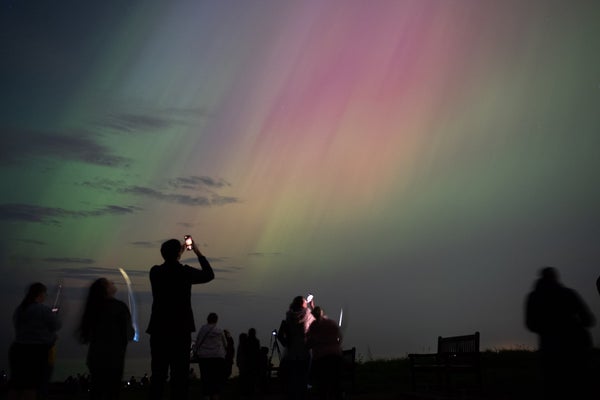
A powerful solar storm could spark auroras as far south as northern California and Alabama on Wednesday, thanks to a particularly rambunctious area on the sun dubbed active region 4274 (AR4274). In recent days the region has unleashed multiple outbursts, including a solar flare that ranks as one of the most powerful of the current solar cycle.
That dramatic flash of light was followed by a coronal mass ejection, or CME, an event in which the sun propels a giant cloud of magnetized plasma into space. If Earth is in the firing line of a CME, it can wreak havoc on our planet in a range of phenomena referred to as space weather. AR4274 is aligned such that its material is heading toward Earth—at some 3.3 million miles per hour, no less. Along the way, it could catch up and join forces with two previous, slower CMEs that occurred on Sunday and Monday.
In response to the outbursts, the National Oceanic and Atmospheric Administration’s Space Weather Prediction Center has issued a G4 geomagnetic storm watch for Wednesday—the fourth such alert of the current solar cycle. The scale behind this system runs from one to five, with a G4 watch deemed “severe.” An event of this magnitude can cause potential interference to power grids, spacecraft operations, satellite navigation and radio communications.
On supporting science journalism
If you're enjoying this article, consider supporting our award-winning journalism by subscribing. By purchasing a subscription you are helping to ensure the future of impactful stories about the discoveries and ideas shaping our world today.
These effects mean that, like terrestrial weather prediction, space weather prediction has been deemed a mission-critical activity that has continued even during the federal government shutdown.
Unfortunately for aurora watchers, the peak of activity is expected to occur during North America’s daylit hours, when any auroral activity will be invisible.
Geomagnetic turmoil is expected to continue into Thursday at a G3, or strong, level, which can trigger auroras as far south as Illinois and Oregon.