Expect Auroras, Solar Flares and More Space Weather from the Solar Maximum

Space weather is heating up in our current solar cycle peak

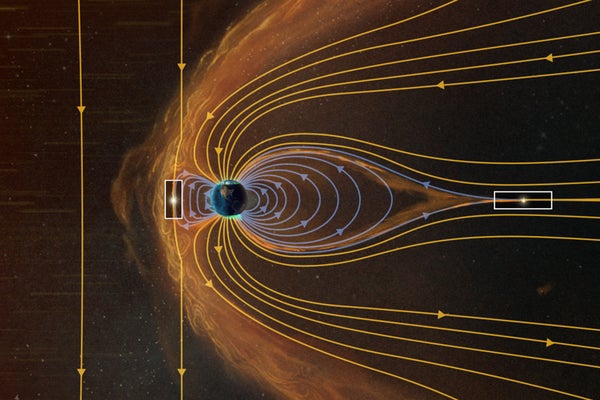
Illustration of Earth with magnetosphere lines drawn to represent conditions during a solar storm. A coronal mass ejection compresses Earth’s magnetosphere. The illustration is rendered in glowing orange, with green auroras visible on the dark side of Earth’s poles.

Matthew Twombly

Join Our Community of Science Lovers!

Aurora sightings may become more common, and satellite communications and power grids could be disrupted, as solar activity peaks. Our nearest star is always volatile, but its magnetic action waxes and wanes on an 11-year loop. The sun is thought to be in a peak now, although scientists will need another year or two to analyze data before they can say for sure. During this high point we should see more sunspots (dark areas where the sun’s magnetic field reaches the surface) and solar storms (ejections of energy from the sun that reach into space and can affect Earth).

During a storm, energy explodes from the sun in the form of light and particles (called a solar flare) and a plasma and magnetic field (called a coronal mass ejection, or CME). If a CME hits Earth’s magnetosphere, it can wreak havoc on our planet’s magnetic field, injecting energy, plasma and particles and heating up and distorting Earth’s upper atmosphere, the ionosphere. All of this chaos can hinder radio signals between satellites and induce strong electric currents that can damage power grids. On the plus side, we often get a nice view of the Northern and Southern Lights as a surge of particles hits Earth’s atmosphere at the poles.

“We need to better prepare for space weather,” says heliophysicist Lisa Upton, who co-chaired the NASA/NOAA Solar Cycle Prediction Panel for the current cycle. “Write your congresspeople and tell them to support solar physics.”


On supporting science journalism

If you're enjoying this article, consider supporting our award-winning journalism by subscribing. By purchasing a subscription you are helping to ensure the future of impactful stories about the discoveries and ideas shaping our world today.


WHAT IS SPACE WEATHER?

The amount of energy, radiation and plasma streaming off the sun into space—collectively known as the solar wind—varies as the sun’s magnetic activity changes. Extreme events, such as CMEs and strong solar flares or storms, generate space weather. Earth’s atmosphere typically acts as an umbrella protecting us from the bulk of the sun’s influence. During severe space weather, however, it can break through this boundary and affect our planet.
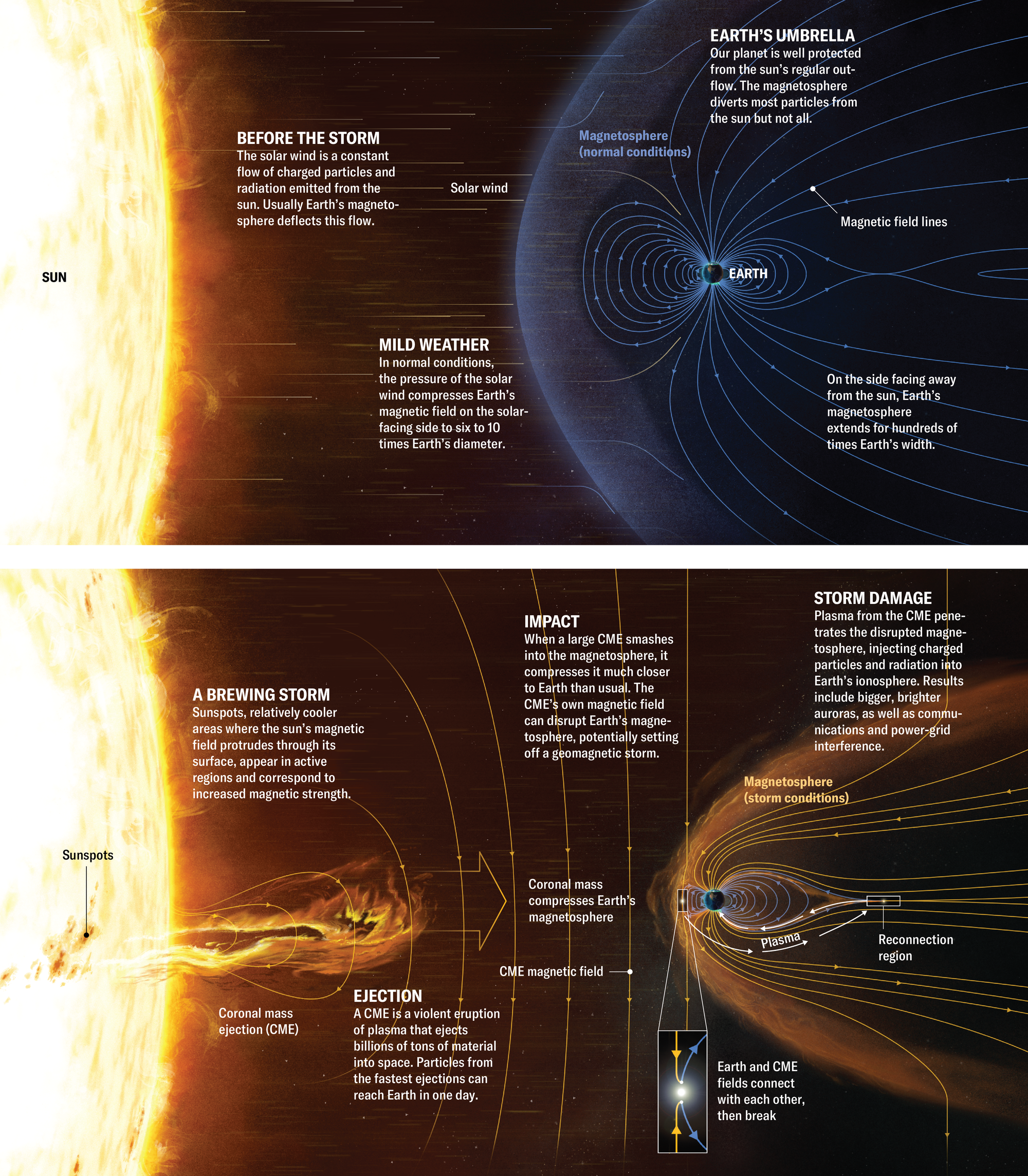
Illustration shows the Sun and Earth for two scenarios. In normal conditions, the pressure of the solar wind compresses Earth’s magnetic field on the solar-facing side to six to 10 times Earth’s diameter. When a large CME smashes into the magnetosphere, it compresses it much closer to Earth than usual. The CME’s own magnetic field can disrupt Earth’s magnetosphere, potentially setting off a geomagnetic storm.

Matthew Twombly

FORECASTING

Like the climate on Earth, space weather has its own seasons, referred to as solar cycles. About every 11 years the sun’s magnetic field reaches its maximum activity level. During solar minimum we observe around one CME a week, but during maximum, where we are right now, we see about two to three a day. Scientists can predict solar activity by observing the number of sunspots visible on our star. During minimums we may see just a few sunspots or even none, whereas during solar maximum we can expect up to 200 at a time.

Chart shows sunspots observed by month, starting in 1900. The sun operates under a roughly 11-year solar cycle, creating a regular pattern of valleys and peaks in sunspot count. In May 2024, 172 sunspots were observed.

Matthew Twombly

EFFECTS

Space weather affects the density and turbulence of Earth’s ionosphere. As radio signals travel through this layer of the atmosphere, its changing thickness may send waves on distorted paths, affecting communications transmission. And an influx of particles streaming toward Earth can cause brighter and more widespread auroras, as well as surges in power grids that lead to outages.

Illustration shows the curvature of Earth and five impacts of solar storms; power surges, radiation exposure, strong auroras, and radio signal and satellite communication disruption.

Matthew Twombly

Clara Moskowitz is chief of reporters at Scientific American, where she covers astronomy, space, physics and mathematics. She has been at Scientific American for more than a decade; previously she worked at Space.com. Moskowitz has reported live from rocket launches, space shuttle liftoffs and landings, suborbital spaceflight training, mountaintop observatories, and more. She has a bachelor’s degree in astronomy and physics from Wesleyan University and a graduate degree in science communication from the University of California, Santa Cruz.

More by Clara Moskowitz

Matthew Twombly is a freelance illustrator and infographic designer. His work can be viewed at www.matthewtwombly.com

More by Matthew Twombly
Scientific American Magazine Vol 331 Issue 2This article was published with the title “Our Stormy Solar Future” in Scientific American Magazine Vol. 331 No. 2 (), p. 90
doi:10.1038/scientificamerican092024-3bKE99q85H0yNvD8CqaTib

It’s Time to Stand Up for Science

If you enjoyed this article, I’d like to ask for your support. Scientific American has served as an advocate for science and industry for 180 years, and right now may be the most critical moment in that two-century history.

I’ve been a Scientific American subscriber since I was 12 years old, and it helped shape the way I look at the world. SciAm always educates and delights me, and inspires a sense of awe for our vast, beautiful universe. I hope it does that for you, too.

If you subscribe to Scientific American, you help ensure that our coverage is centered on meaningful research and discovery; that we have the resources to report on the decisions that threaten labs across the U.S.; and that we support both budding and working scientists at a time when the value of science itself too often goes unrecognized.

In return, you get essential news, captivating podcasts, brilliant infographics, can't-miss newsletters, must-watch videos, challenging games, and the science world's best writing and reporting. You can even gift someone a subscription.

There has never been a more important time for us to stand up and show why science matters. I hope you’ll support us in that mission.

Thank you,

David M. Ewalt, Editor in Chief, Scientific American

Subscribe