
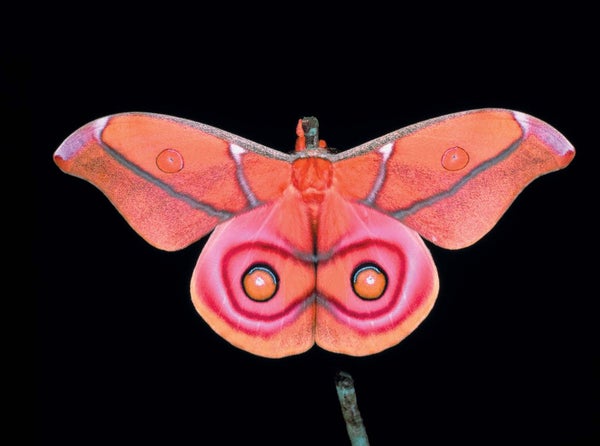
The concentric circles or eyespots on butterfly and moth wings—like those seen on this Suraka silk moth—not only look like real eyes but may also appear to glare directly at predators from many directions, scientists have found. This optical illusion, called the “Mona Lisa effect,” could scare would-be attackers and buy the insects enough time to escape.
Scientists suspect that eyespots, with dark “pupils” in the center surrounded by lighter “irises,” look like real eyes to predators. Hannah Rowland, an ecologist at the Max Planck Institute for Chemical Ecology in Jena, Germany, wanted to see if the direction of this fake gaze contributed to the effect. Her study results were published recently in Frontiers in Ecology and Evolution.
First, Rowland and her co-author trained chicks to attack a mealworm hidden behind a paper printout of two eyespots at the end of a runway. When the eyespots’ pupils were specifically pointed in the chicks’ direction, the birds repeatedly ran toward the paper and then backed away, and they waited a few minutes before attacking—signs of wariness. But when the pupils instead appeared to look away from the direction of the chicks’ approach, the birds attacked in seconds. Centrally located pupils, though not as effective as ones that peered directly toward the chicks, resulted in longer delays than pupils that looked the other way.
On supporting science journalism
If you're enjoying this article, consider supporting our award-winning journalism by subscribing. By purchasing a subscription you are helping to ensure the future of impactful stories about the discoveries and ideas shaping our world today.
“This suggests that they really are paying attention to the direction of the pupils in the eyespots and are perceiving them as eyelike stimuli,” Rowland says. The concentric eyespots found most often in the insect world, she adds, may seem to the chicks like a pair of eyes that follow them, irrespective of approach angle.
National University of Singapore evolutionary biologist Antonia Monteiro, who was not involved in the research, says the study is a “cool” demonstration of an evolutionary theory for eyespots.
“These butterflies can be encountered from all angles, so having the pupil centrally located ends up being pretty good,” Monteiro says. Still, she says, the eyespots used in the study were several millimeters larger than even the largest commonly found in nature, raising the possibility that the chicks may have been extra frightened by the size of the paper eyes.