Pumping Charged Particles onto Airplane Surfaces Could Reduce Lightning Strikes  

Tests reveal that an imbalance of charge buildup can trigger airplane lightning 

Join Our Community of Science Lovers!

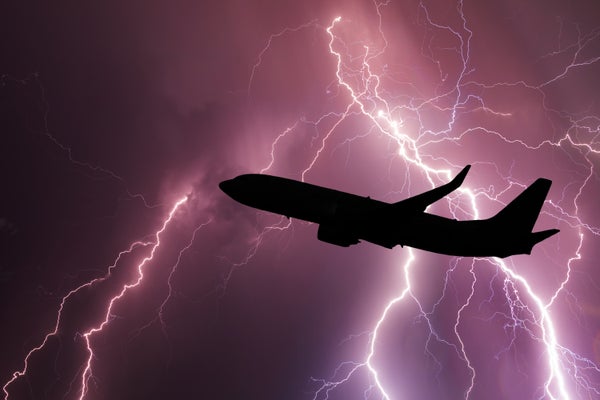
If you're in an airplane and suddenly hear a loud bang or see a flash outside the window, your plane may have just been hit by lightning. When this happens, pilots are supposed to land as soon as possible so the craft can be inspected for potential damage to its skin, structure or electronics. This protocol is paramount for safety but can create costly flight delays and cancellations. Recent tests show that, perhaps counterintuitively, the best way to reduce the chances of a strike may be to add an electrical charge to the outside of the aircraft.

During flight, positively and negatively charged particles called ions can build up on parts of an aircraft's surface, particularly on pointed features such as the nose, tail fins and wing tips. If a large difference in charge, or polarization, develops on the plane before it flies into a charged region of the atmosphere, ions are more likely to flow along the aircraft and complete an electrical circuit with the clouds, sparking a powerful discharge—a lightning bolt. Computer simulations conducted in 2018 by Carmen Guerra-Garcia, an aerospace engineer at the Massachusetts Institute of Technology, and Colin Pavan, a graduate student in her laboratory, revealed a possible solution to ion buildup: adding negative charge to the plane.

Last year Guerra-Garcia and Pavan tested a model plane with a 10-meter-tall electric field generator and subjected it to various conditions, measuring how charges accumulated and dissipated. The data, published in January in the Journal of Geophysical Research: Atmospheres, confirmed that ion flows (or “leaders”) along the plane initiated lightning bolts—and that negatively charging the plane helped to prevent such discharges. The team is investigating how devices that pump ions onto the plane's surface could reduce polarization.


On supporting science journalism

If you're enjoying this article, consider supporting our award-winning journalism by subscribing. By purchasing a subscription you are helping to ensure the future of impactful stories about the discoveries and ideas shaping our world today.


“Charging a plane sounds crazy, but adding negative charge to prevent buildup of positive charge could help stop a leader from forming,” says Pavlo Kochkin, an aerospace engineer at the University of Bergen in Norway, who was not part of the work. In his own research, he records lightning hits on new aircraft test flights. Inspired by the M.I.T. results, he is creating a thundercloud simulator that can generate different levels of charged air and water vapor. A model plane might test how charge emitters reduce the chances of a strike.

Mark Fischetti was a senior editor at Scientific American for nearly 20 years and covered sustainability issues, including climate, environment, energy, and more. He assigned and edited feature articles and news by journalists and scientists and also wrote in those formats. He was founding managing editor of two spin-off magazines: Scientific American Mind and Scientific American Earth 3.0. His 2001 article “Drowning New Orleans” predicted the widespread disaster that a storm like Hurricane Katrina would impose on the city. Fischetti has written as a freelancer for the New York Times, Sports Illustrated, Smithsonian and many other outlets. He co-authored the book Weaving the Web with Tim Berners-Lee, inventor of the World Wide Web, which tells the real story of how the Web was created. He also co-authored The New Killer Diseases with microbiologist Elinor Levy. Fischetti has a physics degree and has twice served as Attaway Fellow in Civic Culture at Centenary College of Louisiana, which awarded him an honorary doctorate. In 2021 he received the American Geophysical Union’s Robert C. Cowen Award for Sustained Achievement in Science Journalism. He has appeared on NBC’s Meet the Press, CNN, the History Channel, NPR News and many radio stations.

More by Mark Fischetti
Scientific American Magazine Vol 322 Issue 5This article was published with the title “Strike Back” in Scientific American Magazine Vol. 322 No. 5 (), p. 15
doi:10.1038/scientificamerican0520-15

It’s Time to Stand Up for Science

If you enjoyed this article, I’d like to ask for your support. Scientific American has served as an advocate for science and industry for 180 years, and right now may be the most critical moment in that two-century history.

I’ve been a Scientific American subscriber since I was 12 years old, and it helped shape the way I look at the world. SciAm always educates and delights me, and inspires a sense of awe for our vast, beautiful universe. I hope it does that for you, too.

If you subscribe to Scientific American, you help ensure that our coverage is centered on meaningful research and discovery; that we have the resources to report on the decisions that threaten labs across the U.S.; and that we support both budding and working scientists at a time when the value of science itself too often goes unrecognized.

In return, you get essential news, captivating podcasts, brilliant infographics, can't-miss newsletters, must-watch videos, challenging games, and the science world's best writing and reporting. You can even gift someone a subscription.

There has never been a more important time for us to stand up and show why science matters. I hope you’ll support us in that mission.

Thank you,

David M. Ewalt, Editor in Chief, Scientific American

Subscribe