
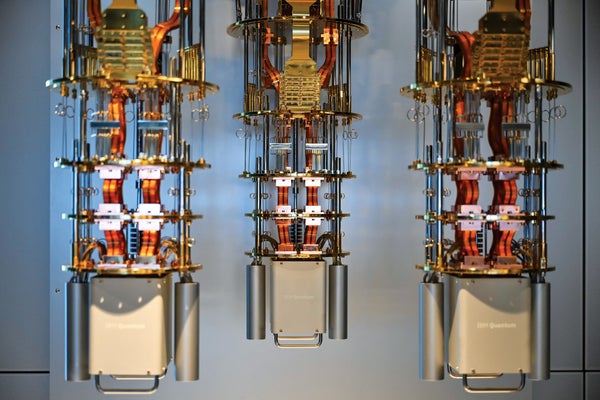
Inside a low-slung building in an office park near the southeastern edge of the San Francisco Bay, a cluster of white tanks sit bathed in blue light. Within these tanks are sets of superconducting circuits etched into chips, all held by golden chandelierlike structures and cooled by liquid helium and liquid nitrogen. The superconducting chips are fabricated in the clean room next door, where white-suited figures work with room-size machinery, fume hoods and acid baths. The facility—the chips, the tanks, the clean room and the enormous reserves of liquid nitrogen behind the building—are all deployed in service of a single dream: quantum computers.
This location is the main fabrication plant for quantum computing company Rigetti Computing in California; each refrigeration tank contains one of Rigetti’s top-of-the-line quantum processing units. One day quantum computers will be able to perform certain kinds of computations orders of magnitude more quickly than the classical computers all around us, experts hope. “We’re talking a million [or a] billion times faster at a very, very small fractional energy consumption,” Rigetti’s CEO, Subodh Kulkarni, tells me. “That’s the beauty of quantum computing. We can potentially solve problems that are unsolvable today.”
Rigetti is just one of dozens of outfits hoping to capitalize on the possibilities. Over the past 20 years start-ups such as Rigetti and giants such as IBM and Google have invested big money in quantum computing—$1.2 billion from venture capitalists in 2023 alone. It’s a major subject of research at universities and government laboratories around the world. All of them are chasing the dream, but the details of that dream depend on whom you ask. Venture capitalists and other purveyors of Silicon Valley hype are promising that quantum computing will supercharge artificial intelligence, or vice versa, but experts are unconvinced of these claims. Kulkarni and others talk about quantum computers revolutionizing drug discovery, weather forecasting and the financial industry. Governments prize their promised abilities to crack heretofore unbreakable codes.
On supporting science journalism
If you're enjoying this article, consider supporting our award-winning journalism by subscribing. By purchasing a subscription you are helping to ensure the future of impactful stories about the discoveries and ideas shaping our world today.
But none of these predictions are certain. Quantum computing is reaching its make-or-break moment: Scientists hope that in the next few decades they’ll be able to scale up today’s quantum systems to the size needed to make real breakthroughs and finally beat classical machines at useful tasks. If they can do that, quantum computers may change the world in all kinds of ways. But plenty of obstacles stand in the way, and until quantum computers can overcome them, we won’t know what they’re really capable of.
What, exactly, is a quantum computer? It’s tempting to say it’s a computer that runs on the principles of quantum physics. But that isn’t adequate—quantum physics governs the behavior of all matter, so all computers would be quantum computers by this definition. Similarly, it’s not enough to say a quantum computer is a computer that takes advantage of quantum phenomena in its operation. Nearly all computers today run on silicon transistors, the workings of which we can understand only through quantum physics.
To truly answer the question of what makes quantum computers quantum—and why they’re so hard to build—we need to talk about Schrödinger’s cat. In the original thought experiment developed in the 1930s by Erwin Schrödinger, one of the founders of quantum mechanics, the famous feline is sealed in a box with a lump of radioactive metal, a vial of poison, and a contraption that will smash the vial if it detects any radiation from the metal, killing the cat. Quantum physics dictates that if you leave the box sealed for a certain amount of time, there will be a 50–50 chance that the metal lump will have emitted some radioactivity. But, crucially, until someone measures the radiation, the lump is in a superposition: a state in which the radiation has been both emitted and not emitted. And that means the vial of poison will be in a superposition of smashed and intact.
The cat will therefore be in an equal superposition of dead and alive until you open the box and see which way things have gone. (What constitutes a “measurement” in quantum physics is a separate and thorny question that people, including me, have written entire books about.)
A Rigetti quantum computer, shown at the Nvidia GPU Technology Conference in Washington, D.C., in 2025, uses superconducting qubits.
Kent Nishimura/Bloomberg/Getty Images
Now imagine that you opened the box slightly earlier, perhaps out of anxiety for the poor creature. In that case, immediately before you opened the box, the cat would still have been in a superposition of dead and alive but with more “aliveness” in the superposition than “deadness.” By waiting the right amount of time, you could put the cat into any superposition you like with any share of aliveness and deadness.
Tunable superpositions such as this one are what make a quantum computer quantum. Conventional computers use their transistors to carry out computations using bits that can be in one of two states: zero or one. Quantum computers use quantum bits, or qubits, which have more options available to them. Like Schrödinger’s cat, qubits can be in any superposition of zero and one.
Qubits have something else in common with the unfortunate feline. When it’s trapped in the box, Schrödinger’s cat becomes entangled with the rest of the box, meaning its quantum state becomes tied up with the quantum states of the lump of metal, the detector contraption and the poison. Similarly, quantum computers must entangle their qubits to perform calculations with them. But whereas the entanglement between the cat and everything else in the box happens in an uncontrolled way, a quantum computer must keep strict control over its qubits’ entanglement with one another: which ones are entangled, how much and in what way.
This combination of qubits controllably entangled with one another is what allows quantum computers to do tricks typical computers can’t, at least in theory. One of the most touted, for a big-enough quantum computer, is the ability to calculate the factors of very large numbers much faster than a standard computer can by using a technique called Shor’s algorithm, after Massachusetts Institute of Technology theoretical computer scientist Peter Shor, who invented it in 1994.
“Faster”is a bit of an understatement: theoretically, using Shor’s algorithm, a quantum computer could factor in several days a number that would take a nonquantum supercomputer millions of years. This impressively speedy algorithm may sound like a niche application, but the fact that it’s incredibly time-consuming for conventional computers to factor large numbers is the basis of most modern encryption, especially the kinds of encryption used on the web. A quantum computer, then, wouldn’t just be a good code breaker—it could potentially break the cryptography underpinning the entire Internet. Unsurprisingly, developing quantum computers has become a priority for the security apparatuses of governments all over the world.
Quantum computers also might be able to use their impressive control of their own qubits to mimic nature on a level never possible before, modeling the interactions of atoms and molecules with detail that regular computers, which lack the quantumness of nature, simply can’t match. These abilities could lead to breakthroughs in basic physics and chemistry, as well as in applied research for materials science, pharmaceutical drugs, and other fields. And some people, such as Kulkarni, believe that quantum computers also may be able to solve more familiar problems better than classical machines, such as simulating financial markets and Earth’s climate.
There is, however, a catch. Schrödinger’s cat became entangled with the rest of the box without making any special effort—entanglement happens naturally between objects that interact with each other in any way. Right now you are becoming somewhat entangled with the air around you, the surface you’re sitting or standing on, and the screen or magazine where you’re reading these words. This kind of natural entanglement that arises between a quantum system and its environment is known as decoherence.
Decoherence is fatal to a quantum computer’s ability to perform calculations. For a quantum processor to keep its vitally important control over its qubits and their entanglement, it must be isolated from the rest of the world while it does its work. It must also maintain a high level of control over the physical interactions among all the atomic components of its own qubits. That isn’t easy to accomplish even for a brief fraction of a second. Preventing unwanted interactions among a quantum computer’s components is one of the prime hurdles standing between today’s relatively modest quantum computers and the larger, more powerful ones scientists and engineers are hoping to develop. One of the main strategies researchers employ is to keep quantum computers very, very cold because heat—the random motion of atoms—creates unintended entanglements.

The Chuang-tzu 2.0, a two-dimensional superconducting quantum computer, uses 78 qubits in its calculations. The processor was built at the Chinese Academy of Sciences Institute of Physics.
Xinhua/Alamy
This challenge is tied up with the biggest open question in quantum computing: What’s the best way to make a qubit? Bits in standard computers are made through voltage changes on small electronic gates in a solid-state chip or the magnetic domains on the disk of a hard drive; controlling these bits is impressive and difficult enough. But a qubit must be even more finely controlled: to carry out calculations, a quantum computer must be able to place its qubits into a specific initial quantum state, then control their entanglement by passing them through a sequence of quantum logic gates, all while maintaining their perfect isolation from their environment and preventing them from interacting with one another or with other components of the quantum computer in unwanted ways. For years after quantum computers were first proposed, in the 1980s, some experts were skeptical that they could ever be built. (A minority of researchers still believe that usefully large quantum computers can’t be built.) But in the past 20 years scientists have developed working quantum computers, albeit relatively small ones, with no more than several hundred or so qubits. These machines are too simple to perform interesting calculations, such as the advanced trickery of Shor’s algorithm or quantum simulations, on anything but small example problems. Scaling them up to more useful sizes means making a bet on the best approach.
Qubits can be made out of many different materials [see “A Qubit Field Guide”]. Researchers have designed several possible architectures, and there is no agreement on the best option. “There are a lot of ways to do it, and everyone thinks that they have the best way,” says Alaina Green, a physicist at the University of Maryland’s Joint Quantum Institute.
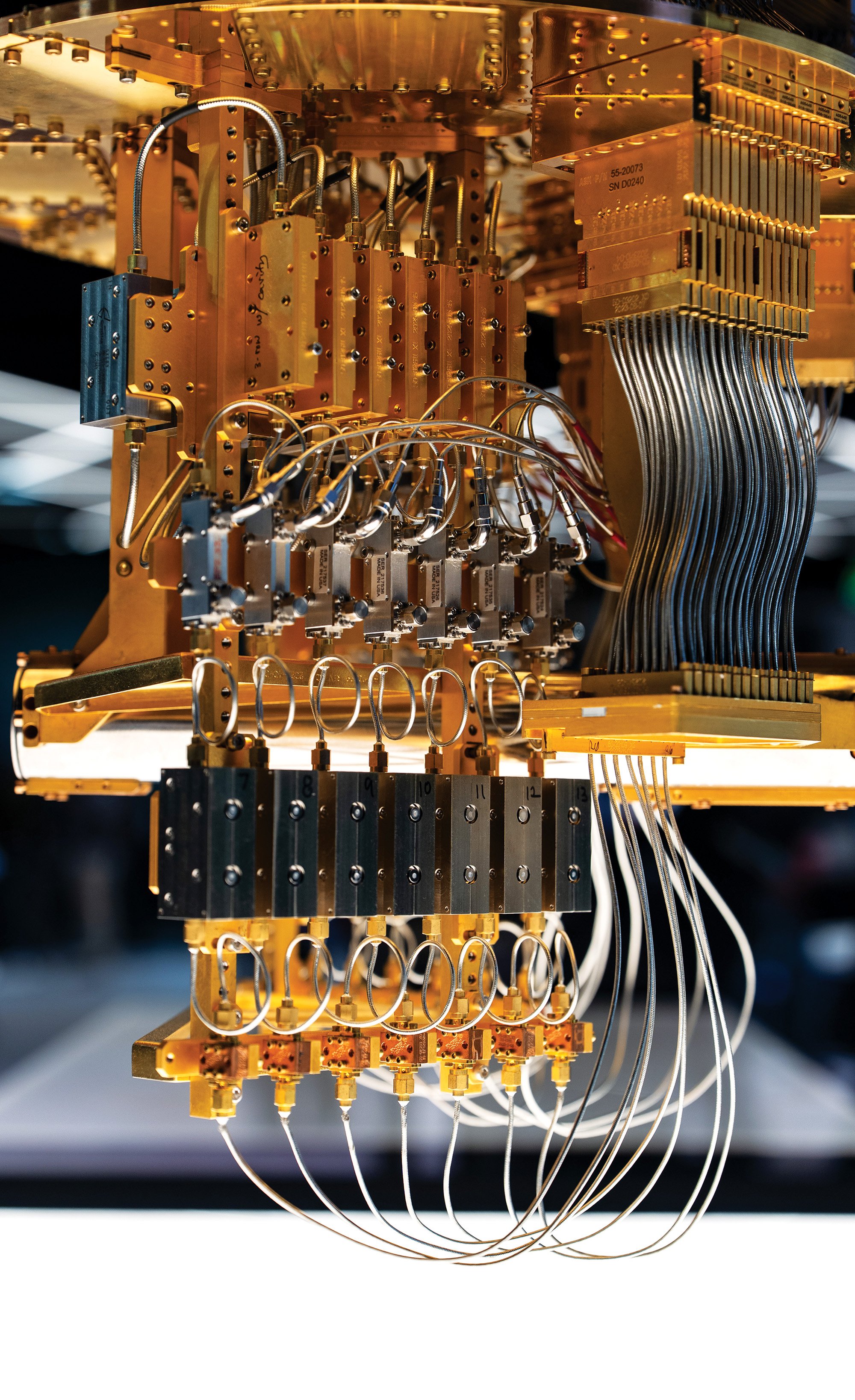
Two of the leading qubit approaches are superconducting circuits and trapped atoms or ions. The former are microscopic electronic circuits made of superconducting materials such as aluminum or tantalum that have no electrical resistance at supercold temperatures. Their advantage is that we can build them using variations on existing technology for computer-chip fabrication, and they can work fast. The disadvantage of superconducting qubits is that each chip is made of billions of trillions of atoms, and even at a hundredth of a degree above absolute zero, having so many atoms around means the chips decohere in tens of microseconds.
The other favored strategy is to build qubits out of individual atoms. This option shines exactly where the superconducting qubits don’t: when there’s only one atom involved, it’s easier to keep it from decohering. Trapped atom or ion qubits can be kept coherent for milliseconds at a time. But individual atoms are slower to work with (and engineers can’t piggyback on conventional computer-chip-fabrication technology). The upshot is that both types of qubits are capable of performing roughly the same number of calculations before they decohere, at least for now. Although the most powerful quantum computers today use superconducting qubits, atom and ion approaches aren’t far behind.

An engineer holds up a quantum processor with photonic chips at technology company Q.ANT in Stuttgart, Germany.
Thomas Kienzle/AFP/Getty Images
But ultimately, to fulfill their promise, quantum computers will need to find ways to become at least somewhat more tolerant of lapses in their control. Errors inevitably creep into quantum computations because of decoherence and other unwanted quantum effects. Although there is no way to completely halt decoherence, there is a way to compensate for some errors within quantum computers by using another celebrated result in theoretical quantum computing: quantum error correction. This process, remarkably, makes it possible under certain circumstances to detect and correct an unwanted error in a qubit’s state without totally destroying its superposition or entanglement with other qubits—akin to altering the mix of deadness and aliveness in Schrödinger’s cat without fully opening the box.
The existence of such quantum error-correction codes makes it much more feasible to achieve the high level of reliability that qubits need to implement Shor’s algorithm and perform other complex quantum-computational tasks. But this help comes at a cost. Quantum error correction works by assembling groups of qubits into “logical qubits,” building a kind of quantum redundancy into each logical qubit by representing it with many actual physical qubits so that an error in a single physical qubit matters less. For error correction to work well, every logical qubit must be composed of a lot of physical qubits—around 100 to 1,000. And to run Shor’s algorithm on any interesting problem, or nearly any other useful application, a quantum computer must have thousands of logical qubits. So for quantum computers to achieve their hoped-for potential, today’s systems of a few hundred physical qubits must scale up to millions of physical qubits whose entanglement with one another can be finely controlled.
Yet recent breakthroughs have given some researchers hope that quantum error correction may be possible with significantly fewer physical qubits. In one recent study, researchers at the California Institute of Technology and quantum computing start-up Oratomic proposed a method for quantum error correction requiring only about five physical qubits for each logical qubit, lowering the threshold for implementation of Shor’s algorithm to around 10,000 qubits. This study has not yet gone through peer review, but if the results hold, it could be possible to build a quantum computer that can run Shor’s algorithm sooner than expected.
Even in that case, however, the big question facing the field will remain: How long will it take for quantum computers to scale up to the point where they are useful? Although conventional computers have grown in power quickly over the past 60 years in accordance with Moore’s law—the prediction, named for Intel co-founder Gordon Moore, that the number of transistors on a chip would double roughly every two years—there is no guarantee that quantum computers will follow the same exponential trend. Moore’s law isn’t an actual law of nature—but the inevitability of decoherence is.
All this focus on Shor’s algorithm isn’t just about cryptography and national security. The celebrated algorithm is the only one that scientists are sure will allow a quantum computer to do something far more quickly than a conventional computer can. “People have been looking for other algorithms that are like [Shor’s] for a long time, and they haven’t found any,” Green says. “Like, none.” Devising quantum algorithms is hard. Proving those algorithms are significantly better than existing nonquantum algorithms is also difficult, and proving they’re better than any conceivable nonquantum algorithm is generally extremely difficult, if not impossible.
MosaiQ is a photonic quantum computer developed by Quandela in France.
Sameer Al-Doumy/AFP/Getty Images
Scientists are most optimistic about using quantum computers to simulate the quantum aspects of nature. “The reason that quantum computers were initially proposed is the idea that you can use them to simulate quantum systems,” says Ewin Tang, a quantum computer scientist at the University of California, Berkeley. But even with this kind of quantum simulation, it may be that quantum computers can’t beat classical ones. “There aren’t that many superconcrete plans for what one would do with a quantum computer that gives a provable quantum advantage,” Tang says. Green agrees. “Unfortunately, it’s harder to make provable statements about quantum simulation definitely being able to improve over classical computing,” she says. “But we think it should be true.”
Even if quantum computers really are better for simulating some quantum systems, as seems reasonably likely, and even if scientists can devise more algorithms that, like Shor’s, show a clear and large advantage over known classical algorithms, quantum computers still won’t beat conventional computers at most tasks. “The idea that quantum computers can do anything faster than classical computers—that is just simply not true,” says William Oliver, a professor of electrical engineering, computer science and physics at M.I.T. and co-founder of a quantum computing start-up recently acquired by Google. “There are only certain problems, which have a certain internal structure to them, as we understand it today, that allow a quantum computer to take advantage of its quantumness.”
In the best-case scenario for quantum computers, they will be specialized devices for solving particular kinds of challenges. In all likelihood, they will be used alongside conventional computers in a data center or supercomputing cluster—but not miniaturized in our cell phones. “The things that quantum computing is good at are just not things that people need to do every day,” Green says. In 30 years you might have a prescription drug in your medicine cabinet that was developed by models run on quantum computers—but you almost certainly won’t have a quantum computer of your own.
Yet the uncertainties that remain in the field haven’t kept the business world from making economic forecasts about quantum computing. In 2024 the Boston Consulting Group projected that quantum computers would generate $450 billion to $850 billion in value by 2040. “Impediments to quantum computing in the near term ... do not threaten the long-term development of the technology or the market,” the writers claimed. Yet the same group said its 2021 forecast about value creation based on quantum hardware and software improvements was overly “optimistic.”
This kind of confident estimate of where quantum computing is going is hard to take seriously, precisely because, for all of its advances so far, the field is still new and filled with unknowns. “Quantum computing is real, it’s happening, and it’s going to take time,” Oliver says. “It’s going to take engineering, and there’s still science to do as well. It’s not all buttoned up.” He estimates that we might have larger-scale quantum computers in about 20 years. “Whatever that time frame is, we will be using them to better understand, from a scientific standpoint, the world around us.”
When I asked Green when she expected good quantum computers to arrive, she gave me a blunt answer: “I don’t know, and I’m unwilling to make a prediction, and I would be very surprised if you found any [physicist] who would.” Still, she’s eager for that future, whenever it comes. “There is a class of problems ... [that] we have no chance of ever solving with classical computers,” she says. “For me, the most promising application of quantum computing is the prospect of potentially solving those problems.”
The reality is that we simply don’t know what will happen with quantum computers. What we do know is that the field is exciting, the scientific challenges it faces are interesting—and anyone who says they know for sure what the future holds is probably selling you something.