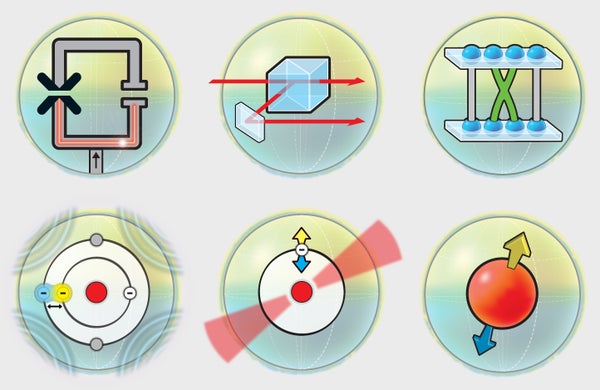
An illustrated field guide to qubits

Here are six ways to build a quantum computer

Six spheres are shown, each holding a different qubit icon.

Ben Gilliland

This piece is part of a package on the future of quantum computing. Read about the quest to develop these machines here and their most promising applications here.

Join Our Community of Science Lovers!

Around the world researchers are racing to build computers that take advantage of the bizarre rules of quantum mechanics. Such machines could perform calculations impossible for conventional computers and solve certain problems much more quickly.

The magic of quantum computers comes from their quantum bits, or qubits. Classical computer bits can occupy one of two states: 0 and 1. Quantum bits, however, can be placed in a weird state called a superposition, where they simultaneously occupy some combination of 0 and 1. Qubits, therefore, can take on an infinite number of possible states akin to the infinite points on the surface of a sphere. Qubits can also experience entanglement—a special quantum connection that enables operations on one qubit to affect another qubit.
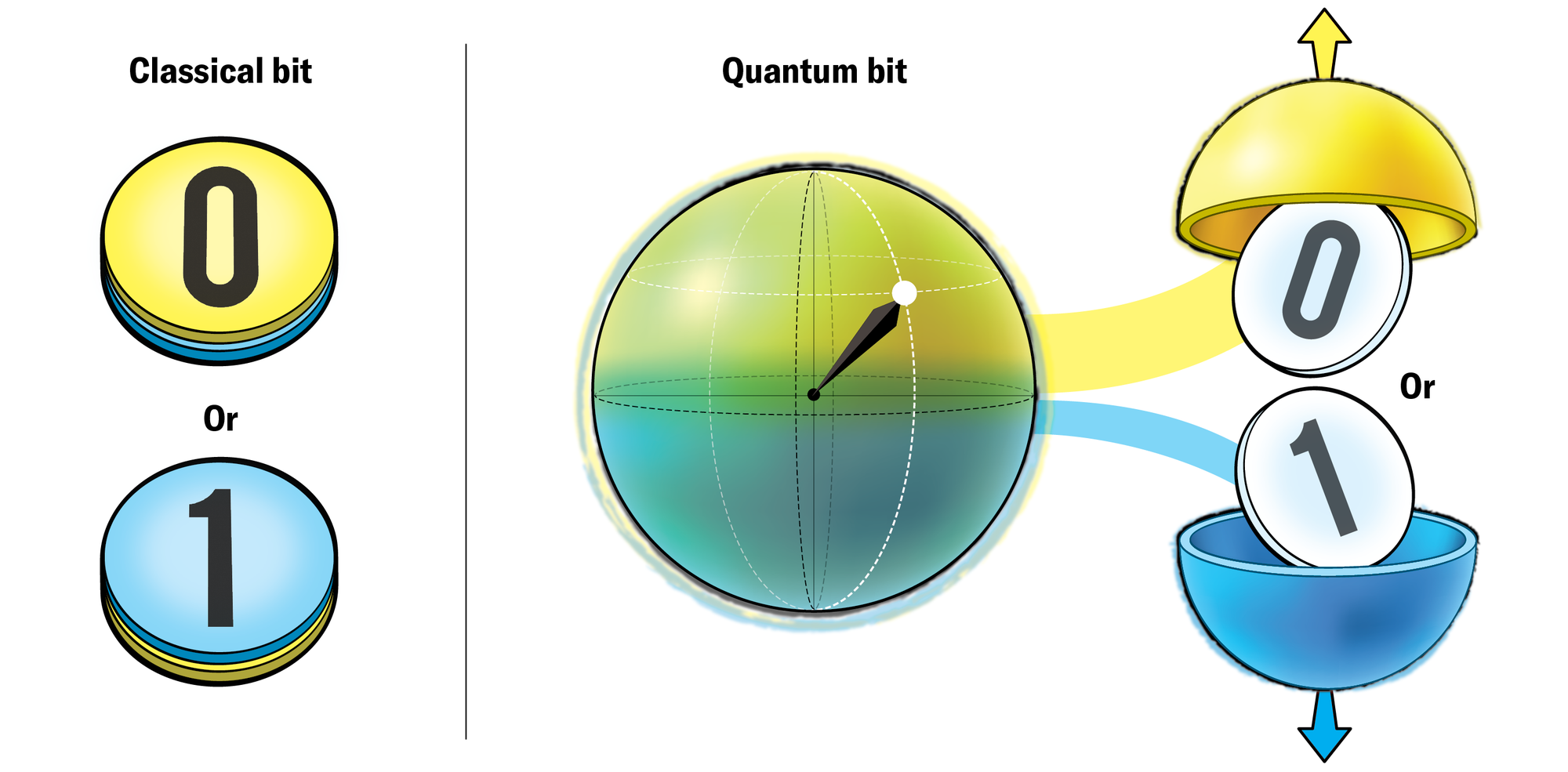
Schematic shows a classical bit as a disc with two discrete sides. The disk shows one side (0) or the other side (1). A quantum bit is represented as a sphere, with a range of a combination of states possible. Ultimately, the system outputs 0 or 1.

On supporting science journalism

If you're enjoying this article, consider supporting our award-winning journalism by subscribing. By purchasing a subscription you are helping to ensure the future of impactful stories about the discoveries and ideas shaping our world today.


These abilities enable their special feats of computing. Imagine that a classical computer solves a maze by trying one path at a time. Quantum computers, in contrast, can essentially explore all possible routes at once. When scientists measure a qubit, however, its limitless possibilities collapse into a single option.
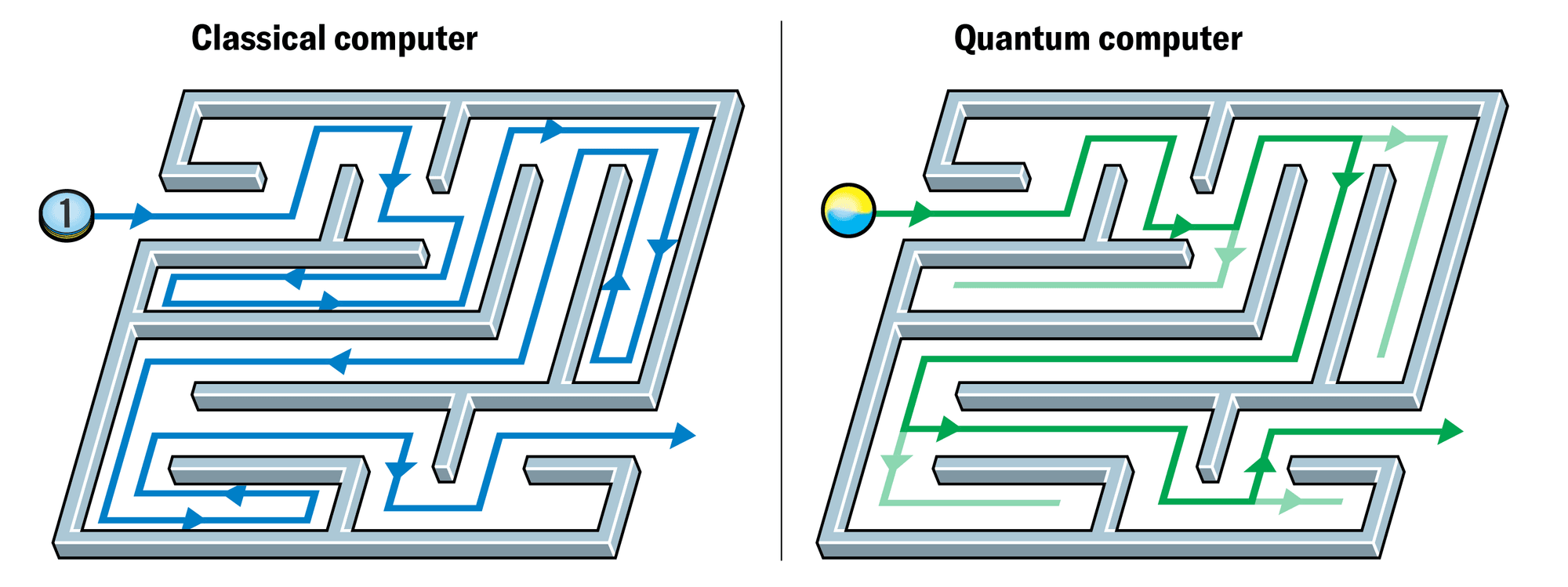
Schematic shows the same base maze in two panels. In the first—labelled “classical computer”—a single line is drawn as if a pencil traced a single person’s path through the maze over time. The line encounters many dead ends, doubling back to the last decision point and then continuing on. In the second—labelled “quantum computer”—lines trace all paths at once. No doubling back is needed. When one line hits a dead end, it simply stops. Another line is already forging ahead.

Source: “The Qubit,” by Massine Kelai/Center for Quantum Nanoscience (https://qns.science/thequbit) (reference)

But what exactly is a qubit? Qubits can be encoded in many different physical systems, and researchers are still pursuing multiple alternatives. “It is a completely wide-open space right now,” says quantum computing scientist Nathalie de Leon of Princeton University, who is also a visiting research faculty member at Google Quantum AI. “All of these platforms still have open science questions in addition to engineering and scaling risk.” Here are some of the options.

Superconducting Qubits

Superconducting qubits are made of tiny circuits of materials that conduct electricity with zero resistance at ultracold temperatures. The energy level of the circuit determines a qubit’s state: when the circuit absorbs a microwave photon, the qubit jumps from the ground state (0) to the first excited state (1). Some scientists favor these qubits because they can perform operations very quickly.

A schematic represents a superconducting qubit with a sphere on the left holding a circuit icon with a Josephson junction. The system is in superposition: A current (electron flow) is both present and absent. On the right the icon is repeated in state 0 (current absent) and state 1 (current present).

Solid-State Spin Qubits

These qubits are based on the spin state of single particles. They include electrons in semiconductors confined by electrostatic traps, electrons and nuclear spins associated with atomic defects in semiconductors, electrons floating on liquid helium, and defect centers in wide-bandgap materials. Chips made with them can be wired using the same technology used in classical semiconductors.
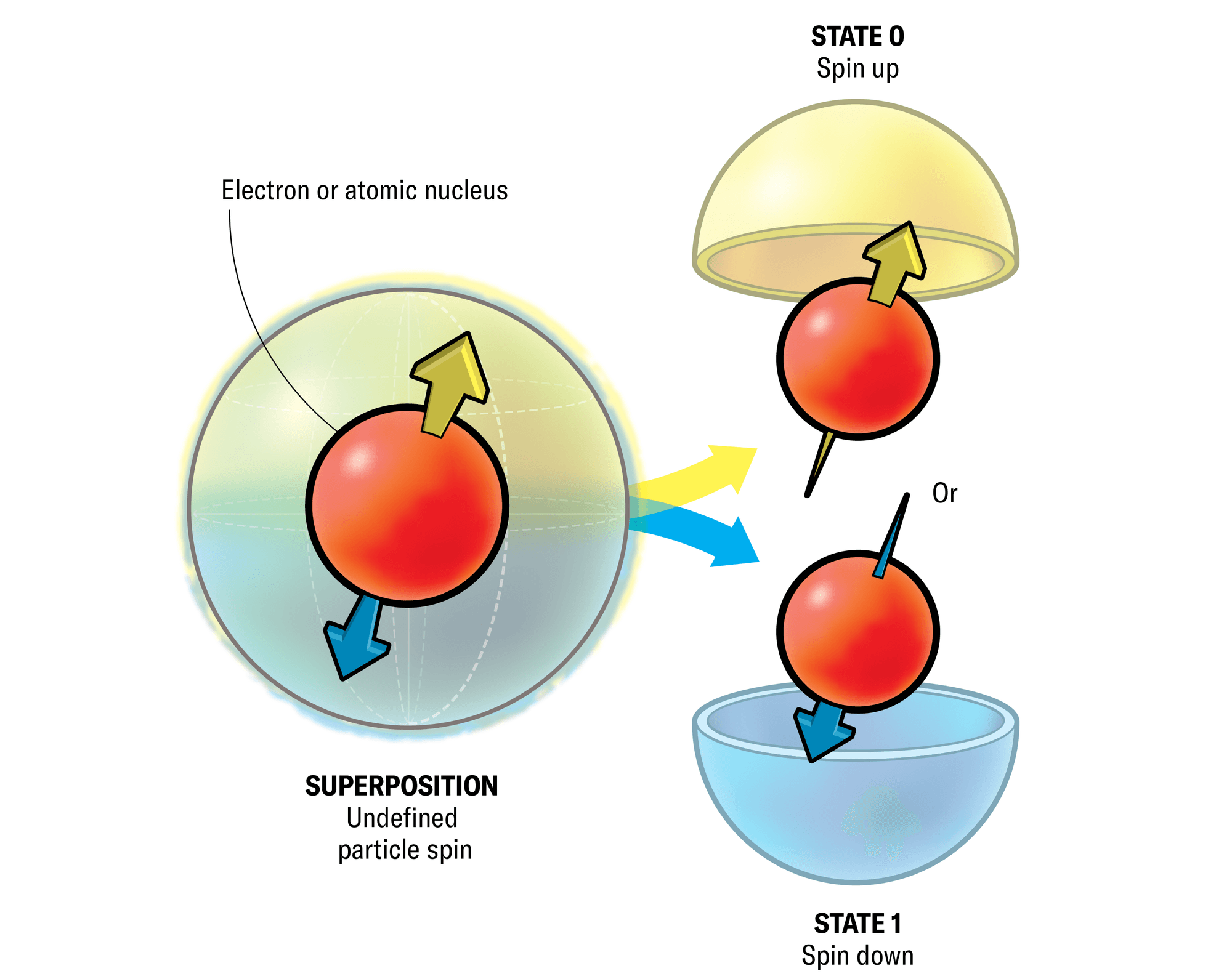
A schematic represents a solid-state spin qubit with a sphere on the left holding a particle icon with arrows pointing down and up. The system is in superposition: Particle spin is undefined. On the right the particle is shown in state 0 (spin up) and state 1 (spin down).

Neutral Atoms

These atoms have no net electric charge. Scientists can make them into qubits by using lasers to trap, manipulate and read them. Their state is determined by the spin of the electron or the spin of the atomic nucleus. They are prized by some researchers for the ease with which they can be combined to scale up into large numbers of qubits.
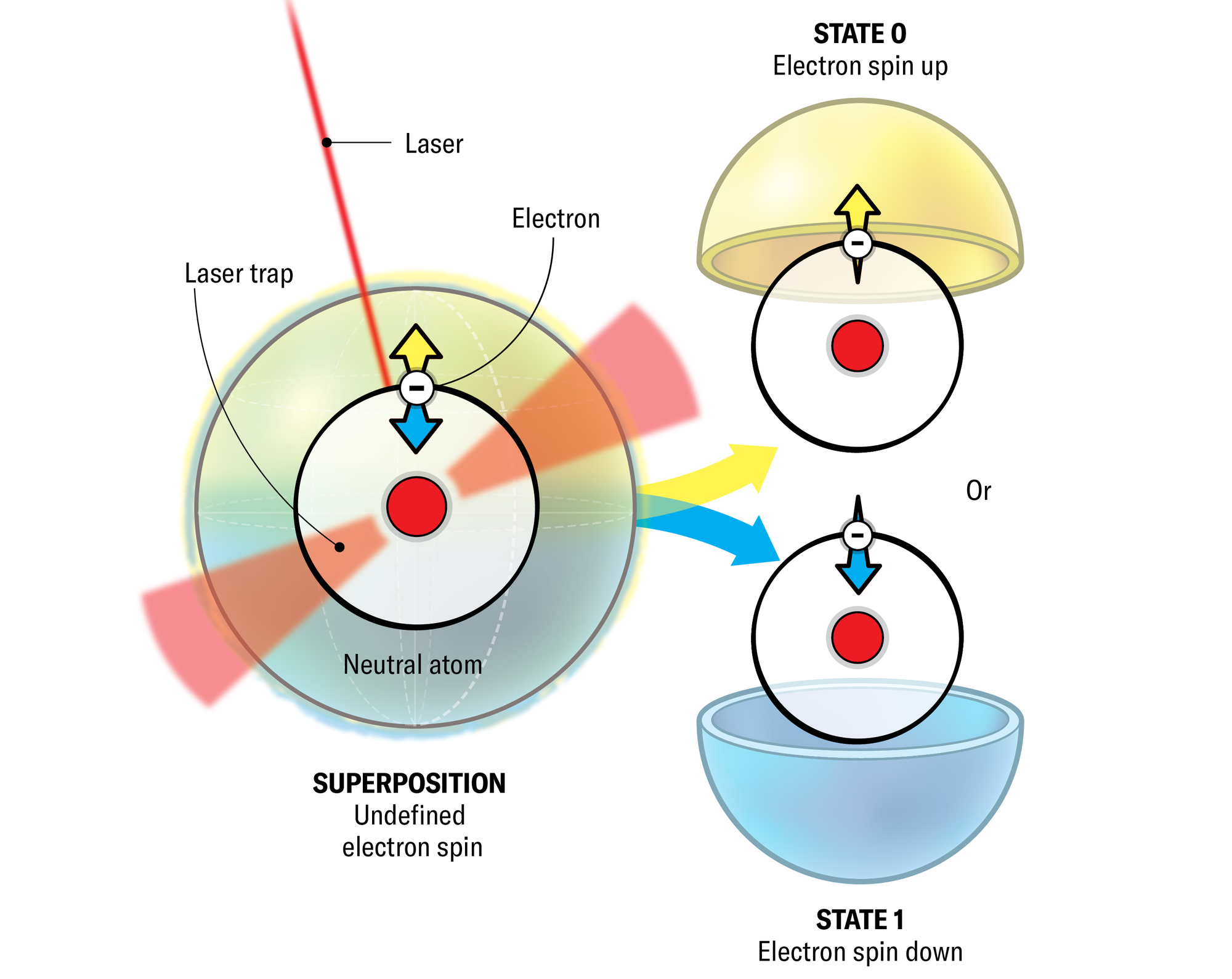
A schematic represents a neutral atom qubit with a sphere on the left holding an icon of an atom held in a laser trap. One of the atom’s electrons includes arrows pointing down and up. The system is in superposition: Electron spin is undefined. On the right the electron is shown in state 0 (spin up) and state 1 (spin down).

Photonic Qubits

These qubits are made of particles of light, called photons, and their state is encoded in the direction of the photon’s travel along a spatial pathway called a rail. One advantage of them is that they can be scaled up into larger and larger computers by means of the same techniques that helped to scale up classical optical and electronic chips.
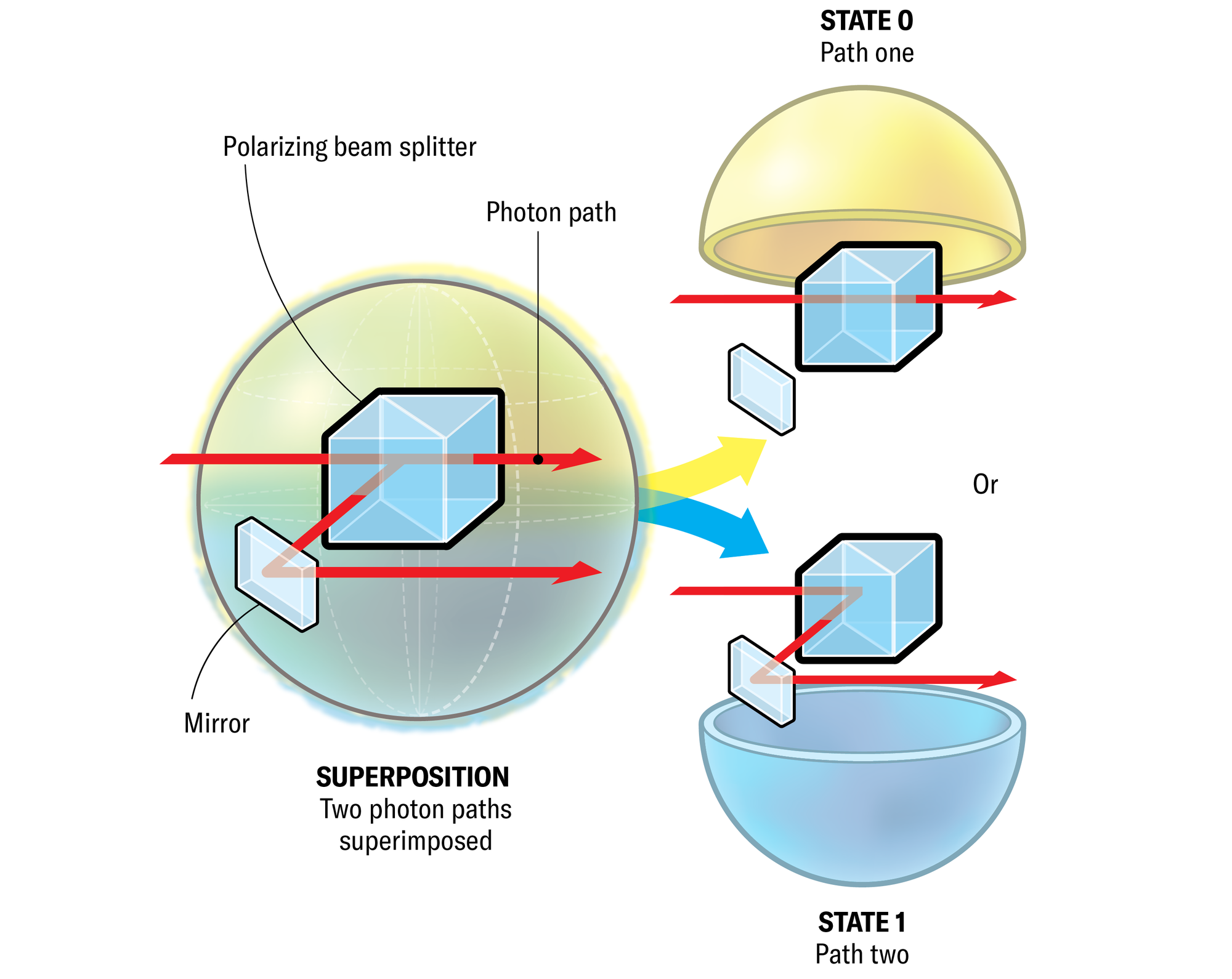
A schematic represents a photonic qubit with a sphere on the left holding polarizing beam splitter and a mirror. The system is in superposition: Two photon paths are superimposed. One continues straight through the beam splitter, the other is redirected to the mirror. On the right the icon is repeated in state 0 (photon continues straight through the beam splitter) and state 1 (photon is redirected).

Trapped Ions

These qubits use the spin states of individual ions (charged atoms) that scientists hold in place with electromagnetic fields and manipulate with lasers. The atoms may be, for example, calcium, magnesium or beryllium. Some early experiments used orbital positions of electrons as qubit states, as shown below. They have demonstrated the lowest error rates for gates between qubits.
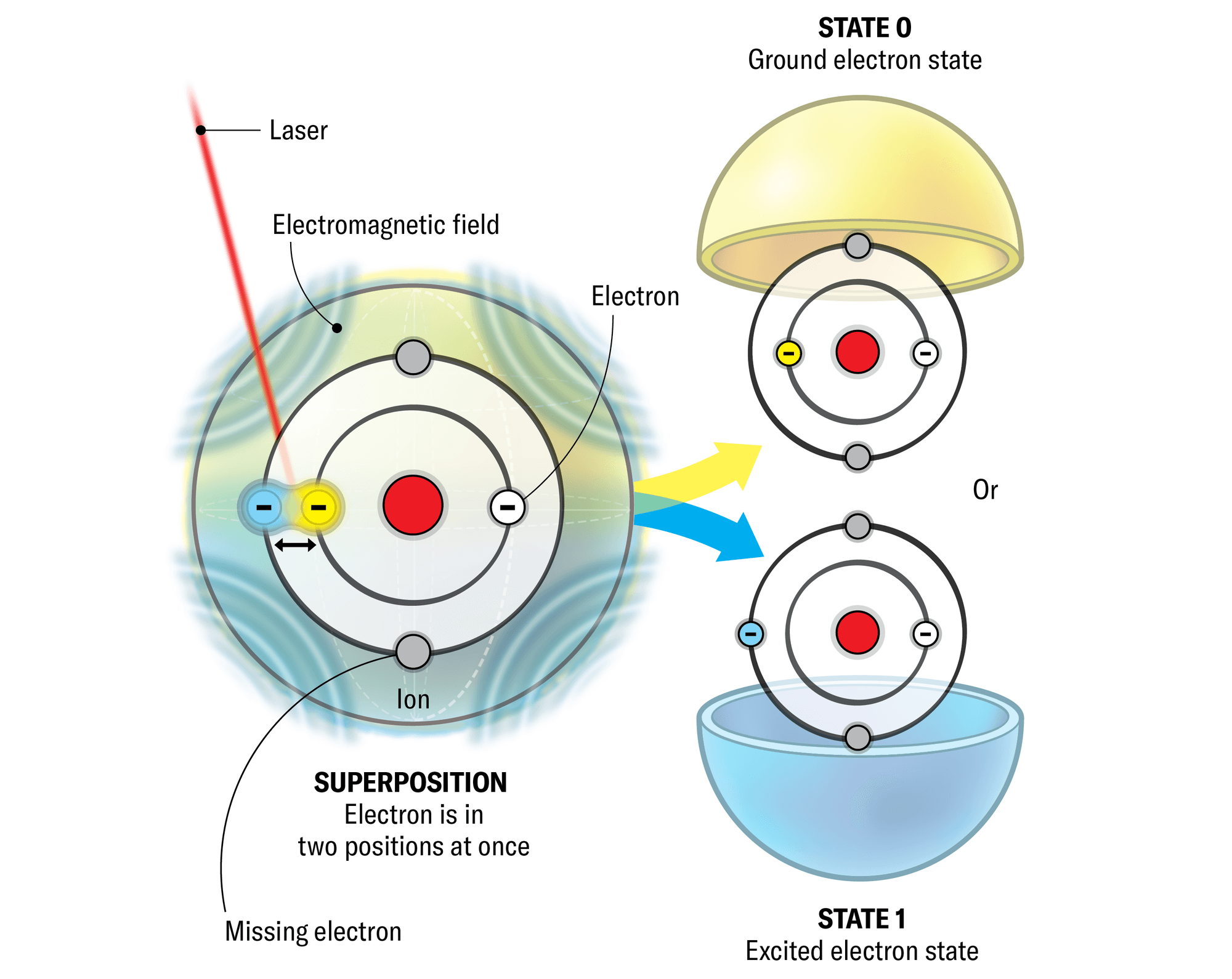
A schematic represents a trapped ion qubit with a sphere on the left holding an icon of an ion held in place with an electromagnetic field. One of the atom’s electrons is in two places at once—the inner and outer orbital. The system is in superposition: Electron position is undefined. On the right the electron is shown in state 0 (ground electron state) and state 1 (excited electron state).

Topological Qubits

Instead of using circuits or individual atoms, topological qubits are made of quasiparticles called anyons. They are theorized to be less error prone than other types of qubits, but scientists are still working on demonstrating them experimentally.
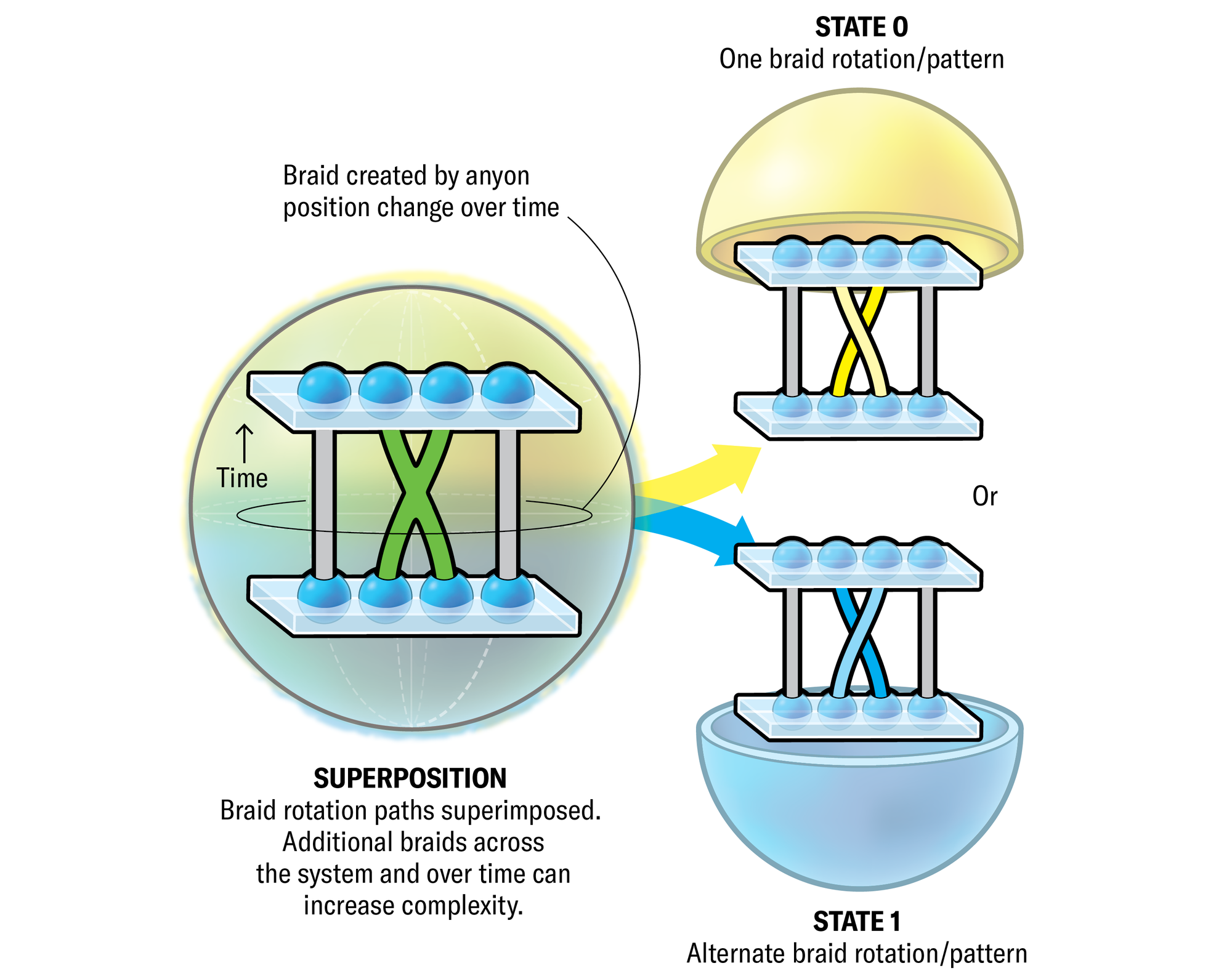
A schematic represents a topological qubit with a sphere on the left holding a braid made of anyone position change over time. The system is in superposition: braid rotation paths are superimposed. On the right the icon is repeated in state 0 (two anyons wrap over time in a clockwise manner) and state 1 (two anyons wrap over time in a counterclockwise manner).

Ben Gilliland

Clara Moskowitz is chief of reporters at Scientific American, where she covers astronomy, space, physics and mathematics. She has been at Scientific American for more than a decade; previously she worked at Space.com. Moskowitz has reported live from rocket launches, space shuttle liftoffs and landings, suborbital spaceflight training, mountaintop observatories, and more. She has a bachelor’s degree in astronomy and physics from Wesleyan University and a graduate degree in science communication from the University of California, Santa Cruz.

More by Clara Moskowitz

Ben Gilliland is a UK-based science writer and visual communicator. He is known for his award-winning infographics and for creating clear, engaging explanations of complex science across print and digital media. His work can be found at https://www.bengilliland.com/.

More by Ben Gilliland

Amanda Hobbs is a freelance researcher, writer and visual content editor specializing in storytelling via art and information graphics. Her work can be viewed at www.athcreative.com

More by Amanda Hobbs
Scientific American Magazine Vol 334 Issue 6This article was published with the title “A Qubit Field Guide” in Scientific American Magazine Vol. 334 No. 6 (), p. 92
doi:10.1038/scientificamerican062026-3Dz0OvhJktzXT7kkFgJc1D

It’s Time to Stand Up for Science

If you enjoyed this article, I’d like to ask for your support. Scientific American has served as an advocate for science and industry for 180 years, and right now may be the most critical moment in that two-century history.

I’ve been a Scientific American subscriber since I was 12 years old, and it helped shape the way I look at the world. SciAm always educates and delights me, and inspires a sense of awe for our vast, beautiful universe. I hope it does that for you, too.

If you subscribe to Scientific American, you help ensure that our coverage is centered on meaningful research and discovery; that we have the resources to report on the decisions that threaten labs across the U.S.; and that we support both budding and working scientists at a time when the value of science itself too often goes unrecognized.

In return, you get essential news, captivating podcasts, brilliant infographics, can't-miss newsletters, must-watch videos, challenging games, and the science world's best writing and reporting. You can even gift someone a subscription.

There has never been a more important time for us to stand up and show why science matters. I hope you’ll support us in that mission.

Thank you,

David M. Ewalt, Editor in Chief, Scientific American

Subscribe