
In June 2018 the journal Science published research showing that chlorophyll-containing blue-green algae, also known as cyanobacteria, that were grown in extremely red light could carry on some photosynthesis despite the light's low energy.
Soon after, the magazine Cosmos ran with that finding to produce a nice article entitled “Pushing the Limit: Could Cyanobacteria Terraform Mars?” The subhead read: “The discovery that blue-green algae can photosynthesize in extremely low light has implications for astrobiology.”
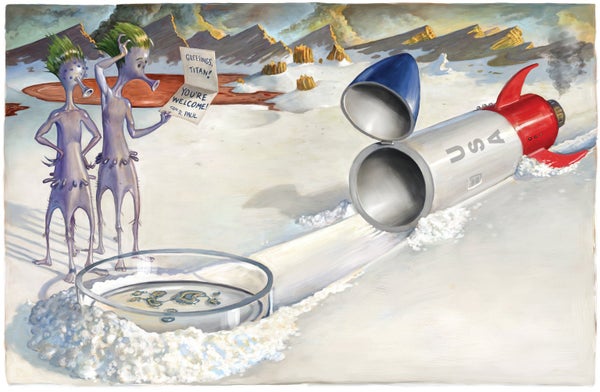
Then, on January 19, 2020, Senator Rand Paul of Kentucky cited the article in a tweet that also said, “Despite climate alarmist predictions, humans will likely survive for hundreds of millions of years into the future. In the meantime, we should begin creating atmospheres on suitable moons or planets.” He then tweeted, “With so many billionaires about, why not a private prize of $10 million for the scientist who genetically creates an O2 producing organism that will thrive in the frigid, methane lakes of Titan?”
On supporting science journalism
If you're enjoying this article, consider supporting our award-winning journalism by subscribing. By purchasing a subscription you are helping to ensure the future of impactful stories about the discoveries and ideas shaping our world today.
These notions struck me as, well, wacky. I knew that species don't last for hundreds of millions of years. And making an organism to terraform Saturn's moon Titan, if even possible, would undoubtedly cost more than some billionaire's chump change.
So I contacted Emory University paleontologist and geologist Anthony J. Martin. He noted that another species of humans, Homo neanderthalensis, “only lasted [approximately] 350,000 years before going extinct.” Our species, Homo sapiens, has tens of thousands of years to go before we even catch up to the Neandertals.
I then wrote to University of Edinburgh evolutionary biologist Steve Brusatte. “If we make it another 10 million years, we'll be a record setter,” Brusatte wrote back. “I can't think of any species that has approached that type of longevity. Ten million years ago there wasn't even a human lineage—it would still be another few million years before our ancestors split from the chimps.” (Podcasts with Martin and Brusatte about books they've written are at ScientificAmerican.com.)
On to tweet two. A guest blog on our Web site in 2016 did in fact claim that Titan might be the second-best place in the solar system (in some ways better than the moon or Mars) for humans to live—a loooooong time from now.
Curious about the idea of oxygenating Titan with an engineered microorganism to be created on the cheap, I wrote to a planetary scientist. That person, who requested anonymity, replied, “I appreciate that Senator Paul is not a planetary scientist nor—apparently—an economist, but it's clear he could thrive as a humorist. I am not sure that a longer lecture on the density of Titan's atmosphere or the hazards of adding free oxygen to a methane mix will help in this case.” The scientist also mentioned the challenge of “finding a photosynthetic bacterium that produces oxygen at 94 kelvins [–290 degrees Fahrenheit].”
Then I heard from Donald Canfield, a geoscientist at the University of Southern Denmark and author of the book Oxygen: A Four-Billion-Year History. “As far as we know,” Canfield wrote, “all life requires water, so if we are looking for life to thrive in something else, we are pushing the boundaries way beyond how we understand life to function. Such a discovery would be foundational but way beyond what we know about life now. Prize money would be incidental to the Nobel Prize that would follow.”
Did I mention that Earth's sulfidic seas in the mid- to late-Proterozoic eon are referred to as the Canfield Ocean, in honor of his research? Anyway, Canfield continued, “I think it might be wiser to offer a prize to someone who could produce a photosynthetic organism that could produce copious amounts of hydrogen for energy, or plastics, or some other useful hydrocarbon as a substantial part of their metabolism.”
Because if we're going to spitball ideas about designer microbes that can help humanity, they might as well be good ones.