
The U.S. Environmental Protection Agency (EPA) is trying to sharply reduce its use of animals in toxicity tests. Many scientists and environmentalists say the move is premature and could undermine chemical regulation.
In a memo to staff, EPA administrator Andrew Wheeler said that the agency would make use of “cutting-edge, ethically sound science” that does not rely on animal testing.
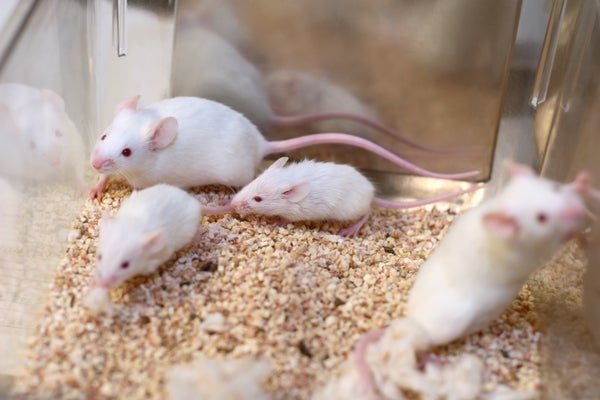
Wheeler signed a directive on 10 September that commits the EPA to reduce its funding request for animal studies by 30% by 2025, and to phase them out entirely by 2035. After 2035, any tests or funds for studies involving animals such as mice would require the approval of the EPA administrator. The plan, which will affect research by EPA scientists and industry, has been in the works for more than a year. Agency officials have said that the shift away from animal experiments won’t limit chemical regulation or reduce public safety.
On supporting science journalism
If you're enjoying this article, consider supporting our award-winning journalism by subscribing. By purchasing a subscription you are helping to ensure the future of impactful stories about the discoveries and ideas shaping our world today.
Wheeler also said that EPA had awarded U.S.$4.25 million in grants to universities for research into alternative toxicity testing methods. The grant recipients are Johns Hopkins University in Baltimore, Maryland; Vanderbilt University in Nashville, Tennessee; Oregon State University in Corvallis; and the University of California, Riverside.
“I don’t think anyone would be saddened by reducing animal research,” says Laura Vandenberg, an environmental health scientist at the University of Massachusetts Amherst. But she fears that the EPA is effectively tying its own hands.
Uncertain outcomes
Scientists can and do use advanced screening tools to study the potential effects of chemicals at the cellular and biochemical level, Vandenberg says. But to regulate a chemical, the EPA must show that there are adverse effects in living organisms, she says. “There is no adverse effect in a Petri dish.”
And just because researchers don’t see negative effects of chemicals on cells in the lab, it doesn’t mean that they aren’t there, Vandenberg adds. “We are going to get caught in a position where we won’t really be able to regulate chemicals in the U.S.”
The Humane Society of the United States, an animal-advocacy group in Washington DC, praised the EPA’s decision. “We applaud the agency and urge industry and other stakeholders to continue this momentum and move away from animal testing,” said chief executive officer Kitty Block in a statement.
Not everyone is so sanguine about EPA’s decision. The move represents an “unholy alliance” between the chemical industry and animal-rights groups that are pushing to halt animal tests, says Jennifer Sass, a senior scientist at the Natural Resources Defense Council, an environmental advocacy group in New York City.
Sass says that the EPA has reduced its reliance on animal testing in certain areas. For instance, tests to see whether a chemical is corrosive to the skin can now be done on skin that is grown in a Petri dish. But without tests on animals such as mice or rabbits, the only way for companies to study chemical interactions in the body is to use computer models, she says. And those models are often proprietary, which makes it hard to assess their accuracy.
“A chemical goes into a black box, and out comes an answer that is very hard for people to understand and independently review,” Sass says.
This article is reproduced with permission and was first published on September 10, 2019.