
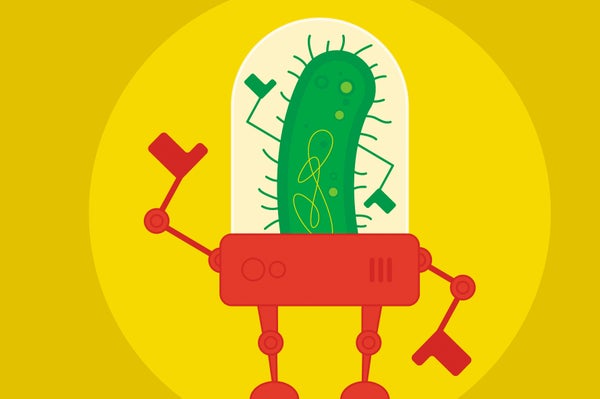
Scientists have implanted an artificial hydrogel scaffold into bacteria to create semisynthetic “cyborg cells” that could one day function as tiny robots in medicine, environmental cleanups and industrial production, according to a recent study in Advanced Science.
In addition to making the cells hardier, this scaffolding eliminates their ability to reproduce so they can be controlled better than genetically modified live bacteria. The cyborg cells are also easier to create than fully artificial cells of similar complexity.
“We never thought this would work,” says synthetic biologist and study co-author Cheemeng Tan of the University of California, Davis. “When you introduce a gel matrix into cells, most of the time you would think you would kill them.” But his team decided to try.
On supporting science journalism
If you're enjoying this article, consider supporting our award-winning journalism by subscribing. By purchasing a subscription you are helping to ensure the future of impactful stories about the discoveries and ideas shaping our world today.
To build a biological robot, researchers often hack a living microbe's genetic code to adapt the organism to an intended purpose. But billions of years of evolution have taught microbes not to do things that endanger them—a vexing situation for synthetic biologists who want cells to produce valuable but toxic chemicals or to do other hazardous jobs.
“They're not stupid; they're not going to do something that doesn't make them either divide better or grow better,” says University of Minnesota synthetic biologist Kate Adamala, who wasn't involved in the new study. “That's kind of their business model”.
Because fully artificial cells don't reproduce or have survival instincts, they're easier to control than live cells. But it's often hard to make them sophisticated enough for complicated jobs. “In terms of complexity, they're just no match for natural cells,” Tan says.
To make cyborg cells, the researchers infused live Escherichia coli with a hydrogel, which Tan likens to a dense mass of wet molecular noodles. This fortification made the cells sturdier, letting them survive toxic stressors that would kill ordinary E. coli. Such cells fall somewhere between artificial and natural: they can't divide but otherwise have normal function and metabolism. The team also showed that cyborg cells can be programmed with genetic “circuits” (sets of genes that let cells do simple computations) and equipped with genes that help them invade tumor cells.
Scientists have incorporated hydrogels into fully artificial cells before. But hydrogel components are “superhard to control” within a living cell, Adamala notes. Tan says the group stumbled onto the right hydrogel basically by accident—and spent months fine-tuning the recipe so bacteria could survive it.
Tan and Adamala agree that turning other cell types into cyborgs could be useful; yeast, for instance, is a fungus that can make proteins bacteria can't. For now Tan's team is working on programming cyborg bacteria to deliver vaccines and act as tiny terminators for cancer cells.