
As a child, Makoto Miyata loved tinkering with radios and amplifiers. Now his interest in fiddling with things has only grown—but as a cellular biologist, he does it at a much finer scale. For a paper in Science Advances, Miyata's team at Osaka Metropolitan University in Japan has tweaked the genes of the smallest synthetic life-form to make it move on its own, hinting at how minimal genetic additions could have helped primordial cells begin to move.*
Researchers have long been working to understand how the earliest natural cells might have developed movement. Such studies have used the bacterial genus Spiroplasma: single-celled, helix-shaped parasitic microbes that move by simply bending, flexing and changing their shape—not by using specialized appendages, as many other bacteria do. In Spiroplasma, scientists had already identified seven genes likely to aid this kind of cell movement. But confirming these genes' precise roles experimentally has proved challenging.
The team turned to a synthetic cell, called JCVI-syn3.0 (syn3.0 for short), which researchers at the J. Craig Venter Institute created in 2016. The cell survives and replicates with a record-breakingly small total of 473 genes—humans, by comparison, have more than 20,000. But syn3.0 can't move.
On supporting science journalism
If you're enjoying this article, consider supporting our award-winning journalism by subscribing. By purchasing a subscription you are helping to ensure the future of impactful stories about the discoveries and ideas shaping our world today.
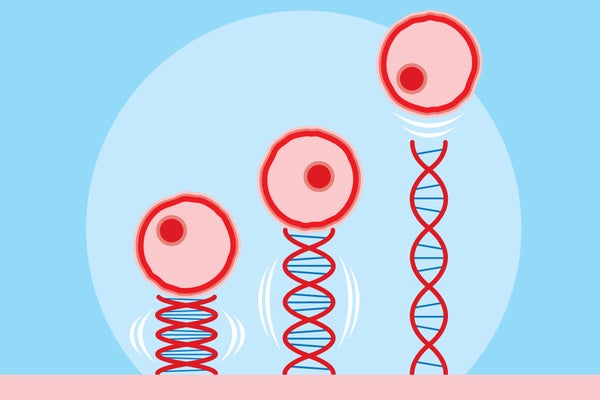
Miyata and his colleagues inserted combinations of the seven movement-associated Spiroplasma genes into syn3.0 cells. He says he vividly remembers the moment he peered through a microscope and saw the previously stationary synthetic cells “dancing.” Nearly half had taken on new shapes; some had even developed twisting helical forms to swim, just like Spiroplasma.
Miyata had imagined creating a synthetic cell that could move, but he says it was still “quite surprising” when it actually happened. He wasn't the only one surprised, according to National Institute of Standards and Technology cellular engineer Elizabeth A. Strychalski, who was not involved in the study but attended a presentation ahead of its release. “When they showed the video of these organisms swimming and how their [shapes] had changed, you could almost feel the collective gasp,” she says. Miyata's team found that introducing combinations of just two genes was enough to produce Spiroplasma-like movement.
Strychalski notes that other researchers used a similar DNA-insertion technique to add jellyfish fluorescence genes into feline embryos, creating domestic cats that glowed. But few had expected it could work in synthetic cells. This experiment “felt very bold,” she says, “and [its success] is also tremendously motivating and uplifting for the field.”
Although it's hard to imagine what conditions triggered cells' first movements billions of years ago, this research shows how small changes could help them take that massive leap. The study also has implications for the future, Strychalski says: “Mobile synthetic cells might someday be engineered to seek out contaminants, pathogens or even cancer cells in the human body.”
*Editor’s Note (3/21/23): This sentence was edited after posting to correct the name of the journal that published the study.