
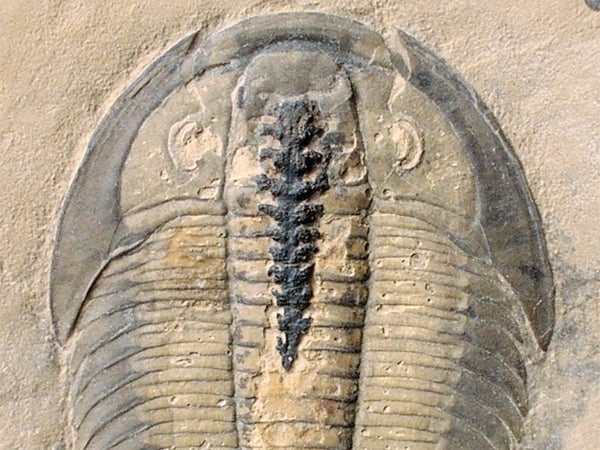
If every living thing died right now, by some estimates only around 1 percent would become fossils. Even fewer would have any soft tissues preserved. These rare tissue fossils offer crucial clues about biology and evolution, but their formation remains mysterious. Why do scientists find fossilized intestines, for example, but never a fossilized liver?
Fossils develop when minerals replace the body parts of organisms that die and get buried in sediment, such as the mixture of mud and seawater on the ocean floor. Paleontologists are particularly fond of the fossil-building mineral calcium phosphate because it can preserve soft organs in exquisite detail—sometimes all the way down to cell nuclei. This mineral forms only under specific acidity conditions, so scientists have hypothesized for decades that differences between decaying organs’ pH levels determine which ones get preserved.
To better understand how organs change after death, University of Birmingham paleontologist Thomas Clements made a trip to the fishmonger with a plan to ruin four delicious seabass. His team poked pH probes into the fishes’ internal organs, then submerged the carcasses in artificial seawater and let them rot.
On supporting science journalism
If you're enjoying this article, consider supporting our award-winning journalism by subscribing. By purchasing a subscription you are helping to ensure the future of impactful stories about the discoveries and ideas shaping our world today.
For 70 days the researchers watched the seabass bloat, shed their flesh and disintegrate into piles of bones while the probes monitored the body parts’ changing chemistry. The results, recently published in Paleontology, show that within 24 hours every organ’s acidity reached the right range for calcium phosphate to crystallize, with these conditions lasting up to five days. The team had expected to find stark differences between organs, but instead the whole carcass rotted evenly into a relatively homogeneous soup of decay by-products, held inside by the skin for up to 20 days.
This surprising result prompted the researchers to consider other factors that could aid fossilization, such as phosphorus levels within an organ’s tissues. “Muscles are full of phosphate,” Clements says. “If you have the phosphate already there, then there’s already a high likelihood that [the organ] will be replaced by calcium phosphate.”
“It would be interesting to do this in [nonfish organisms] as well,” says paleontologist Victoria McCoy of the University of Wisconsin–Milwaukee, who was not involved in the study. She suggests future work could monitor other aspects of the environments within decaying organs, such as concentrations of various elements. Researchers could also investigate whether tissues’ physical structures influence mineral formation. “In many ways, it brings up more questions than there would have been if they found organ-specific pH gradients,” McCoy says. “But that’s what makes it so cool.”