
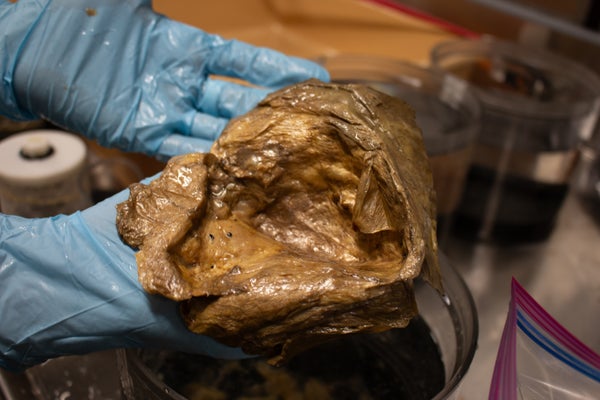
In August 2023 scientists discovered something utterly bizarre in the deep ocean off the coast of Alaska: a golden orb. The thing looked like something out of a science-fiction movie, but now scientists at the National Oceanic and Atmospheric Administration and the Smithsonian Institution can reveal that it is not, in fact, an alien. It’s an anemone, or more specifically, the remnants of one.
The strange object was found during an expedition of the NOAA ship Okeanos Explorer. The crew were using remote-controlled submersibles to explore a seamount in the Gulf of Alaska, more than two miles beneath the surface, when suddenly the orb popped into view on the video feed. Stuck to a rock amid some more pedestrian-looking sponges, one of the researchers commented that they seemed to have found something resembling a “yellow hat.”
As they got a closer look, they saw that it was dome-shaped and about four inches in diameter and that it had a small tear near its base. The object was so strange that the scientists had no idea what it was beyond the observation that it seemed to be at least biological in origin. Guesses as to its nature veered from it being an odd egg casing to evidence of an entirely unknown stage of life. To find out, the researchers collected the orb and sent it to the Smithsonian’s National Museum of Natural History for further study.
On supporting science journalism
If you're enjoying this article, consider supporting our award-winning journalism by subscribing. By purchasing a subscription you are helping to ensure the future of impactful stories about the discoveries and ideas shaping our world today.
“This turned into a special case that required focused efforts and expertise of several different individuals,” said Allen Collins, director of NOAA Fisheries’ National Systematics Laboratory, in a statement. “This was a complex mystery that required morphological, genetic, deep-sea and bioinformatics expertise to solve.”
The efforts to solve the object’s identity included genetic analysis and close examination of its physical attributes. Another, similar sample collected in 2021 was also studied for comparison. The scientists found both were composed of a fibrous material that contained many stinging cells called spirocysts, which belong exclusively to the branch of aquatic invertebrates known as cnidarians.
Whole-genome sequencing revealed the orb shared lots of genetic material with deep-sea anemones. Sequencing its and the other specimen’s mitochondrial genomes revealed that they were almost identical to that of a species of anemone called Relicanthus daphneae.
While the golden orb doesn't look much like an R. daphneae, Steve Auscavitch, a marine biologist at the Smithsonian who was part of the team that found the 2021 sample, explains that there's a good reason for that. Anemones grip onto a spot on the sea floor using a sticky substance that they secrete. Because it's underneath them, it can be hard to get a look at what that actually looks like. The golden orb is what happens when an anemone glues itself into place.
"I suspect that this anemone was growing here for quite some time, kind of layers and layers and layers of this material," he says.

Deepwater Exploration of the Marianas, NOAA Ocean Exploration
This species was discovered in the 1970s but wasn’t formally classified until 2006. R. daphneae anemones live on the ocean floor, usually near thermal vents, and have pinkish or pale purple tentacles that stretch as long as seven feet.
“So often in deep ocean exploration, we find these captivating mysteries, like the ‘golden orb,’” said William Mowitt, acting director of NOAA Ocean Exploration, in the same statement. “With advanced techniques like DNA sequencing, we are able to solve more and more of them. This is why we keep exploring—to unlock the secrets of the deep and better understand how the ocean and its resources can drive economic growth, strengthen our national security, and sustain our planet.”
Much of what lives in the deep sea remains undiscovered by humans. Auscavitch notes that it's rare for an expedition to come back without something new to identify. While most discoveries don't capture the public imagination quite like the orb did, he believes the techniques used to identify its origins will lead to many more revelations.
"There's thousands of other in the collections that we have not genetically sequenced," he says. "Being able to do the same type of analysis on all those thousands of other things would probably reveal some more discoveries like this. Those things will come in time, and we're just glad to get this one out first."