
The movie 2001: A Space Odyssey famously opens with an ancient apelike human ancestor suddenly realizing that he could use large bones as weapons. Others in his group who see him quickly adopt the novel skill, leading to a frenzy of weapon wielding that the movie implies sparks all of human innovation and accomplishment.
For decades, most researchers assumed that humans were the only ones who were capable of learning new breakthrough behaviors from innovative members of their species, facilitating cultural evolution and biological success. Plenty of nonhuman species are known to learn new behaviors from other members of their group, but many researchers thought that this was restricted to behaviors that most individuals could have figured out on their own—thus putting inherent limitations on the extent to which these species’ cultures could evolve.
Now a pair of new studies contradict this idea by demonstrating that two very different species—chimpanzees and bumblebees—can learn complex behaviors by watching others.
On supporting science journalism
If you're enjoying this article, consider supporting our award-winning journalism by subscribing. By purchasing a subscription you are helping to ensure the future of impactful stories about the discoveries and ideas shaping our world today.
“Obviously, in terms of breadth and depth, human culture is unrivaled, but the underlying capacity for it is clearly not unique, exclusive or even rare,” says Alice Bridges, a biologist at the University of Sheffield in England and lead author of the bumblebee paper, which was published in Nature on Wednesday. “This fundamentally alters how we’ve been approaching this idea of culture.”
“It’s very exciting to see these two cleverly designed studies come out on very distinct taxa,” says Kathelijne Koops, a primatologist at the University of Zurich, who was not involved in the research. Both studies provide “convincing evidence” that nonhuman animals can teach one another behaviors that are too complex to invent individually, she says, “challenging the idea that this capacity, which is proposed to characterize uniquely human cumulative culture, is a fundamental distinction between humans and other animals.”
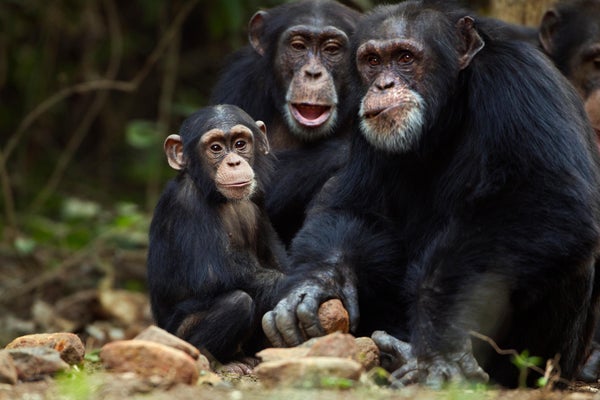
In the study of chimpanzees, published in Nature Human Behaviour on Wednesday and conducted with animals at a sanctuary in Zambia, researchers designed a puzzle box that contained a delicious-smelling peanut reward. The box required three steps to access the reward: retrieving a wooden ball, pulling out a drawer to insert the ball into and then closing the drawer. “Like puzzle boxes given to little kids, once you know how to open it, it’s not that hard,” says Edwin van Leeuwen, a behavioral biologist at Utrecht University in the Netherlands and lead author of the study. “But before you show them the solution, they’re literally puzzled.”
Van Leeuwen and his colleagues installed the boxes in the forested enclosures of two chimpanzee groups with a total of 66 individuals. They distributed balls around the area and watched on camera monitors as the chimpanzees tried all kinds of tactics to open the boxes, from hitting the balls against them to pulling out the drawers. After three months, none of the chimps were successful.
The researchers next selected one high-ranking, intelligent adult female from each group and taught these two chimps how to open the boxes. After eight daily 20-minute training sessions, the females became “really proficient” at fetching balls to access the reward, van Leeuwen says.
In the last step of the study, the researchers watched what happened in the groups after the two females were successfully trained. The females opened the boxes at least 1,000 times each, oftentimes in front of other chimpanzees. Over a five-week period, 14 of the untrained chimps were also able to open the box—after they observed the females opening it at least nine times. The study shows that, like humans, “chimps can copy something that’s not in their immediate zone of solutions,” van Leeuwen says.
Frans de Waal, a primatologist and professor emeritus at Emory University, who was not involved in the research, says he hopes the decades-long debate over whether chimpanzees can use social information to acquire new skills “is now over.”
The bumblebee study revealed similar but more unexpected findings, given the differences between humans and insects. “Bees don’t resemble us, and their brains aren’t anything like ours, so we assume they must be simple,” Bridges says. But the new findings show that “we need to challenge our own biases about what is complex and what isn’t.”
In the study, Bridges and her colleagues put bumblebees in an experimental arena that required them to push open a blue tab and then slide a red tab to gain access to a sugar reward. The team first confirmed that the bees could not figure out how to access the two-step reward on their own. Next, the researchers painstakingly trained a set of demonstrator bumblebees to access the reward. “We weren’t even sure we could train a bee to do the whole thing,” Bridges says. When they finally succeeded, “it really was an incredible moment.”
As with the chimpanzees, some individuals in the group of naive bees that were paired with the demonstrator bees were able to learn the behavior. Five out of 15 bumblebees succeeded in accessing the reward after three solo tests. Bridges notes that more bees may have learned the behavior from the demonstrators if they had been given more chances.
“The chimpanzee experiment is important in showing humans are not alone in observational learning, allowing the many to benefit from major advances invented by the few,” says Andrew Whiten, a psychologist at the University of St. Andrews in Scotland, who was not involved in either study. “But it seems all the more remarkable to discover that the same is true of the humble bumblebee.”
“If this is true for animals as different as the ape and the bee,” he adds, “traditional ideas about what makes human culture different to animals are going to need some rethinking.”