
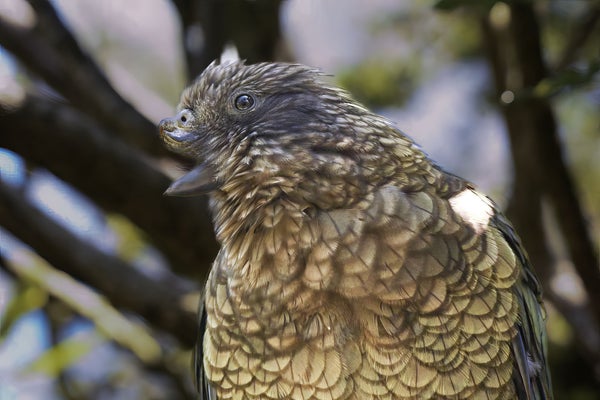
There’s an Internet parable in which a boy with one arm becomes a judo champion by learning a single move—a move his opponents can’t block because they can’t grab his missing arm. That apocryphal tale about turning a disability into an advantage does gangbusters on social media, so just wait until LinkedIn gets a load of Bruce, an injured Kea parrot that turned his disability into a weapon—literally. He uses his disability for stabbing.
New research published on Monday in Current Biology argues that Bruce became the dominant male of his social group because of, not in spite of, a disability. “Because of his disability, he has had to innovate behaviors. He’s found a way to make himself more dangerous,” says study co-author Ximena Nelson, a professor of animal behavior at the University of Canterbury in New Zealand.
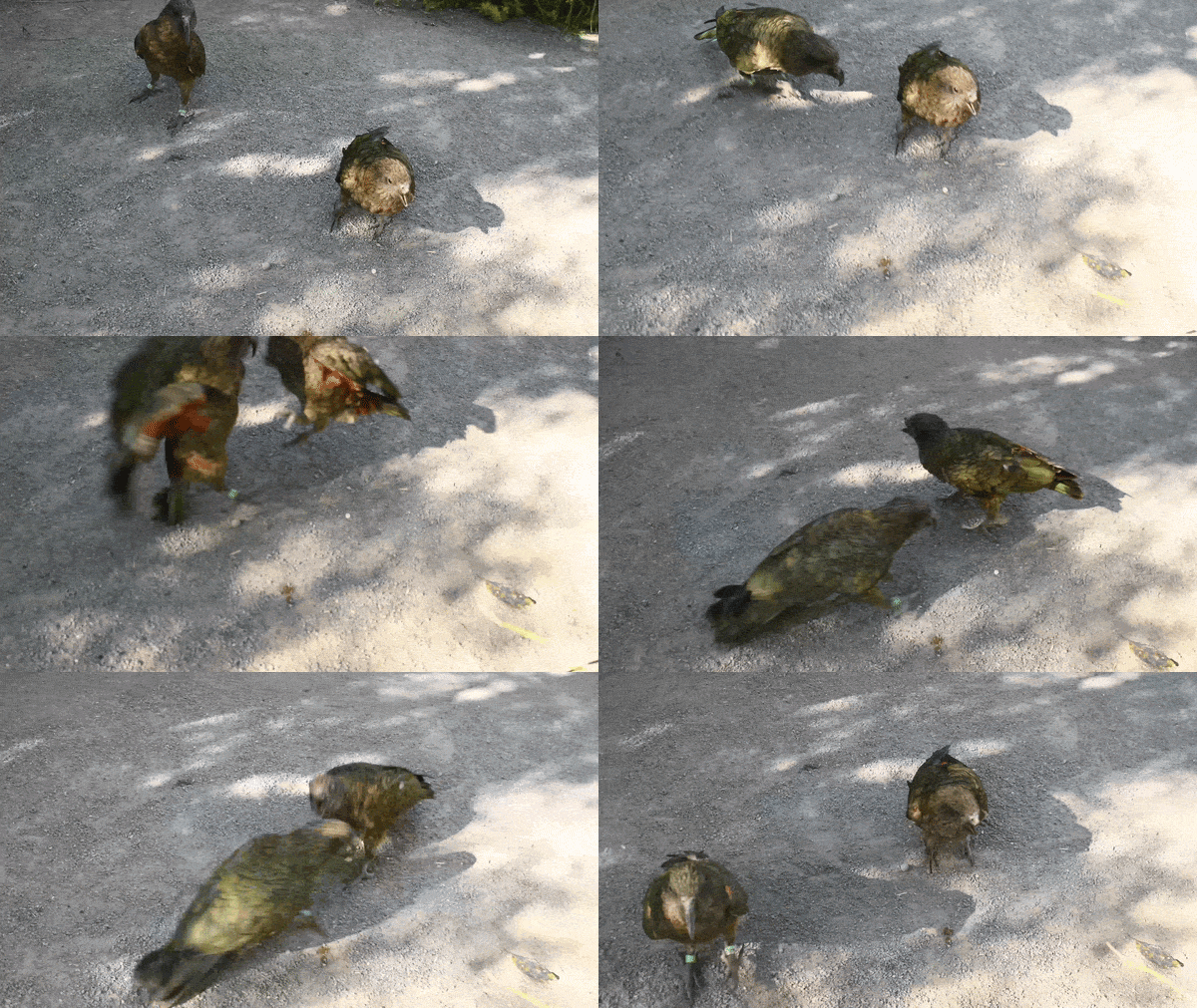
Bruce and another Kea “joust.”
Ximena Nelson
On supporting science journalism
If you're enjoying this article, consider supporting our award-winning journalism by subscribing. By purchasing a subscription you are helping to ensure the future of impactful stories about the discoveries and ideas shaping our world today.
Bruce is missing the curved upper half of his beak because of an injury he received as a fledgling in the wilds of New Zealand’s South Island, and this leaves his sharp lower beak exposed. His signature move is what researchers describe as a “jousting” motion—he crouches down, gets a running start and leaps at other birds with his chin jutting forward, aiming for their wings, their legs and even their face.
Clearly, it’s not pleasant to be on the receiving end of a joust. The other birds “spring away” with alacrity, Nelson says. (In one video, you can see a would-be victim fling himself off a rock to avoid a lunge from Bruce.) While the other males in the Willowbank Wildlife Reserve’s Kea group spend lots of time squabbling and making threat displays, Bruce is free to wander the aviary and monopolize feeding stations and prime perches, the study reports.
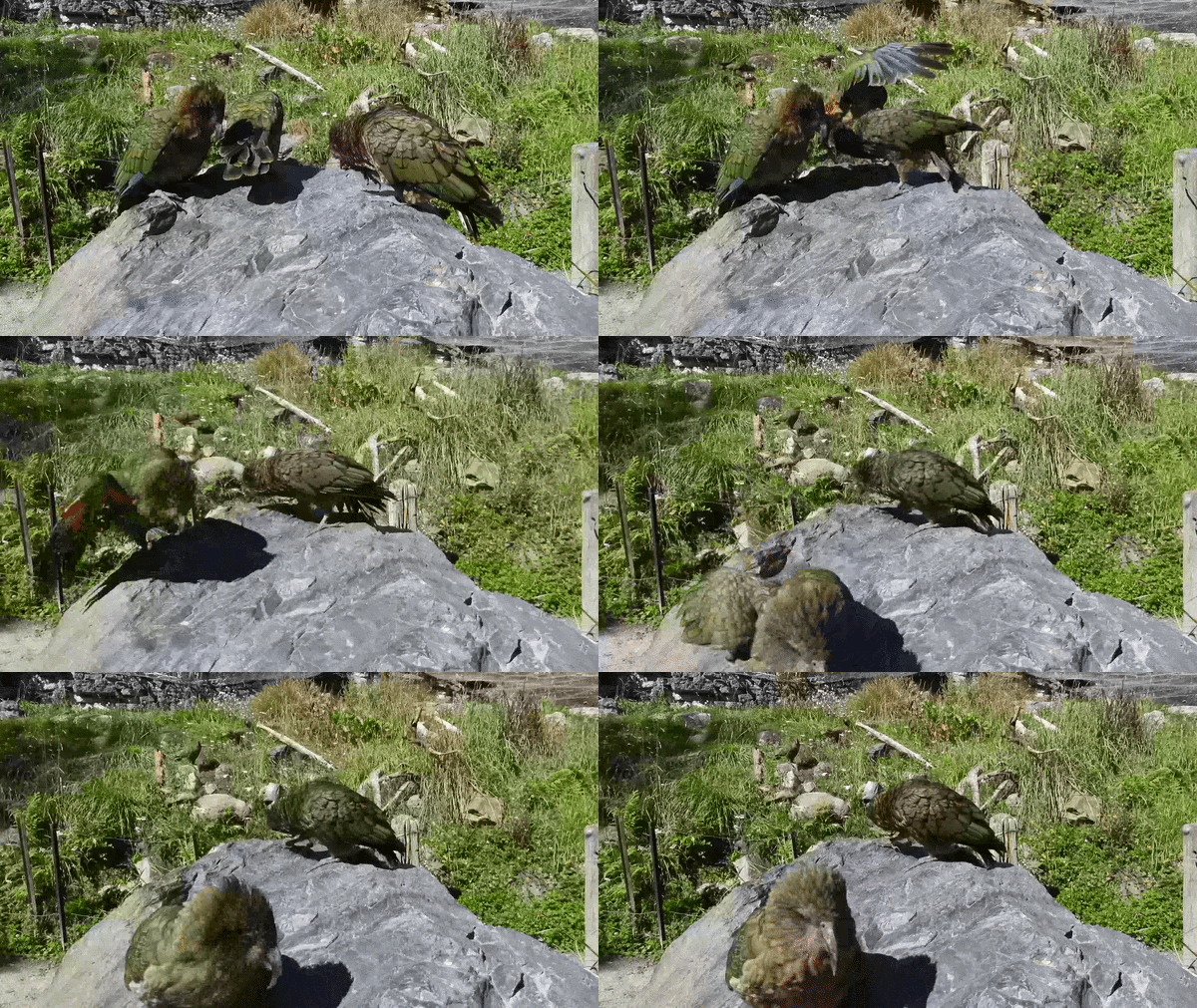
Bruce runs toward a subordinate male, who leaps out of the way.
Alex Grabham
The finding speaks to the cleverness of Kea (Nestor notabilis), mountain-dwelling parrots with a reputation for impish intelligence. “They’re often called hooligans and rightly so,” Nelson says. The birds make snowballs, sled on their backs, joyfully deface tourists’ cars and use their beak to fling rocks at passing people, she says.
The researchers are quick to say that Bruce isn’t a bully—his leadership style is more “aloof” than anything, and they’ve occasionally observed him breaking up fights among subordinate males. The rest of the social group (called a “circus”) is quite deferential to Bruce—the males will sometimes groom him, a privilege Kea normally reserve for their mate. And a peak into his poos reveals that Bruce has the lowest stress hormones of any male in the circus.
But Raoul Schwing, a Kea researcher now at University College Roosevelt in the Netherlands, who originally found Bruce as an undersize fledgling more than a decade ago and wasn’t involved in the new study, cautions that just because Bruce is “top dog ... doesn’t mean his welfare can’t be improved upon” through interventions such as prostheses.
Bruce struggles with basic parrot tasks because of his missing top beak, and this has led him to develop other wily work-arounds. Kea are among the animals known to use tools, and in 2021 Bruce gained fame for employing a pebble to help preen himself. (It works fairly well, the researchers say, though he does seem slightly more disheveled than the average parrot.)
Overall, Schwing says, he’s impressed with how far the beakless parrot has come. Some Kea like Bruce are simply “innovators,” Schwing says. “They just have a special combination of curiosity and, for lack of a better word, stick-to-itiveness that allows them to solve problems.”