
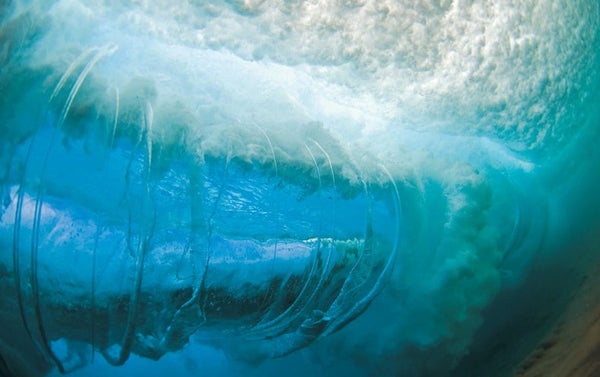
Imagine the perfect ocean wave: a wall of water swells and curls in on itself before breaking dramatically near the shore. Catching such a wave would be any surfer's dream—and the physics underneath its churning surface is just as mind-blowing as the ride.
As an ocean wave coils, it creates a hollow tube made of spinning water. If you could peek under the surface, you would see numerous small, thin twisters known as rib vortices looping around this primary vortex. Scientists have only recently begun to investigate why and how these beautiful, delicate secondary eddies form.
“Basically there's a separation that occurs,” says Christine Baker, a fluid mechanics researcher at the University of Washington. When a wave begins to break, tiny aerated regions along the leading edge cause a few streams to separate from the main vortex. These streams twist themselves into rib vortices as they pick up momentum.
On supporting science journalism
If you're enjoying this article, consider supporting our award-winning journalism by subscribing. By purchasing a subscription you are helping to ensure the future of impactful stories about the discoveries and ideas shaping our world today.
“We often make the analogy of a figure skater,” says Jim Thomson, an oceanographer at the University of Washington. Initially a wave's rib vortices are wide bands of water that twist slowly like figure skaters spinning with their arms outstretched. But as the wave travels forward, Thomson explains, its ribs corkscrew into thin filaments—an effect similar to when figure skaters tuck in their arms. “They rotate faster and faster,” he says. This rotation stretches the separation between the main vortex and its mini vortices as they loop and grow.
Baker's work uses a combination of computer calculations and physical experiments to investigate how these vortices sweep trash and pollution from the shore out into the ocean. Until the past decade or so few people in the scientific community paid much attention to rib vortices, partly because they are difficult to photograph, the researchers say—the ephemeral twists require a high-resolution camera and precise timing to capture. In addition, modern computer simulations are finally complex enough to model them. “We often don't study things or see things until we have the tools to do so,” Thomson says.