See How a Parasite Travels from Tiny Crustacean to Fish to Bird

A tiny bug manipulates the behavior of its hosts to ensure its unlikely life cycle

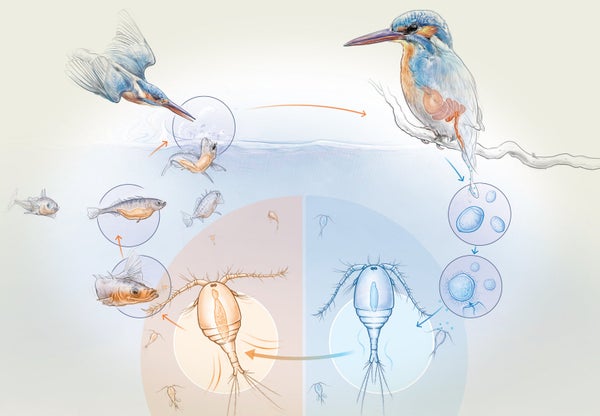
Detail of lifecycle drawing follows parasitic cestode Schistocephalus solidus through 3 hosts: a copepod, a fish and a bird.

Daisy Chung

Join Our Community of Science Lovers!

Parasites give new meaning to the cliché “eat or be eaten.” Often their life cycle can be completed only if they are ingested by a host—multiple times for some—making the odds of their survival seemingly minuscule. To improve their chances, certain parasites manipulate their hosts' behavior to make it more likely the eater will get eaten.

The parasitic cestode Schistocephalus solidus requires a much larger host—specifically, a three-spined stickleback fish—to grow in and then a bird to breed in. But the parasite's larvae, less than a millimeter long, are too small to be eaten by the fish.

Instead a larva must first be ingested by a copepod, a crustacean akin to a tiny shrimp. When ready for its next host, the larva makes the copepod twitch. If all goes well (for the parasite), a three-spined stickleback then eats the copepod. Inside the fish, the larva grows enormously, making the poor stickleback gasp at the water's surface, where it is likely to get snacked on by a bird. Inside the bird, the parasite matures and mates, sending its eggs back to the water through the bird's poop. And so the cycle begins again.


On supporting science journalism

If you're enjoying this article, consider supporting our award-winning journalism by subscribing. By purchasing a subscription you are helping to ensure the future of impactful stories about the discoveries and ideas shaping our world today.


Credit: Daisy Chung

Madhusree Mukerjee was a senior editor at Scientific American, where she covered psychology, anthropology, and diverse other topics. She has authored two nonfiction books: Churchills Secret War (Basic Books, 2010) and The Land of Naked People (Houghton-Mifflin, 2003). She has a Ph.D. in physics from the University of Chicago and received a Guggenheim fellowship to complete her first book. She has written numerous articles on Indigenous issues, development, and colonialism and is working on a third book.

More by Madhusree Mukerjee
Scientific American Magazine Vol 327 Issue 4This article was published with the title “An Improbable Life Cycle” in Scientific American Magazine Vol. 327 No. 4 (), p. 78
doi:10.1038/scientificamerican1022-78

It’s Time to Stand Up for Science

If you enjoyed this article, I’d like to ask for your support. Scientific American has served as an advocate for science and industry for 180 years, and right now may be the most critical moment in that two-century history.

I’ve been a Scientific American subscriber since I was 12 years old, and it helped shape the way I look at the world. SciAm always educates and delights me, and inspires a sense of awe for our vast, beautiful universe. I hope it does that for you, too.

If you subscribe to Scientific American, you help ensure that our coverage is centered on meaningful research and discovery; that we have the resources to report on the decisions that threaten labs across the U.S.; and that we support both budding and working scientists at a time when the value of science itself too often goes unrecognized.

In return, you get essential news, captivating podcasts, brilliant infographics, can't-miss newsletters, must-watch videos, challenging games, and the science world's best writing and reporting. You can even gift someone a subscription.

There has never been a more important time for us to stand up and show why science matters. I hope you’ll support us in that mission.

Thank you,

David M. Ewalt, Editor in Chief, Scientific American

Subscribe