See How Close We Are to Gender Equality around the World

U.N. statistics show progress toward the goal of gender equality but a long way left to go

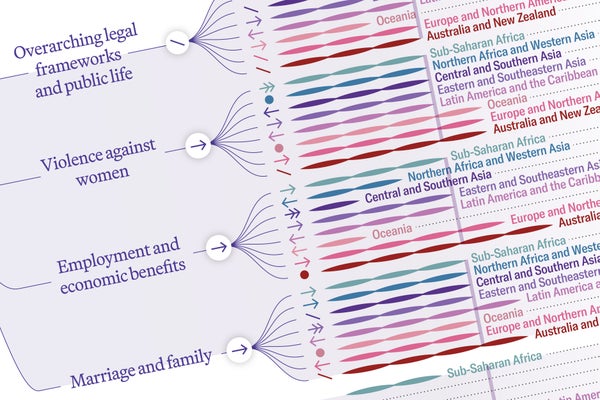
Detail of a chart shows levels and trends of Sustainable Development Goal 5.

Federica Fragapane

Join Our Community of Science Lovers!

Around the world, women and girls still face disproportionate discrimination, poverty and violence, as well as a lack of access to education, health care and property ownership, among other disadvantages. Every year the United Nations agencies U.N. Women and U.N. Department of Economic and Social Affairs track progress toward global gender equality—one of the U.N.’s 17 Sustainable Development Goals, which all U.N. member countries agreed to try to reach by 2030. The project gathers data from government questionnaires and household surveys and from other agencies such as the World Health Organization, the World Bank and the U.N. Children’s Fund (UNICEF).

The report highlights some important gains: child marriage is declining, women make up a slightly larger share of parliaments and local governments, and 56 legal reforms have been enacted to close the gender gap since 2019. “There’s been some progress to celebrate,” says Papa Seck, chief of U.N. Women’s research and data division. “But that progress has just not been enough to get us where we want to be by 2030. Much more can be done and should be done.” At the current pace of progress, gender parity in parliaments won’t be achieved until 2063, child marriage will persist until 2092, and it will take 137 years to end extreme poverty among women.

Goal 5


On supporting science journalism

If you're enjoying this article, consider supporting our award-winning journalism by subscribing. By purchasing a subscription you are helping to ensure the future of impactful stories about the discoveries and ideas shaping our world today.


Achieving gender equality, Goal 5, is one of the U.N.’s 17 Sustainable Development Goals. Others include ending poverty (Goal 1), ending hunger (Goal 2) and ensuring education for all (Goal 4). All of the goals are related, and many of their targets overlap—for instance, achieving gender equality involves ending women’s poverty and hunger and broadening their access to education. Goal 5 encompasses 9 targets and 14 indicators.

Chart shows levels and trends of Sustainable Development Goal 5—achieving gender equality—by region.

Federica Fragapane; Source: Progress on the Sustainable Development Goals: The Gender Snapshot 2024, Published by UN-Women and the United Nations Department of Economic and Social Affairs (data)

Clara Moskowitz is chief of reporters at Scientific American, where she covers astronomy, space, physics and mathematics. She has been at Scientific American for more than a decade; previously she worked at Space.com. Moskowitz has reported live from rocket launches, space shuttle liftoffs and landings, suborbital spaceflight training, mountaintop observatories, and more. She has a bachelor’s degree in astronomy and physics from Wesleyan University and a graduate degree in science communication from the University of California, Santa Cruz.

More by Clara Moskowitz

Federica Fragapane is an independent information designer who specializes in creating projects and data visualizations as a freelancer. Many of her projects take an experimental approach, carefully selecting visual languages to encourage readers to engage with the narratives conveyed by the data. In 2023 three of her projects were acquired by the Museum of Modern Art (MoMA) in New York City, becoming part of its Permanent Collection. Her work can be found at www.be.net/federicafragapane

More by Federica Fragapane
Scientific American Magazine Vol 331 Issue 5This article was published with the title “Progress toward Gender Equality” in Scientific American Magazine Vol. 331 No. 5 (), p. 86
doi:10.1038/scientificamerican122024-7kYGYuwNzezVBhxUgGvtmh

It’s Time to Stand Up for Science

If you enjoyed this article, I’d like to ask for your support. Scientific American has served as an advocate for science and industry for 180 years, and right now may be the most critical moment in that two-century history.

I’ve been a Scientific American subscriber since I was 12 years old, and it helped shape the way I look at the world. SciAm always educates and delights me, and inspires a sense of awe for our vast, beautiful universe. I hope it does that for you, too.

If you subscribe to Scientific American, you help ensure that our coverage is centered on meaningful research and discovery; that we have the resources to report on the decisions that threaten labs across the U.S.; and that we support both budding and working scientists at a time when the value of science itself too often goes unrecognized.

In return, you get essential news, captivating podcasts, brilliant infographics, can't-miss newsletters, must-watch videos, challenging games, and the science world's best writing and reporting. You can even gift someone a subscription.

There has never been a more important time for us to stand up and show why science matters. I hope you’ll support us in that mission.

Thank you,

David M. Ewalt, Editor in Chief, Scientific American

Subscribe