
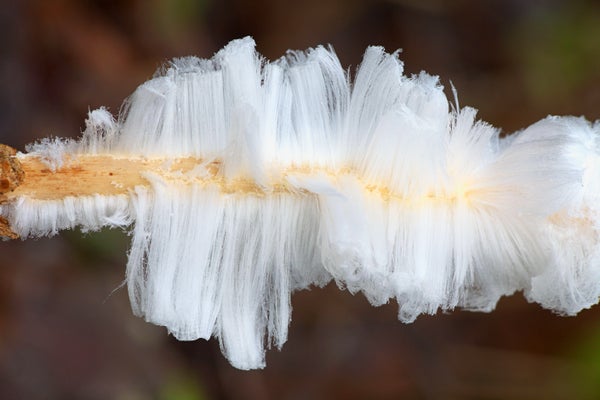
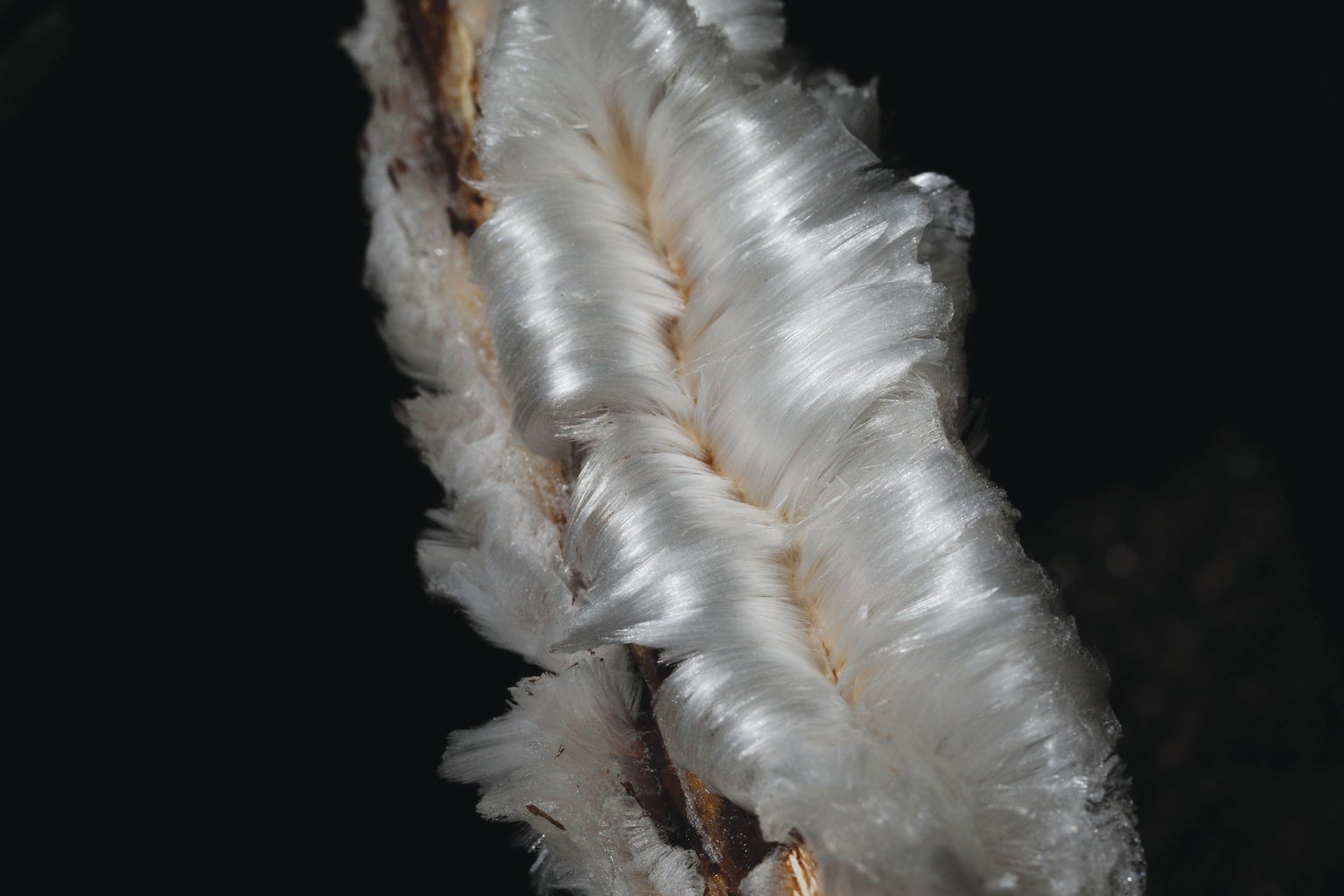
The “hair” sprouting off this branch resembles a downy feather duster or fluffy tuft of cotton—maybe even fragments of a bad white wig. But each strand is in fact made of hard, cold ice.
For these manes of silky-smooth ice crystals (aptly termed “hair ice”) to appear, a particular fungus called Exidiopsis effusa has to colonize rotting wood from a broadleaf tree, and temperatures must hover just below freezing in a sufficiently humid environment. Such a specific convergence of conditions might seem rare, but it happens often enough that scientists had been puzzling over this bizarre ice formation’s cause for more than a century— including Alfred Wegener, the scientist who proposed in 1912 that Earth’s continents were once a single mass—before researchers pinpointed the role of E. effusa in 2015.
Credit: Nancy Morrison Alamy Stock Photo
On supporting science journalism
If you're enjoying this article, consider supporting our award-winning journalism by subscribing. By purchasing a subscription you are helping to ensure the future of impactful stories about the discoveries and ideas shaping our world today.
By observing hair ice in the wild (and growing some in a home garden), investigators have learned a few things about its formation. Under the right temperature and humidity conditions, ice forms on a branch surface while water stays liquid inside the wood’s pores. The temperature difference between the two states of water creates a suction that draws liquid water to the freezing front—gradually extending the reach of the growing “hair.”
Studies suggest that as the fungus digests part of the wood, it provides fragments of larger molecules that serve as a scaffold on which the ice can grow. This process can churn out hairs stretching to a length of 20 centimeters (almost eight inches). Each strand can be as thin as 0.02 millimeter in diameter, and some curl or wave. They might last for days, even as temperatures fluctuate near the freezing point. Some researchers hypothesize that the thin crystals are able to endure such changing conditions because something within the plant material acts like an antifreeze, which can keep ice crystals from changing shape even as the temperature varies. When it gets cold outside every year, scientists continue to document this icy mystery.