
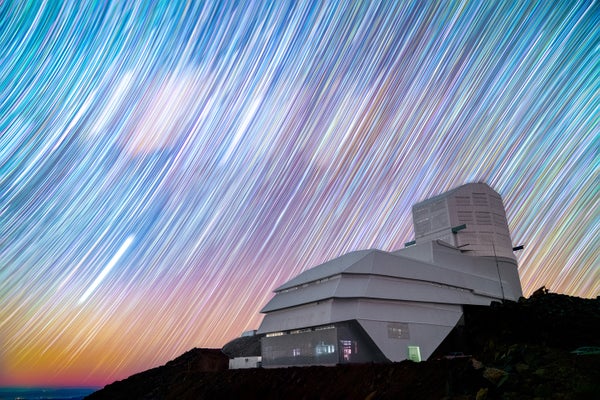
A brand-new, cutting-edge telescope called the Vera C. Rubin Observatory is about to release its first images to the world, and the public can watch in real time.
On June 23 the observatory will unveil a first look at ultrahigh-definition images and videos of the cosmos taken from a mountaintop in Chile. And you can participate by joining a public livestream (in English and Spanish) or one of the in-person watch parties at planetariums, universities and museums around the globe. These watch parties will include a stream of the live unveiling event, as well as three-dimensional virtual tours of the observatory and its surroundings on the peak of Cerro Pachón, a mountain in the Chilean Andes.
Space enthusiasts who can get to a watch party at a planetarium will be rewarded with immersive full-dome images of the horizon-to-horizon Southern Hemisphere night sky. U.S. planetariums throwing watch parties include the Adler Planetarium in Chicago, the CCNY Planetarium at the City College of New York, the Fogg Planetarium at the Challenger Learning Center of Tallahassee in Florida, the Eastern Michigan University Planetarium in Ypsilanti, the Fiske Planetarium in Boulder, Colo., and the Ritter Planetarium at the University of Toledo in Ohio, among others. A full list can be found at the Rubin Observatory Watch Party website.
On supporting science journalism
If you're enjoying this article, consider supporting our award-winning journalism by subscribing. By purchasing a subscription you are helping to ensure the future of impactful stories about the discoveries and ideas shaping our world today.
The Vera C. Rubin Observatory takes a full image of the southern sky every three nights using the 8.4-meter Simonyi Survey telescope, whose array of mirrors includes the largest convex mirror ever made. The view from the telescope is photographed with the Legacy Survey of Space and Time (LSST) camera, which is the largest digital camera ever made—about the size of a car. The sky images can be stitched together to show changes in the cosmos, such as the movements of comets through the solar system.
During the public events, you’ll also get to watch one of the observatory’s high-resolution time-lapse “movies” of the visible sky. It will be sky watching in high definition: the observatory is designed to show very detailed views of the universe in crisp detail over wide areas, so viewers will get a glimpse of distant galaxies, galaxy clusters and stars. One goal is to map the Milky Way and look for streams of stars that are the remnants of galaxies that were torn apart by their neighbors eons ago. These remnants can help scientists understand how the Milky Way formed. Another goal is to catalog the solar system’s asteroids and comets, as well as farther-flung transient phenomena such as supernovae. Finally astronomers want to use the Rubin Observatory to understand dark matter, which has mass but doesn’t release or reflect light. So while you won’t get a glimpse of this pervasive matter, astronomers can study it through its gravitational effects on visible matter, such as the galaxies and galaxy clusters that the LSST camera will photograph night after night.
Anyone can sign up to host a watch party at the Rubin Observatory website. Hosts will receive access to a virtual 3D model of the observatory and a virtual tour of Cerro Pachón. They’ll also have access to a planetarium-dome-sized feed of the livestream, as well as other planetarium content. Home viewers will be able to see the livestream and images at rubinobservatory.org.