
This article is part of a special report on the total solar eclipse that will be visible from parts of the U.S., Mexico and Canada on April 8, 2024.
On the afternoon of Monday, April 8, the moon will pass between Earth and the sun, its shadow sweeping across North America from west to east in a total solar eclipse. The sun and moon will appear to line up perfectly only along a narrow strip of land 100 miles (180 kilometers) wide. Everywhere else will experience a partial eclipse, in which the moon appears to take a bite out of the sun by covering part of its disk.
For those outside the path of totality, a partial eclipse is still a great consolation prize. The sight of our usually round sun instead appearing as an increasingly slim crescent is a special spectacle in its own right. (This partial eclipse view will also be visible to those along the path of totality during the hours before and after the full eclipse.) As the event progresses, sunlight will seem to weaken as more of the sun is obscured.
On supporting science journalism
If you're enjoying this article, consider supporting our award-winning journalism by subscribing. By purchasing a subscription you are helping to ensure the future of impactful stories about the discoveries and ideas shaping our world today.
To experience a partial solar eclipse, the first step is to find a clear sky. Then protect your eyes, either with eclipse glasses—sourced from somewhere reputable, please—or the darkest welder’s glass (above shade 12).
To see the sun’s crescent effect without looking right at it, try an indirect viewing method with an object made of mesh or pinholes, such as a colander. In most places, the partial eclipse will last several hours; check a specialized eclipse guide for details.
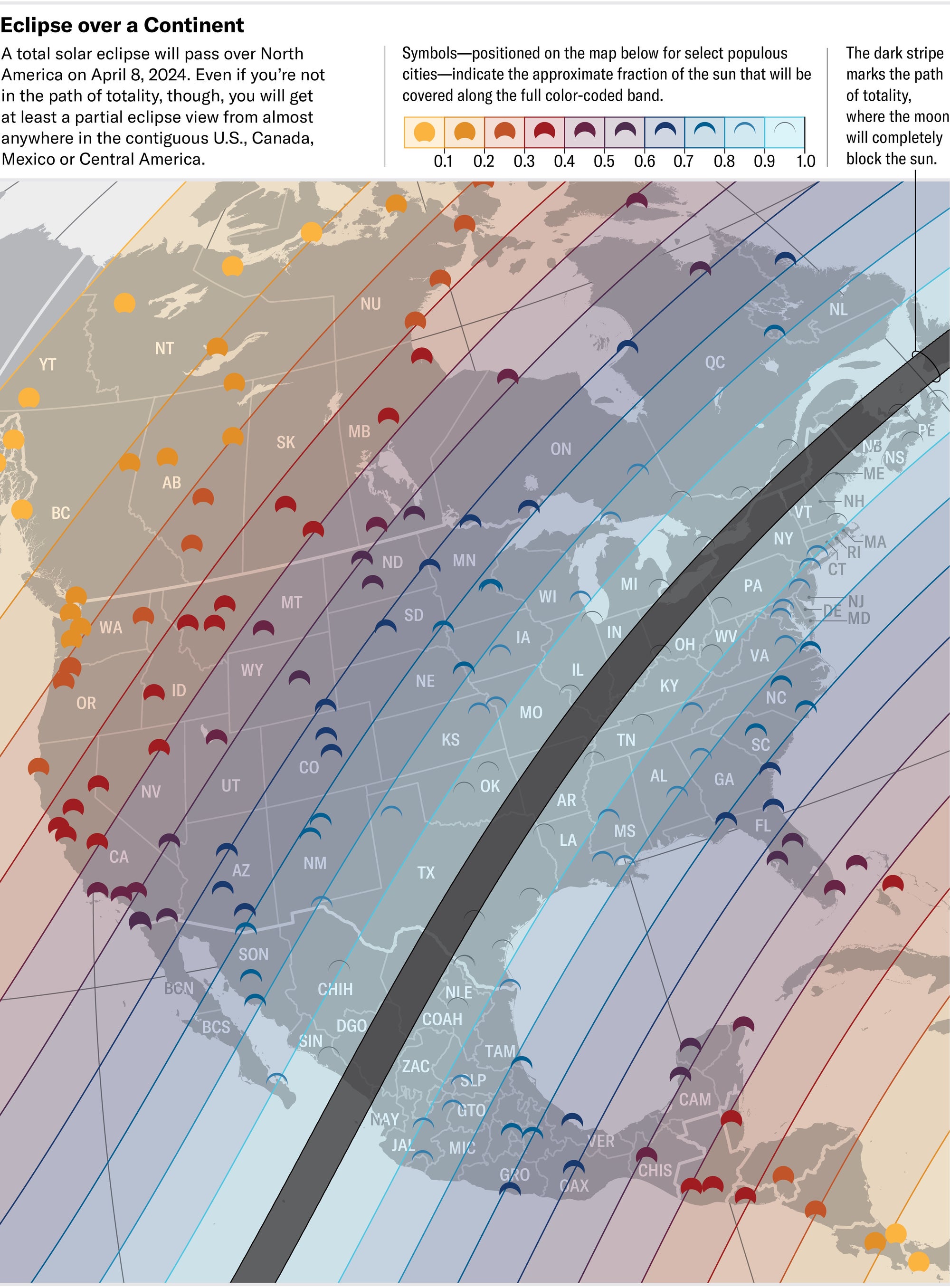
Credit: Katie Peek; Source: NASA (eclipse track data)