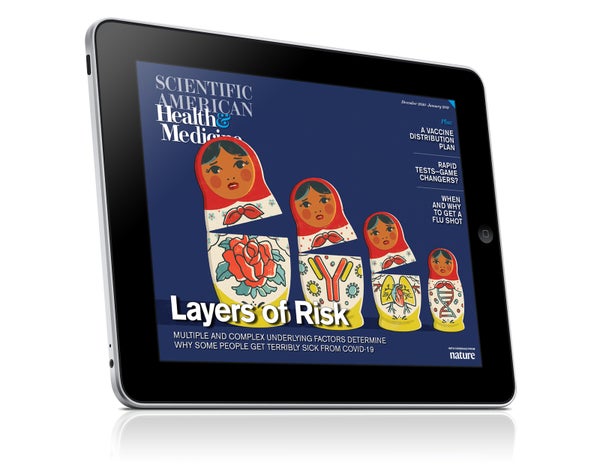
Scientific American Health & Medicine December 2020
Join Our Community of Science Lovers!
If we must find some good news about the global novel coronavirus pandemic, we perhaps could point to the improved survival rates recorded in the latest tallies—about 1.5 percent of diagnosed cases ending in death as of the beginning of November, compared with about 7 percent fatality during the spring’s devastating first wave. Researchers have also assembled a clearer picture of what preexisting conditions dispose an individual to higher risk of death from COVID-19, which helps identify society’s most virus-vulnerable populations.
In this edition’s cover story [“Why Some People Get Terribly Sick from COVID-19”], journalist Claudia Wallis profiles these conditions and creates the compelling takeaway image of Russian nesting dolls, in which vulnerability to death is a complex equation: underlying roots, such as specific genes, are confounded by social and economic factors. Such insights haven’t quite given humans an edge over this insidious virus, but we are slowly gaining ground. We hope you find many takeaways in this issue.
It’s Time to Stand Up for Science
If you enjoyed this article, I’d like to ask for your support. Scientific American has served as an advocate for science and industry for 180 years, and right now may be the most critical moment in that two-century history.
SciAm always educates and delights me, and inspires a sense of awe for our vast, beautiful universe. I hope it does that for you, too.
If you subscribe to Scientific American, you help ensure that our coverage is centered on meaningful research and discovery; that we have the resources to report on the decisions that threaten labs across the U.S.; and that we support both budding and working scientists at a time when the value of science itself too often goes unrecognized.