
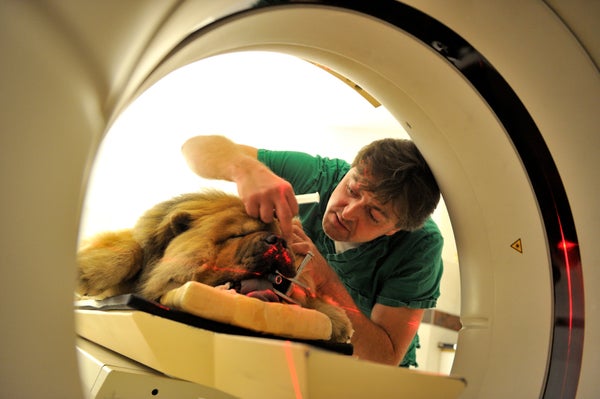
Little Jonah once radiated pain. The 12-year-old Maltese dog’s body was curled and stiff from the effort of walking with damaged knees. But after Kristi Lively, Jonah’s veterinary surgeon, enrolled him in a clinical trial of a therapeutic antibody to treat pain, his owner returned to the Village Veterinary Medical Center in Farragut, Tennessee, with tears in her eyes. Her tiny companion trotted easily alongside her. “I got my dog back,” she said.
Such cutting-edge treatments were once reserved for humans. But in recent years, the changing nature of pet ownership has sparked a boom in sophisticated therapies for animals—and many are now approaching the market. On June 9, the company that sponsored the antibody trial, Nexvet of Dublin, presented its results at the American College of Veterinary Internal Medicine Forum in Denver, Colorado. Other companies are working on bone-marrow transplants, sophisticated cell therapies and cancer vaccines.
“When I was a child and just wanted to be a veterinarian, certainly I didn’t imagine I’d be doing what I’m doing now,” says Heather Wilson-Robles, a veterinary oncologist at Texas A&M University in College Station, who is engineering canine immune cells to fight cancer.
On supporting science journalism
If you're enjoying this article, consider supporting our award-winning journalism by subscribing. By purchasing a subscription you are helping to ensure the future of impactful stories about the discoveries and ideas shaping our world today.
Cancer, arthritis and other diseases associated with old age are becoming more common as pets live longer, thanks in part to better treatment by their owners. “A generation ago, as beloved as Snoopy was, he lived in the backyard in the doghouse,” says Steven St. Peter, president of Aratana Therapeutics, a pet-therapy company in Leawood, Kansas. Now, pets are considered family members, often sharing beds with owners who are willing to pay hefty veterinary bills.
Many standard pet treatments are human drugs given at lower doses to account for animals’ smaller size. But antibodies and cell therapies generally cannot be used across species without provoking an unwanted immune response. And some human treatments simply will not work in pets: many common pain medications are toxic to cats.
Nexvet, which has raised more than US$80 million from investors since it was founded in 2011, takes antibodies that have been approved as human medicines and alters their structures to make them effective in cats or dogs. Moving from a drug lead to safety testing takes about 18 months, says chief executive Mark Heffernan, who estimates that Nexvet’s antibody therapies for pain will cost around $1,500 a year. The company is now looking into developing antibodies that block a protein called PD-1, thereby unleashing the immune system to fight cancer. This approach has shown tremendous promise for treating cancer in people.
Aratana is also developing antibody therapies for pets, and has applied for regulatory approval of a cancer vaccine that uses a bacterium to target malignant cells. The company hopes to move into cell therapies, and to develop a way to manufacture stem cells from fat for use against joint pain. St. Peter wants his company to be the first to win approval from the US Food and Drug Administration for a stem-cell therapy—ahead of firms developing such treatments for people.
Other forms of cell therapy could also result in new veterinary remedies. Last July, veterinary oncologist Colleen O’Connor founded a cancer-treatment company in Houston, Texas, called CAVU Biotherapies. To treat lymphoma, CAVU aims to isolate a sick dog’s immune cells, rejuvenate them in culture, and then infuse them back into the dog’s blood to stimulate an immune response. O’Connor used a similar approach in 2011 to treat Dakota, a bichon frise that belonged to then-US Senator Kent Conrad (Democrat, North Dakota). The dog, a Capitol Hill fixture known as the ‘101st senator’, entered remission but later died of cancer.
For many pet owners, cost is no object. Steven Suter, a veterinary oncologist at North Carolina State University in Raleigh, runs a bone-marrow transplant clinic for dogs that claims to cure 33% of lymphomas. Suter’s clinic was booked solid after it opened in 2008, despite offering treatment that can cost a dog owner up to $24,000. Still, Suter has worked to drive down the cost of care: to filter stem cells from blood, his clinic uses second-hand machines that were donated by a physician with a soft spot for schnauzers. Earlier this year, several major pet-insurance companies added bone-marrow transplants to the lists of procedures that they will pay for.
But when it comes to the latest pet treatments, some animals might be more equal than others. Cats are “physiologically finicky”, Suter says, noting that they may be too small to allow bone-marrow transplants using his usual machines. And O’Connor notes that cats’ immune systems also differ wildly from those of both humans and dogs—meaning that more basic research must be done before sophisticated immunotherapies can be deployed against feline ailments.
At Lively’s clinic, many dog and cat owners were grateful that their animals could participate in Nexvet’s clinical trial. But about a month after the trial ended, the effects of the antibody therapy began to fade. Jonah’s owner was among the clients who called Lively, desperate for a way to access the treatment again. “It’s tough,” Lively says. “They’ll have to wait until this product comes to market.”
This article is reproduced with permission and was first published on June 14, 2016.