
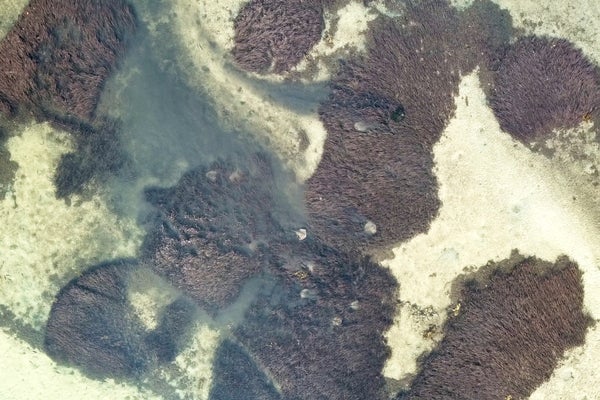
With their winglike fins undulating in slow motion, stingrays and other rays seem to fly gracefully through the water. But these elegant fins can also serve a startling, earthier purpose: rays use them to push an astonishing quantity of sand around the seafloor. In Australia’s Brisbane Water estuary, these fish shifted an amount of sand equivalent to the weight of two Eiffel Towers over the course of a year.
This finding, published in June in Remote Sensing in Ecology and Conservation, underscores rays’ importance in keeping key nutrients moving through seabed ecosystems, the researchers say.
Rays, of which stingrays are one subgroup, are a type of cartilaginous fish called batoids that inhabit both freshwater and marine habitats throughout the world. Many species eat mollusks, worms and other invertebrates that hide under the sand of the seafloor. To expose them, most rays hover over one spot, flap their winglike pectoral fins and spurt water from their mouth and gills to displace the sand directly beneath them until they find a meal. This process pockmarks the seafloor with huge numbers of “feeding pits,” craters about the size of the ray itself, and makes these fish structural engineers of their ecosystems.
On supporting science journalism
If you're enjoying this article, consider supporting our award-winning journalism by subscribing. By purchasing a subscription you are helping to ensure the future of impactful stories about the discoveries and ideas shaping our world today.

Drone imagery of an estuary stingray swimming over sand flats, surrounded by feeding pits.
Molly Grew
Populations of the estuary stingray (Hemitrygon fluviorum), which can grow to 130 centimeters (or about four feet) across and are found only in Australia, have been plummeting because of fishing, habitat degradation and climate change—and researchers are concerned that their loss could impact the entire Brisbane Water estuary. For one thing, these rays’ peculiar hunting technique helps cycle nutrients and oxygen that many other organisms need. Without the rays, “that sand can become anoxic, and nothing can live in it,” says team member Molly Grew, a Ph.D. student at the University of Newcastle in Australia and lead author of the new study. So she and her colleagues tried to measure how much sand these fish were actually moving.
Previously, researchers would have had to venture underwater and measure the area’s hundreds of underwater feeding pits by hand to calculate how much sand was displaced. But Grew and her colleagues found that they could use an aerial drone, three-dimensional computer modeling and aerial images of the estuary to do the math.
They discovered that over seven days the inhabitant rays created 1,090 feeding pits and moved nearly eight tons of sand—in a mere 2 percent of their feeding areas within the estuary. And that’s a conservative estimate because the team only measured pits that were visible from above. “This,” Grew emphasizes, “is not even scratching the surface of how much sand they actually move.” Based on this estimate, the researchers calculated that in the entire estuary, the rays displace more than 20,000 tons of sand per year.

Drone imagery of the study location, Pelican's Spot in the Brisbane Water estuary in Australia.
Molly Grew
Ray conservation biologist Kathryn Flowers, who was not involved in the research, cautions that “we shouldn’t jump to conclusions about the ecological importance of stingrays based solely on their high sediment turnover rates.” She notes that currents, tides, wind and other organisms also contribute significantly to sand displacement.*
Still, because little is known about these rays, scientists need more research like this to better understand what role rays play in their ecosystems, Flowers says. “Studies like this one,” she says, “offer the first clues to solving these mysteries.”
*Editor’s Note (7/23/24): This sentence was edited after posting to better clarify Kathryn Flowers’s comments on contributions to sand displacement.