
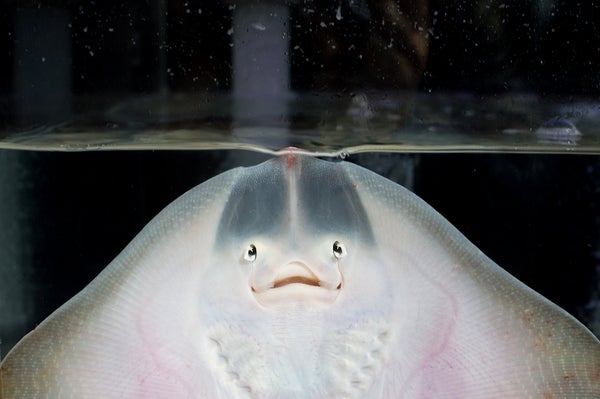
A stingray in a small aquarium in Hendersonville, N.C., has become pregnant—despite living in a tank without a male ray.
This seemingly miraculous event has stirred up online speculation that the expecting stingray, Charlotte, may have been impregnated by one of the small sharks that share her tank at the Aquarium & Shark Lab. But experts say that’s extraordinarily unlikely, on par with suggesting that a lion and a wolf could have baby “li-wolves” (“wolvions”?).
In fact, shark-ray babies would be even more dramatic than that, says Demian Chapman, director of the shark and ray conservation program at Mote Marine Laboratory & Aquarium in Florida. The last common ancestor of cats and dogs lived around 45 million years ago. Sharks and rays diverged from one another at least 300 million years ago, according to a 2021 paper in the journal Developmental Biology.
On supporting science journalism
If you're enjoying this article, consider supporting our award-winning journalism by subscribing. By purchasing a subscription you are helping to ensure the future of impactful stories about the discoveries and ideas shaping our world today.
There’s another explanation for Charlotte’s impending motherhood, though, and it’s not much less weird: she almost certainly impregnated herself, a phenomenon known as parthenogenesis.
“Quite a variety of species of shark and rays are known to reproduce like that in captivity,” says Chapman, who studied the first known case of parthenogenesis in a hammerhead shark, which occurred in 2001. “We even have evidence of one species of ray doing it in the wild.”
Charlotte, a round stingray (Urobatis halleri), has a noticeable baby bump (visible on both her underside and her back) and may give birth at any time, according to the Aquarium & Shark Lab, which is run by the nonprofit educational organization Team ECCO. The pregnancy was confirmed by ultrasound. Charlotte would be the first known round stingray to have undergone parthenogenesis, says Kady Lyons, a research scientist at the Georgia Aquarium. “It’s kind of cool that we have another documented case of this in a new species,” Lyons says.
Researchers don’t fully understand why parthenogenesis happens or what triggers it. Here’s how the process works: Inside the female’s body, cell division creates sex cells, or gametes. That division, called meiosis, results in the egg, which can eventually be fertilized by a sperm, and three extra cells called polar bodies. The egg and each polar body each contain half of the complement of genes needed to make a new organism. In parthenogenesis, a polar body fuses with the unfertilized egg, triggering it to form an embryo.
This is different than cloning, Lyons cautions, which would create an exact copy of the mother ray. In parthenogenesis, because both the egg and the polar body contain only portions of the mother’s genome, the babies end up less genetically diverse than their mother. Some parthenogenetic species get around this by doubling up their genes before they split their sex cells: whiptail lizards of the genus Aspidoscelis get along just fine reproducing in this way. But for many other species that only occasionally undergo parthenogenesis, offspring might not be as robust, Lyons says. “You can think of them as a highly inbred individual,” she adds.
Even typical round stingray reproduction is quirky. Female stingrays mate with multiple males in the spring and three to four months later give birth to litters with multiple different fathers, Lyons says. And they bathe their fetuses in a kind of nutritious uterine fluid, not unlike mammal milk, that gives them a survival boost when they emerge. At birth, the babies are less than three inches in diameter—about the diameter of a baseball—and are ready to fend for themselves.
“They’re super adorable,” Lyons says.