
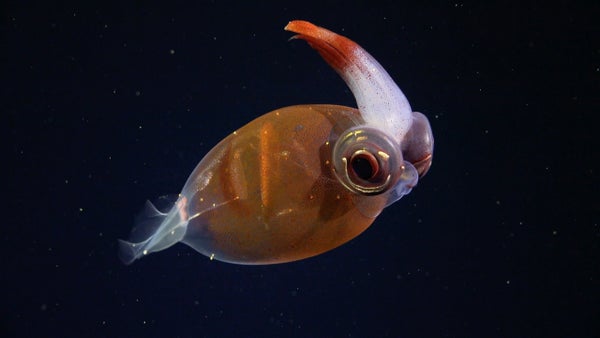
Two miles below the ocean’s surface, off the coast of Argentina, a gorge plunges nearly twice as deep as the Grand Canyon. The canyon and the nearby ocean floor are crawling with creatures that look like they belong in an alien carnival, including a see-through squid with a hornlike collection of arms, pale pink lobsters, a lumbering king crab carrying 100 hitchhiking barnacles and a ghostly squid that hovers somewhere between goofy and grotesque.
A translucent telescope octopus floats in the deep sea.
ROV SuBastian/Schmidt Ocean Institute (CC BY-NC)
This past July and August scientists onboard the Schmidt Ocean Institute’s research vessel Falkor (too) spotted the oddities through the eyes of an underwater robot as they explored the Mar del Plata Canyon. Over the course of three weeks, the team recorded many strange and startling sights, including more than 40 species that may be new to science.
On supporting science journalism
If you're enjoying this article, consider supporting our award-winning journalism by subscribing. By purchasing a subscription you are helping to ensure the future of impactful stories about the discoveries and ideas shaping our world today.
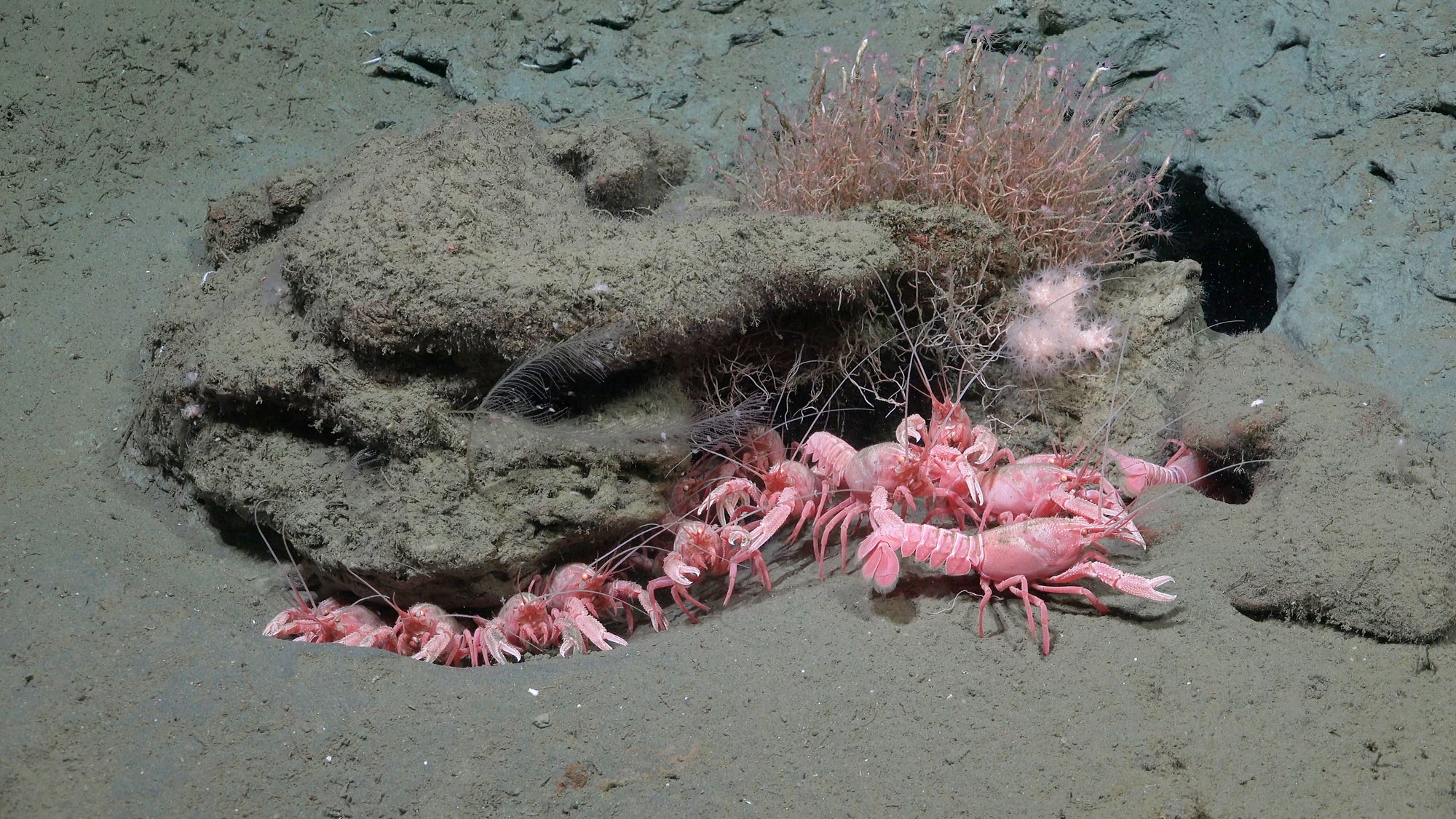
Patagonian lobsterette (Thymops birsteini) (unconfirmed) are crustaceans found on the continental shelf around South America, particularly in the Argentine Sea.
ROV SuBastian/Schmidt Ocean Institute (CC BY-NC)
“The deep sea is a place full of life, not only in terms of abundance but also in the variety of species,” says the expedition’s chief scientist Daniel Lauretta of the Argentine Museum of Natural Sciences. One of his favorite areas was a large stretch of seafloor he nicknamed the “Beet Field” because it was covered in spidery red octocorals. A fan favorite for the millions who livestreamed the dives was a cheeky sea star that looked like the SpongeBob SquarePants character Patrick Star.
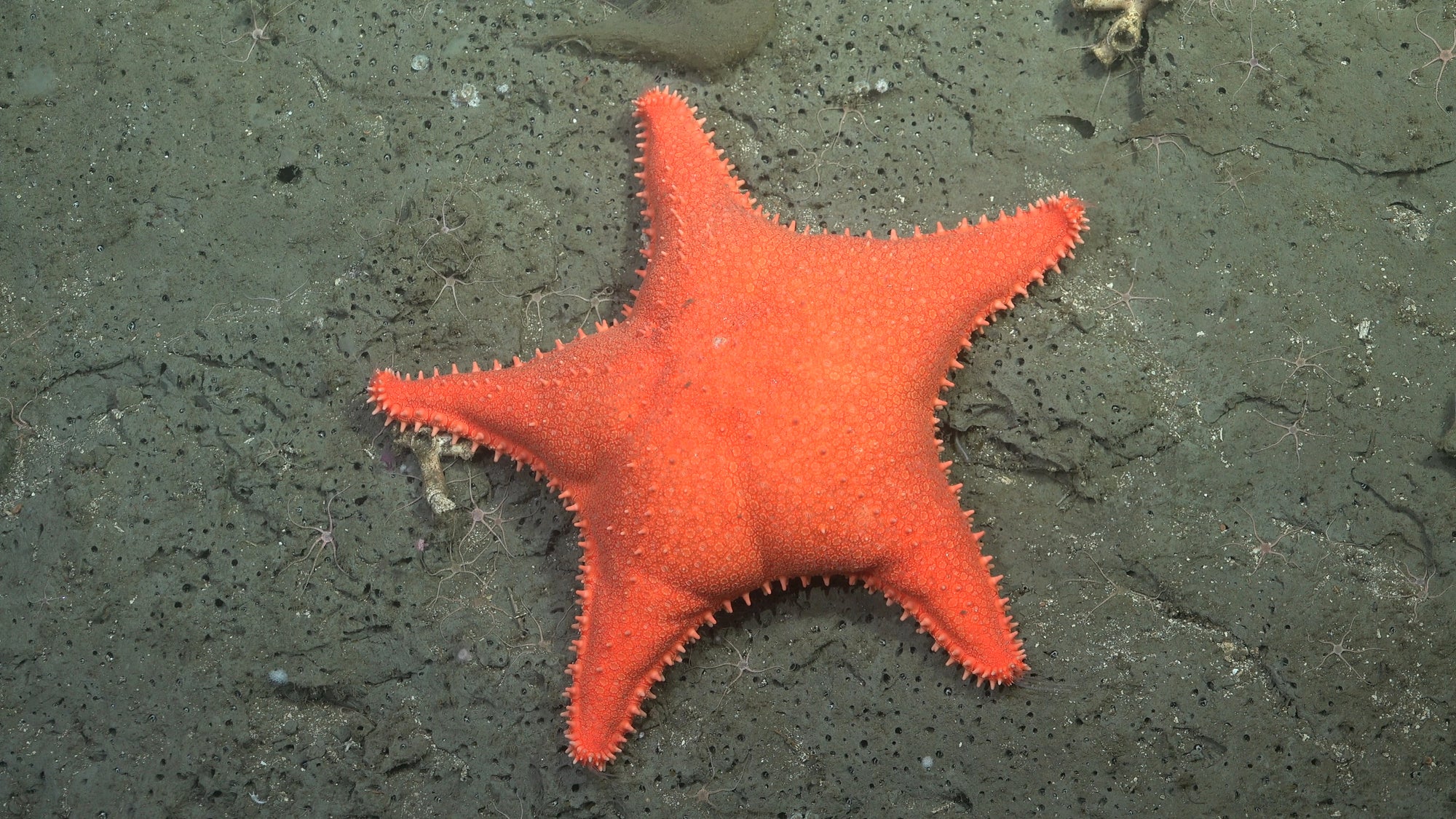
Many viewers thought this sea star resembled the SpongeBob SquarePants character Patrick Star.
ROV SuBastian/Schmidt Ocean Institute (CC BY-NC)
The researchers had visited the Mar del Plata Canyon in 2012 and 2013 but were then only equipped with trawls and fishing nets. They found hints of unique ecosystems and identified new species at that time. In revisiting the area with state-of-the-art technology, however, the scientists can develop a far more complete understanding of the region.
READ MORE: This Is the First Colossal Squid Filmed in the Deep Sea—And It’s a Baby!
The area, situated about 190 miles off Argentina’s northeastern coast, is shaped by two converging currents: one is salty and flowing down from the tropics, and the other is cold, full of nutrients and swelling up from Antarctica. Deep-sea canyons such as Mar del Plata act like funnels, channeling and concentrating the waters. “This confluence creates one of the most energetic oceanic regions in the world, fueling high productivity and supporting remarkable biodiversity,” says Jonathan Flores, a postdoctoral researcher at the National Scientific and Technical Research Council in Argentina. Flores was not part of the expedition but reviewed live-streamed footage of it as an independent expert.
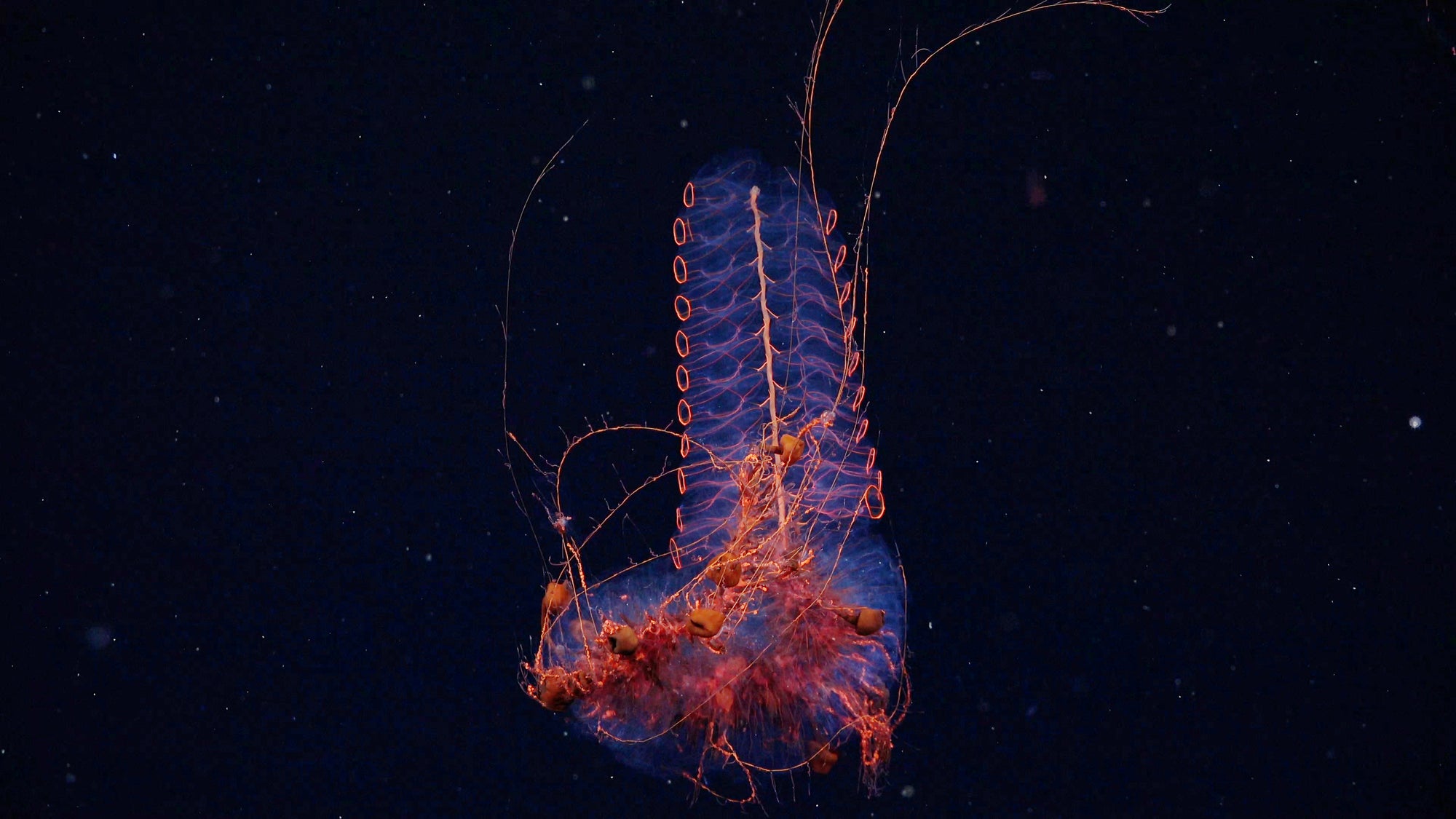
A siphonophore documented at 1,250 meters deep in the Mar del Plata Canyon.
ROV SuBastian/Schmidt Ocean Institute (CC BY-NC)
Some creatures found there might not exist anywhere else in the world. “Deep-sea canyons are biodiversity hotspots and play key roles in ecosystem functioning, yet we still know very little about them,” Flores says. “Continued exploration is essential to document species before they are lost—to understand how these ecosystems respond to environmental change and to inform conservation and management decisions.”
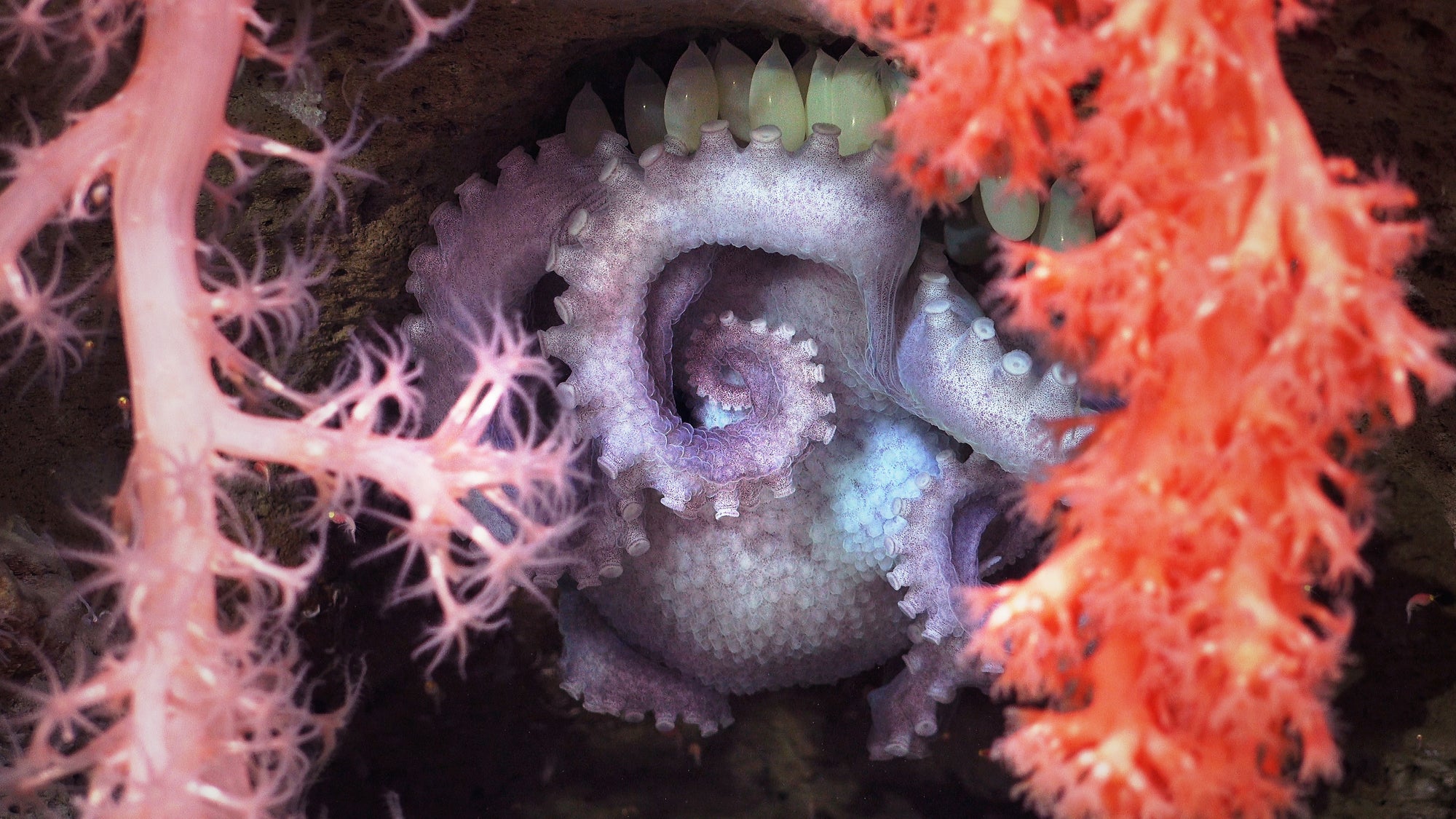
A brooding mother octopus shelters her eggs behind two different types of corals.
ROV SuBastian/Schmidt Ocean Institute (CC BY-NC)
The expedition set out to establish a baseline inventory of life inhabiting the canyon. When the robot descended, the scientists found a deep-sea Barbie Wonderland: A mother octopus clutched her eggs in a protective embrace as she sheltered behind pink and orange corals, blush-toned lobsters ambled across the seafloor in a tight pack, spiky scarlet crabs scuttled around, and a crimson comb jelly glittered with bioluminescence. Peachy corals of a potentially new species clung to the canyon wall.
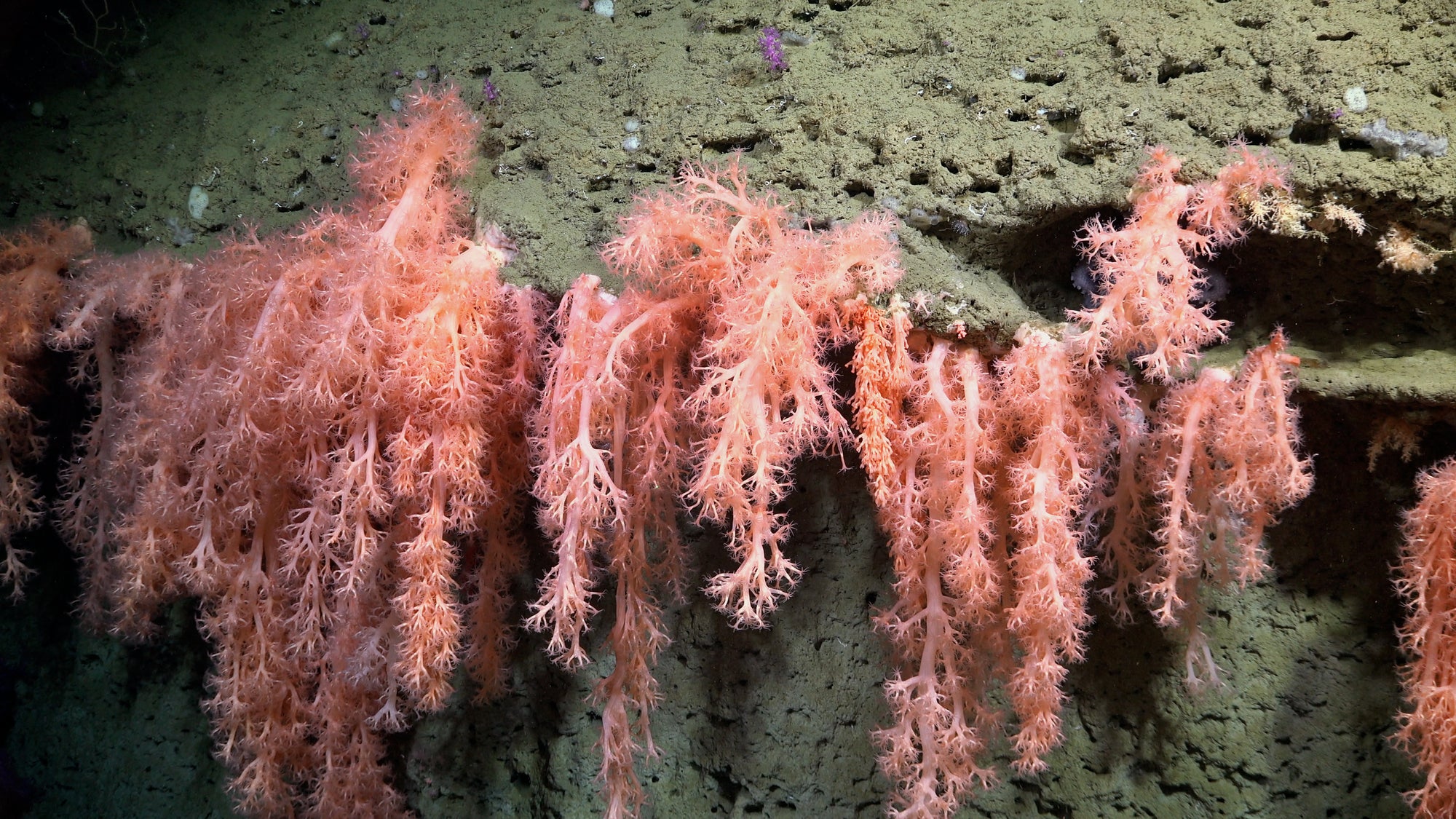
Hanging soft coral (octocoral) in the Mar del Plata submarine canyon in Argentina.
ROV SuBastian/Schmidt Ocean Institute (CC BY-NC)
Though bright in the robot’s spotlight, these creatures are actually clad in stealthy camouflage. Red light doesn’t travel far in the deep sea, which means reddish animals can more easily avoid predators.
A helmet jellyfish undulates in Mar Del Plata Submarine Canyon.
ROV SuBastian/Schmidt Ocean Institute (CC BY-NC)
Scientists scooped up several of the organisms to study in laboratories on land and verify whether they’re new species.
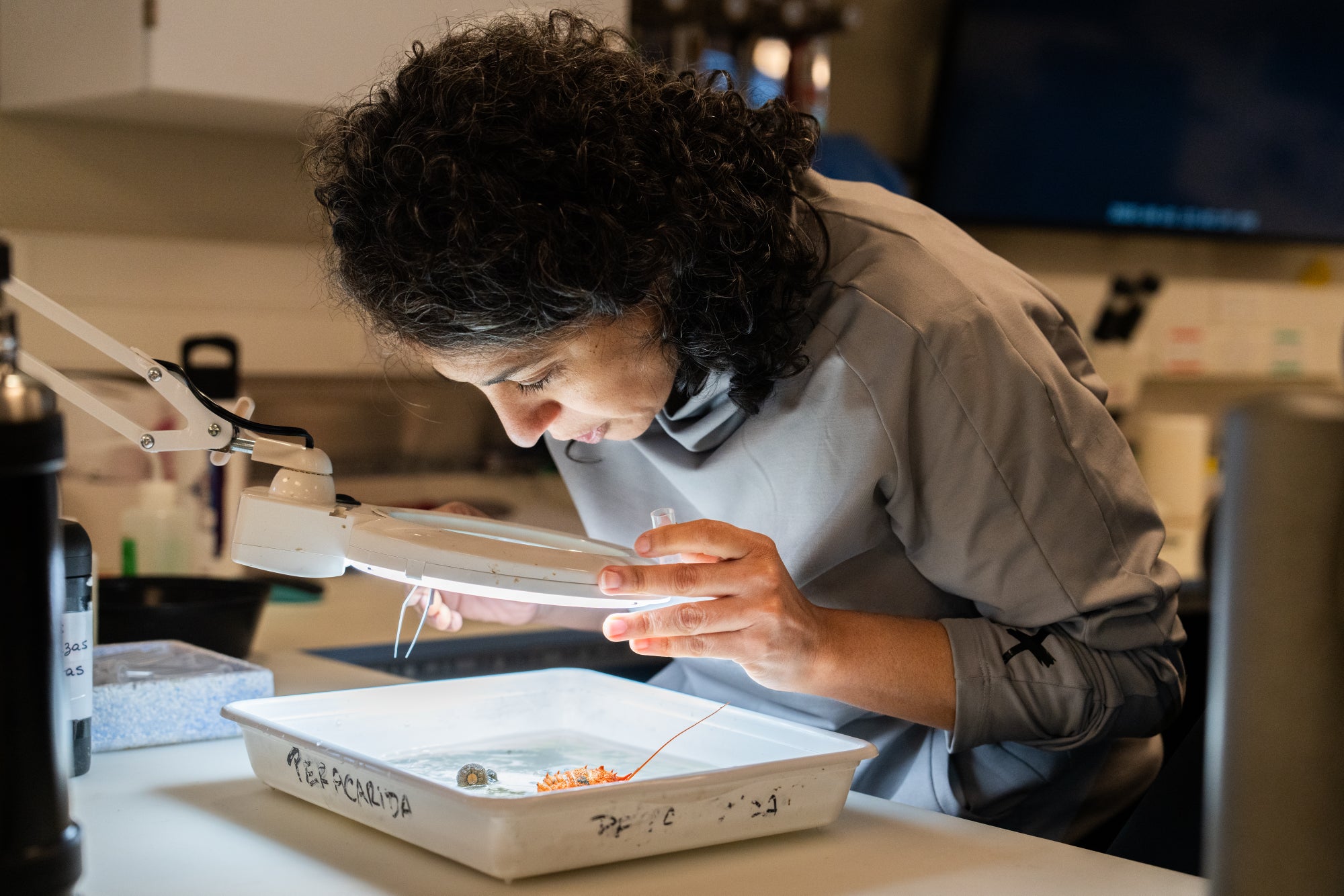
Brenda Doti, an associate researcher at Argentina’s National Scientific and Technical Research Council, works with a specimen of a crustacean in the main lab of research vessel Falkor (too). The science team documented rich biodiversity, including deep-sea coral reef environments filled with sea anemones, sea cucumbers, sea urchins, snails, and other life-forms.
Misha Vallejo Prut/Schmidt Ocean Institute (CC BY-NC)
“One way to confirm is by bar coding—sequencing a piece of mitochondrial DNA,” says U.S. National Oceanic and Atmospheric Administration research zoologist Mike Vecchione, who was not involved in the expedition. Vecchione has cataloged many new species over the course of several decades. “But for some deep-sea organisms, this can take years,” he says. “Some species are so poorly known that their mitochondrial DNA has not been sequenced, although the species have been described.”
READ MORE: Stunning Antarctic Sea Creatures Discovered after Iceberg Breaks Away
Such painstaking work is par for the course in deep-sea biology, where entire ecosystems remain unexplored. “Discovering multiple candidate new species in such a short exploration window is not unusual in deep-sea research,” Flores says, “precisely because these ecosystems remain so poorly sampled.”
A version of this article entitled “Canyon Wonderland” was adapted for inclusion in the November 2025 issue of Scientific American. This text reflects that version, with the addition of some material that was abridged for print.