
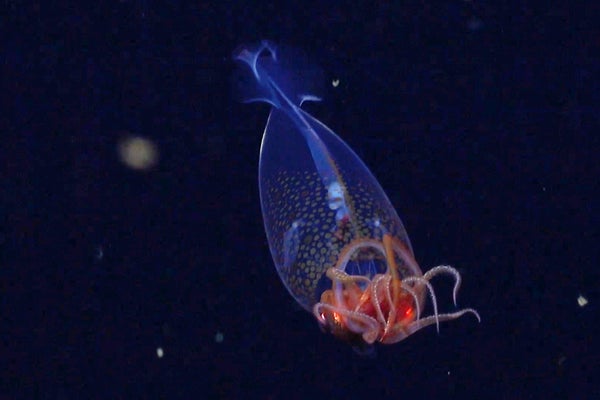
A faintly fluttering specter, at first hardly visible among bits of marine snow falling in slow motion, emerged from the deep-sapphire void. The pilot of the underwater robot brought the creature to the center of the frame, giving scientists on a ship at the ocean’s surface a good view of the strange life-form. Its mostly transparent, speckled dome was topped with fins that busily flapped like tiny wings, and its tentacles were drawn up underneath it, toward its glowing red undercarriage.
There was little fanfare—just a few minutes of quiet, almost reverent observation. But the encounter, 100 years in the making, marked the first time a colossal squid (Mesonychoteuthis hamiltoni) had ever been caught on film in its natural habitat.
“This is one of the planet’s true giants, living in one of our most pristine marine ecosystems,” says Kat Bolstad, an associate professor at the Auckland University of Technology in New Zealand, who helped independently identify the creature from the footage. “It’s a source of fascination and wonder, and it also plays a huge role in Antarctic food webs.”
On supporting science journalism
If you're enjoying this article, consider supporting our award-winning journalism by subscribing. By purchasing a subscription you are helping to ensure the future of impactful stories about the discoveries and ideas shaping our world today.
Scientists onboard the Schmidt Ocean Institute’s research vessel Falkor (too) saw the colossal squid about 2,000 feet beneath the surface near the remote, uninhabited South Sandwich Islands in the South Atlantic Ocean. These leviathans can grow to about 23 feet long and can weigh more than 1,000 pounds—shorter, but much stockier, than the giant squid (Architeuthis dux), which grows to about 43 feet long and 600 pounds. The colossal squid that was captured on film was just a baby, however, measuring only about a foot in length.
“We filmed it because it was beautiful and unusual, and then we kind of descended back all the way down to the seafloor to do the exploration that the rest of that dive was focused on,” the expedition’s chief scientist, Michelle Taylor of the University of Essex in England, said during a press conference. It wasn’t until a few days later, after the team heard from some glass squid experts, that the researchers fully realized the observation’s significance.
Though people have known about the existence of colossal squids for a century, the animals had mainly been found among the stomach contents of whales and seabirds, successfully evading human eyes in their natural habitat.
“Much of our scientific and filming gear is noisy and bright, so squid will be aware of our equipment long before we know they’re there—and they will stay well away,” Bolstad says. “The deep sea is a vast 3D space, and looking for specific animals there is tricky, especially when they are probably actively trying to avoid us!” Scientists still don’t know much about what these reticent creatures feed on, how long they live or what their reproductive traits are.
“To get footage of a juvenile is so wonderful,” said Aaron Evans, an independent glass squid expert, at the press conference. Scientists know colossal squid are born tiny, and some adult specimens are preserved in collections, but their time between those stages isn’t well understood. “So for us to see this kind of midrange size, in between a hatchling and an adult, is really exciting because it gives us the opportunity to fill in some of those missing puzzle pieces to the life history of this very mysterious and enigmatic animal.”
The sighting came alongside many other strange encounters, including a grenadier fish with parasitic pigtails, a piñatalike anemone, a carnivorous sponge that resembled a dandelion and Seussian corals. In a region so remote and underexplored, it’s no surprise that weird and wonderful discoveries emerge—and each new find offers valuable insight into a world that science is still just beginning to understand.
“Observing the colossal squid gives us the chance both to learn about this remote place,” Bolstad says, “and to share the excitement of such discoveries with people who may not think about the deep sea very often—even though it makes up 95 percent of the living space on Earth and plays an enormous role in regulating our climate.”
And hopefully one day the researchers will catch sight of a grown colossal squid. “Eventually, when we see the adults, we will get footage of very large ones,” Bolstad said at the press conference. “They will have impressive hooks; they’ll be big and muscly. There will be lots of monster hype about them. But in this case, we get to introduce the live colossal squid to the world as this beautiful, little, delicate animal that highlights the magnificence of a lot of deep-sea creatures.”