
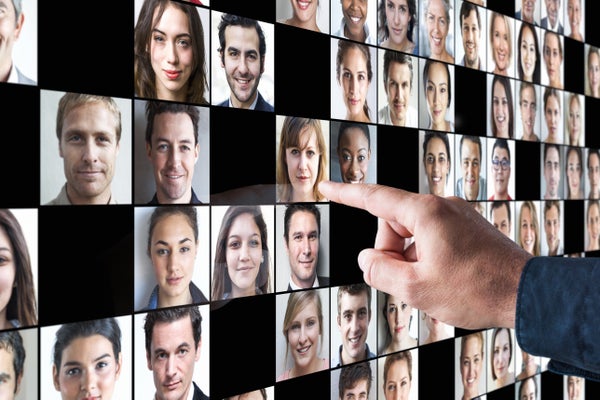
Some people are truly exceptional at recognizing faces. Once they have seen a person, they can often remember the individual’s face decades later. Even if the person spotted was a youngster at the time and has meanwhile become a grown woman, or a man with a full beard, they can still make the ID.
Psychologists from Australia’s University of New South Wales (UNSW) have been looking for these “super-recognizers” for years, using a specially designed online test.
On a typical face-recognition test, a super-recognizer will score 100 percent. But the UNSW group went a step further and created a particularly difficult test on which most test-takers will score between 50 and 60 percent but a super-recognizer will reach 70 percent. The highest score ever was 97 percent, and no one has ever achieved a perfect score, the researchers reported in PLOS One. They estimate that they have identified about 2,000 super-recognizers among the 50,000 people who have taken the online test since 2017.
On supporting science journalism
If you're enjoying this article, consider supporting our award-winning journalism by subscribing. By purchasing a subscription you are helping to ensure the future of impactful stories about the discoveries and ideas shaping our world today.
“What we have learned from analyzing this test is that while all super-recognizers are exceptional at face recognition, some are better than others,” says James Dunn, a psychologist at UNSW and lead author of the study. “We hope that with more people completing the test we can find the ‘Einstein of face recognition,’ that special extraordinary individual who is the best of the best.”
Other researchers in face recognition have also weighed in. “This is an excellent advance in the field of super-recognition research, and it provides a powerful new tool for the identification of individuals with superior face identification ability,” says David Robertson, a lecturer in psychology at the school of psychological sciences and health, University of Strathclyde, Glasgow, who was not involved in the study.
“I have no doubt that this test will be very useful in identifying people with extraordinary face perception abilities, which will prove useful not just for our understanding of human face recognition ability, but also for appointing people to face-specific roles within various professions (jobs that require identifying people),” says Kay Ritchie, a senior lecturer in cognitive psychology at the University of Lincoln in Lincoln, England, who also was not involved in the study.
In the study, Dunn and colleagues describe people who have taken the UNSW test and who had an inkling that they were better than others at facial recognition. The online test, which takes about 20 minutes to complete, then revealed whether that talent was really exceptional. For instance, one woman named Jessica knew she was better at recognizing faces than her husband. But it was only when the UNSW team contacted her that she found out how much better.“Then a lot of things suddenly made sense in my life,” she told the researchers.
Super-recognizers often learn to conceal their ability, the scientists write. A woman named Sallie told the team she has to pretend she has never seen a person she remembers well, for fear of giving the impression that she is a stalker.
The researchers hope to recruit super-recognizers to examine, among other things, how the brain processes faces. To do this, high-level test performers may be invited to the lab to undergo further testing to confirm that their results are really well above average.
These exceptional individuals appear to have an innate ability that cannot be achieved through training. An ascertained super-recognizer may be in demand from a range of institutions that have an interest in reidentifying people—from police to intelligence agencies to casinos.