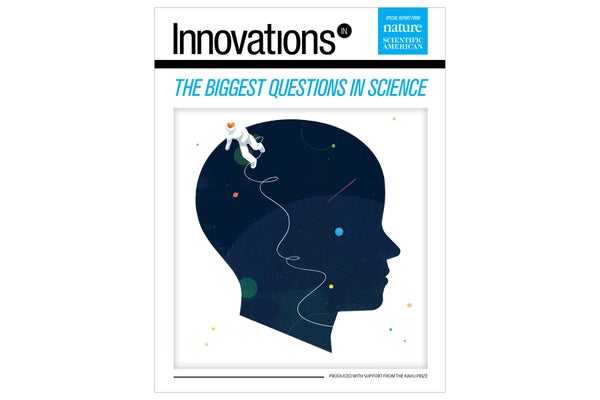
The Biggest Questions in Science

An editorially independent special report on research into fundamental scientific mysteries, produced with support from The Kavli Prize

Chris Gash

Join Our Community of Science Lovers!

“We are all in the gutter, but some of us are looking at the stars,” Oscar Wilde wrote. Ever since an early human sat by the glowing embers of a fire on a winter night, as others fell asleep and the camp quietened, we have pondered the mysteries of existence. What are those points of light studding the sky? What are these movements within my belly? Where did this life come from? What is life? How do I protect this being from all harm?

Such questions have occupied not only ordinary humans through the ages but also philosophers and, later, scientists. In recent centuries we have learned so much—and such marvelous things—about the worlds around and within us that it may sometimes seem that no nook is left unexplored, no miracles left for us to unravel. The truth is, though, that every new discovery leads us to ever deeper questions. We know what the stars are, but their motion defies explanation. We can look into the farthest crannies of the universe, but the more we see, the more we suspect that we may never, truly, understand it all. We have a good idea of how the body works, but the mind remains elusive. We know what life is but not where that first spark came from. We can observe unimaginably minute objects, but the more we try to control them, the more they seem to evade our grasp.

This special report on “The Biggest Questions in Science,” which is being published in both Scientific American and Nature, is sponsored by the Kavli Prize. It was produced independently by Scientific American and Nature editors, who have sole responsibility for all the editorial content. Beyond the choice to sponsor this particular topic, the Kavli Prize had no input about the content of the articles in this package.


On supporting science journalism

If you're enjoying this article, consider supporting our award-winning journalism by subscribing. By purchasing a subscription you are helping to ensure the future of impactful stories about the discoveries and ideas shaping our world today.


Table of Contents

What Is Spacetime?
by George Musser

What Is Dark Matter?
by Lisa Randall

What Is Consciousness?
by Christof Koch

How Did Life Begin?
by Jack Szostak

What Are the Limits of Manipulating Nature?
by Neil Savage

How Much Can We Know?
by Marcelo Gleiser
 

Madhusree Mukerjee was a senior editor at Scientific American, where she covered psychology, anthropology, and diverse other topics. She has authored two nonfiction books: Churchills Secret War (Basic Books, 2010) and The Land of Naked People (Houghton-Mifflin, 2003). She has a Ph.D. in physics from the University of Chicago and received a Guggenheim fellowship to complete her first book. She has written numerous articles on Indigenous issues, development, and colonialism and is working on a third book.

More by Madhusree Mukerjee
Scientific American Magazine Vol 318 Issue 6This article was published with the title “Looking at the Stars” in Scientific American Magazine Vol. 318 No. 6 (), p. 54
doi:10.1038/scientificamerican0618-54

It’s Time to Stand Up for Science

If you enjoyed this article, I’d like to ask for your support. Scientific American has served as an advocate for science and industry for 180 years, and right now may be the most critical moment in that two-century history.

I’ve been a Scientific American subscriber since I was 12 years old, and it helped shape the way I look at the world. SciAm always educates and delights me, and inspires a sense of awe for our vast, beautiful universe. I hope it does that for you, too.

If you subscribe to Scientific American, you help ensure that our coverage is centered on meaningful research and discovery; that we have the resources to report on the decisions that threaten labs across the U.S.; and that we support both budding and working scientists at a time when the value of science itself too often goes unrecognized.

In return, you get essential news, captivating podcasts, brilliant infographics, can't-miss newsletters, must-watch videos, challenging games, and the science world's best writing and reporting. You can even gift someone a subscription.

There has never been a more important time for us to stand up and show why science matters. I hope you’ll support us in that mission.

Thank you,

David M. Ewalt, Editor in Chief, Scientific American

Subscribe