
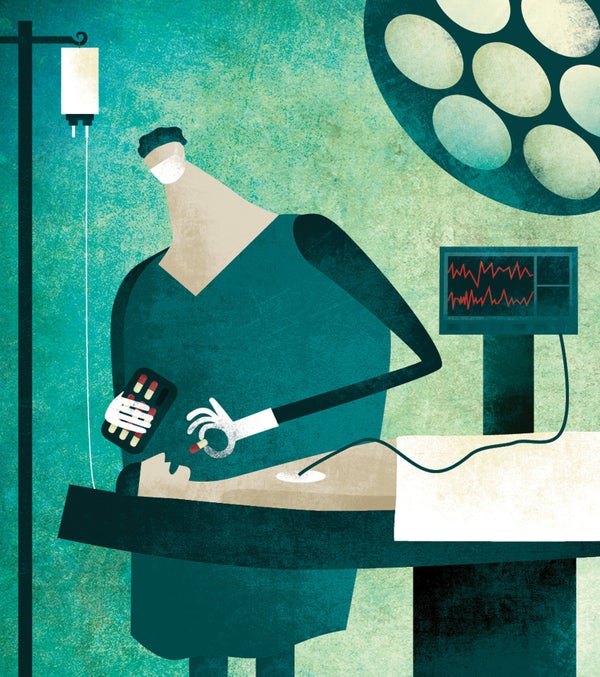
Modern heart surgery is miraculous. To think a failing aortic valve can be replaced via catheter without even cutting open the chest is to appreciate one of the wonders of 21st-century medicine. But as two recent landmark studies suggest, we may be a bit too avid for cardiac procedures. When it comes to treating some common heart conditions, medication can often get the job done.
That was the lesson of the much anticipated ISCHEMIA trial, the results of which were revealed at last November's meeting of the American Heart Association. The study involved 5,179 people with moderate to severe ischemia—insufficient blood flow to the heart—caused by narrowing of the coronary arteries. All participants in ISCHEMIA (International Study of Comparative Health Effectiveness with Medical and Invasive Approaches) got medication optimized for their needs: statins and sometimes additional cholesterol-reducing drugs; aspirin or other blood thinners; plus drugs to lower their blood pressure and heart rate where helpful. Subjects were educated on diet, exercise and relaxation techniques. But half the participants were randomly selected to also be treated with either stents—devices that prop open narrowed vessels—or, if stenting was not possible, with bypass surgery.
Although both procedures are routinely used to treat blocked vessels, researchers found that over a three-year period they offered no advantage over drug therapy alone in reducing the rate of heart attacks, hospitalization for heart failure or chest pain, or cardiac death. Past studies had come to similar conclusions, but this trial was larger and better designed, involving patients with more severe cardiovascular disease—the very patients thought to benefit from an invasive approach. Still, it makes sense that medication works so well: “When you have coronary narrowing, it's not just where you see it; it's all throughout the arteries,” explains study chair Judith Hochman, senior associate dean of clinical sciences at NYU Langone Health. “Medical therapy addresses all of them where stenting addresses only the focal ones.”
On supporting science journalism
If you're enjoying this article, consider supporting our award-winning journalism by subscribing. By purchasing a subscription you are helping to ensure the future of impactful stories about the discoveries and ideas shaping our world today.
Where the procedures did outshine drugs was in reducing chest pain, or angina. One out of five patients who had daily or weekly chest pain became angina-free within one year with drug therapy, but that rose to one out of two with the invasive strategy. That finding suggests that people prone to angina might want to opt for a procedure. It's important to note that stents and bypass remain vital therapies for people suffering from heart attacks or unstable angina and those with narrowing of the left main coronary artery—all higher-risk groups not included in this trial.
Another study comparing heart medication with a more invasive treatment yielded similar results. Published last March, the CABANA trial looked at two approaches to atrial fibrillation—bouts of rapid, irregular heartbeats that afflict about 2 percent of adults younger than 65 and 9 percent of seniors in the U.S. The 2,204 patients in the study were randomly assigned to be treated with just medication or with catheter ablation, a procedure in which heat or cold was used to isolate or destroy heart tissue causing the abnormal rhythm. In this study, too, there was no difference between the two groups in mortality or in rates of disabling stroke, serious bleeding or cardiac arrest. Again, there was a difference in terms of symptoms: ablation patients were less likely to have recurrent attacks of A-fib and reported a better quality of life. By some measures ablation also outperformed drugs for patients younger than 65, minorities, and people with heart failure, says cardiologist Douglas Packer of the Mayo Clinic, who led the trial.
The studies should help put more decision-making power into the hands of patients. Rather than being rushed to the “cath lab” for a procedure on pain of death, people can take time to weigh their options. “I think the two studies are, in some senses, are twins,” says Stephen Wiviott, a cardiovascular medicine specialist at Brigham and Women's Hospital, who was not involved in either trial. “They are fairly patient-empowering.”
The studies' impact will be fascinating to see. At least 500,000 cardiac stent procedures are done annually in the U.S., many on an emergency basis. If doctors simply stopped doing them electively in the least symptomatic patients—those without angina—the U.S. could eliminate about 22,800 procedures a year, saving about $570 million, Hochman says. Ablations may also decline for people with few A-fib symptoms, but Packer says the quality-of-life argument for many patients is strong: “CABANA can't support the notion that people will live longer because of an ablation. It supports the notion that they will live better.”