
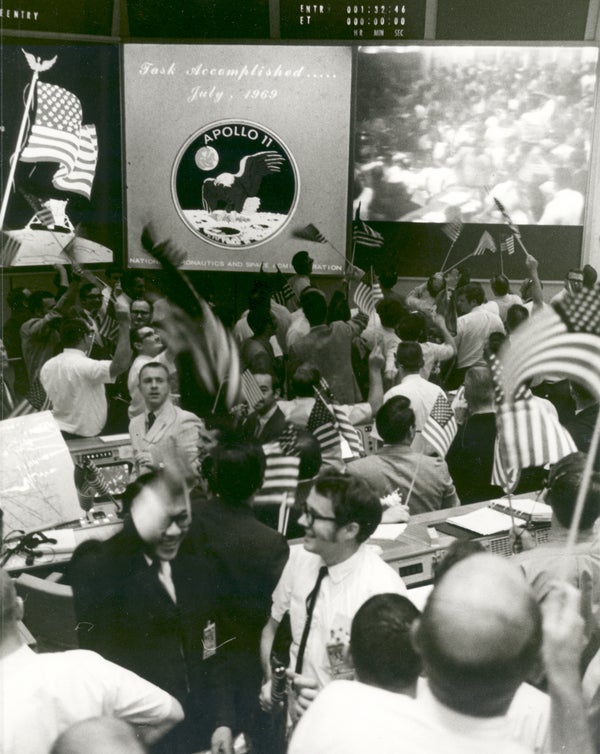
At 4:18 p.m. on July 20, 1969, Neil Armstrong's voice crackled from the speakers at NASA's Mission Control in Houston. He said simply, "the Eagle has landed."
With those words, the dream President John F. Kennedy's voiced in 1961--putting humans on the Moon by the end of the decade--had at last come true.
From the launch on July 16 atop a powerful Saturn rocket, Apollo 11 and its crew of three astronauts performed flawlessly. While Michael Collins orbited the Moon in the Command Module, Armstrong piloted the Lunar Lander, named the Eagle, to a safe landing in the Moon's Sea of Tranquility. He and his copilot, Edwin "Buzz" Aldrin, soon became the first humans to tread on another world. They spent nearly 21 hours on the lunar surface, collecting samples of rock and soil and setting up remote instruments.
On supporting science journalism
If you're enjoying this article, consider supporting our award-winning journalism by subscribing. By purchasing a subscription you are helping to ensure the future of impactful stories about the discoveries and ideas shaping our world today.
The return trip proved to be every bit as smooth. After taking off from the Moon and docking with the craft piloted by Collins, the astronauts soared back to Earth, splashing down in the Pacific Ocean on July 24. Their pinpoint landing put them just a few miles from the recovery ship, the U.S.S. Hornet. Overall, the mission lasted 195 hours, 18 minutes and 35 seconds--and covered 952,700 nautical miles.
Over the years, several astronauts followed in Collins, Armstrong and Aldrin's footsteps, but none won the same acclaim. And with the flight of Apollo 17 in 1972, the U.S. put aside its plans for a permanent base on the Moon, deciding to rely instead on unmanned spacraft and the fleet of space shuttles for the future. Apollo was officially retired.
That said, this celebration has an edge of sadness: the first to the Moon were close to being the last. But for many--including those who were born well after the Eagle landed--the excitement lives on.