
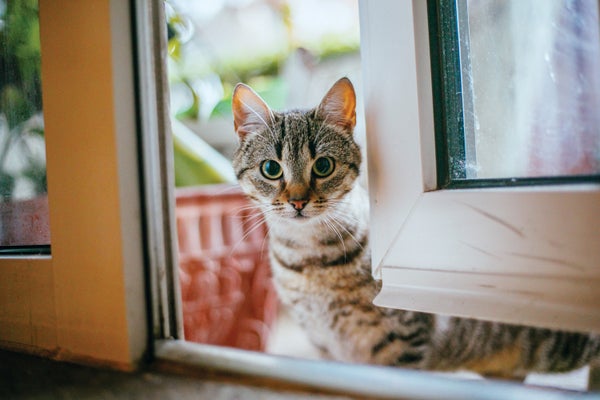
Cats have taken quite a journey from wild animal to undisputed ruler of millions of couches worldwide.
Scientists long knew the broad outlines of that journey. As humans settled into agriculture and began stockpiling grain, local wild cats sought out these stores as promising places to hunt for rodents. Eventually some humans began encouraging the volunteer pest-control officers, sparking a symbiotic relationship in which both cat and person benefited. Faster than a catnap, felines began changing at a genetic level to become domesticated.
But a pair of new studies, one in Science and one in Cell Genomics, shows it isn’t so easy to herd cats—cat domestication unfolded more slowly and less smoothly than scientists had thought.
On supporting science journalism
If you're enjoying this article, consider supporting our award-winning journalism by subscribing. By purchasing a subscription you are helping to ensure the future of impactful stories about the discoveries and ideas shaping our world today.
“Domestication is a process,” says Leslie Lyons, a feline geneticist at the University of Missouri, who was not involved in either study. “It’s not just that one day all the cats are sitting on your lap.”
SEE MORE: See Stunning Feline Photography Revealing the Science of Cats
Both teams faced the same challenge in their quest to understand how cats pussyfooted their way into humans’ lives—namely, a paucity of archaeological evidence through time. There are several reasons for this lack: For instance, cat bones are very small, and because the animals weren’t on humans’ menu, their remains wouldn’t have been tossed into the garbage piles archaeologists often excavate. In addition, the first signs of domestication are likely to be behavioral or cosmetic changes—such as new tolerance of humans or new coat colors—that are not visible in bones at all.
These complications mean both teams’ reconstructions of feline history are hypothetical and require further investigation; they are not the definitive story of cats. Still, the studies do offer new insights into how these creatures conquered the world.

Barisic Zaklina/Getty Images
Pawing into the Past
For the study detailed in Cell Genomics, researchers compared domesticated cats and Asian leopard cats, which are similar in size but have completely different temperaments. (Lyons calls the leopard cats “nasty little kitties.”) The scientists found that the wild cats lived close enough to humans in China for their bones to be discovered at settlements spanning some 3,500 years—but despite all that time, the animals were a “clear example of a ‘failed domestication,’ ” says study co-author Shu-Jin Luo, a biologist at Peking-Tsinghua Center for Life Sciences in China. “Leopard cats returned to their natural habitats, living today as our elusive and hidden neighbors,” Luo says.
Domesticated cats, the study suggests, finally flourished in China only by following the Silk Road, arriving there from the Near East around 1,400 years ago. The Asian leopard cats had retreated from human settlements perhaps a couple of centuries earlier, possibly because climate change led to agricultural and population shifts in the region that reduced the amount of food available, the researchers say.
The other paper, published in Science, focuses on cats in Europe, the Near East and North Africa. It builds on previous research of mitochondrial DNA, which is passed from mother to offspring within the power plants that keep cells operating. That analysis had suggested that the ancestors of domestic cats were a blend of Near Eastern and North African wild cats.
For the new research, the scientists analyzed samples of nuclear DNA—the main genome of an organism, containing both parents’ contributions—from some of the same specimens that were examined in the older study, for which nuclear DNA analyses weren’t feasible then. Particularly intriguing was a new view of cats that lived in Turkey thousands of years ago, which the researchers had expected to be domesticated. “I was so excited to have a look at their nuclear genomes for the first time,” says Marco De Martino, a paleogeneticist at the University of Rome Tor Vergata and lead author of the study.
The new analysis indicated something quite unexpected: these Neolithic felines were pure wild cat. The finding, similarly to the results of the analysis done in China, suggests that cats lingered aloofly near humans with only superficial relationships for thousands of years before domestication.
“Cats are a complex species; they are independent,” says Claudio Ottoni, a paleogeneticist at the University of Rome Tor Vergata and senior author of the Science study. “They were not just staying with humans—they would still go around and mix with local wild cats.”
Both findings lend weight to the idea that truly domesticated cats arose and spread far later than previously believed, perhaps as late as 2,000 years ago. If that timeline is correct, it underscores just how rapidly cats have settled into the human world after their stop-and-go history—for comparison, dogs have been making puppy eyes at humans for close to 11,000 years—and how much we have to learn about our feline friends.
“They’re just [cracking] the door open a little bit at a time, just a whisker’s length, to give us ideas of how they got where they are,” Lyons says.