
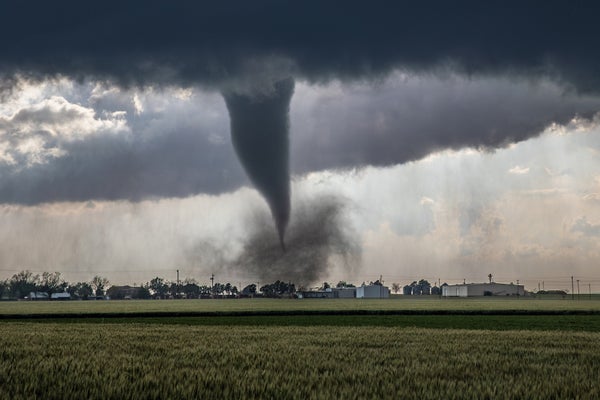
By last Saturday, the National Weather Service reported that 552 tornadoes had occurred in the U.S. this year—well above the average total of 337 for the period of January through April in 1991–2020. Then an outbreak struck Texas and Oklahoma on Saturday night, killing at least three people. Parts of those two states were at the center of the twister-prone “tornado alley” for most of the 1900s, but this well-known corridor has been shifting steadily eastward in the past three and a half decades. This year many of the touchdowns that caused deaths occurred in Mississippi, Alabama and Tennessee, all east of the old alley.
In 2023 Scientific American created a map, based on a then new extensive study to show the shift in large tornado outbreaks.
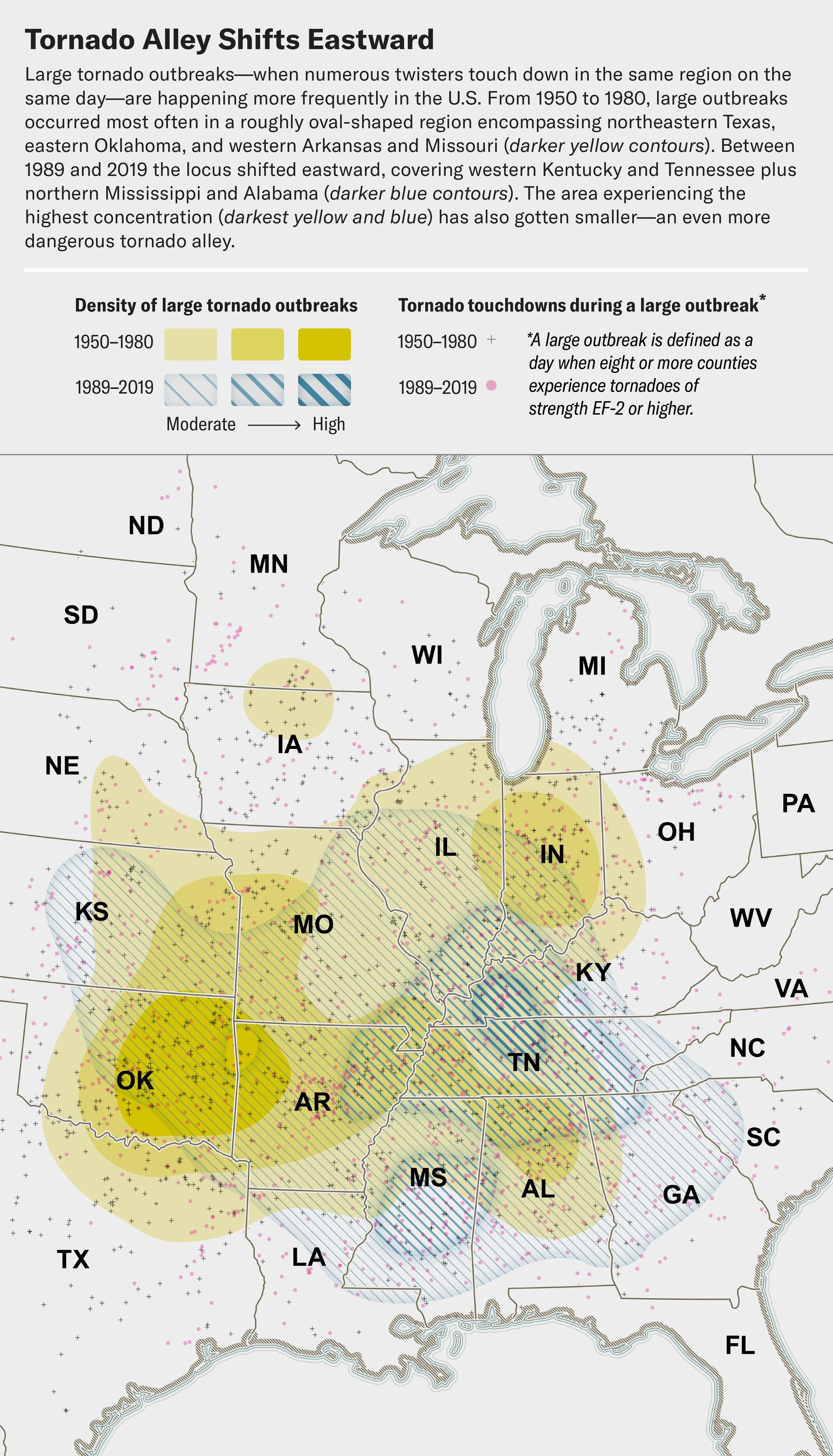
Daniel P. Huffman (map); Source: “Examining the Changes in the Spatial Manifestation and the Rate of Arrival of Large Tornado Outbreaks,” by Niloufar Nouri and Naresh Devineni, in Environmental Research Communications, Vol. 4; February 2022 (data)
On supporting science journalism
If you're enjoying this article, consider supporting our award-winning journalism by subscribing. By purchasing a subscription you are helping to ensure the future of impactful stories about the discoveries and ideas shaping our world today.
Why does the U.S. have so many tornadoes?
Far more tornadoes strike the U.S. than any other country, and this is because of its geography. Wet, westerly winds from the Pacific Ocean become dry as they pass over the the Rocky Mountains, then become high and cool as they blow farther east. Meanwhile warm, humid air streams northward from the Gulf of Mexico, moving at a lower elevation. Flat terrain along these paths allows the two streams to run into each other. The angles at which they collide tend to create unstable air and wind shear—two big factors that favor tornado formation.
Where has tornado alley moved?
For decades, most of the largest outbreaks occurred across northeastern Texas, eastern Oklahoma, and western Arkansas and Missouri. But between 1989 and 2019, the focus shifted eastward by 400 to 500 miles, covering western Kentucky and Tennessee plus northern Mississippi and Alabama.
Why is tornado alley sliding eastward?
Most tornadoes are created by a supercell—a strong thunderstorm with a rotating updraft of air. Supercells tend to form when warm, humid, low-level air interacts with cool, dry, higher air. And climate change is now generating more of that warmer, moister air. Tornadoes also are more likely to develop when the local atmosphere is unstable, and warming increases instability. Climate change is warming the Gulf of Mexico as well, and this can send generous amounts of water vapor into the southeastern U.S.—farther east than it tended to travel decades ago. In addition, climate change has moved the rough north-south boundary between dry western U.S. air and moist, eastern U.S. air about 140 miles to the east.
Why does the shift matter?
Tornado shelters are common in Texas and Oklahoma but less so in other U.S. regions. The Southeast is more densely populated, and mobile homes (which often fare poorly in windstorms) are prevalent. Tornadoes in the Southeast also occur at night more often than those that strike farther west do, in part because winds can bring ample moisture from the Gulf after dark. And nighttime makes it much harder to see a storm coming.