If you're enjoying this article, consider supporting our award-winning journalism by subscribing. By purchasing a subscription you are helping to ensure the future of impactful stories about the discoveries and ideas shaping our world today.
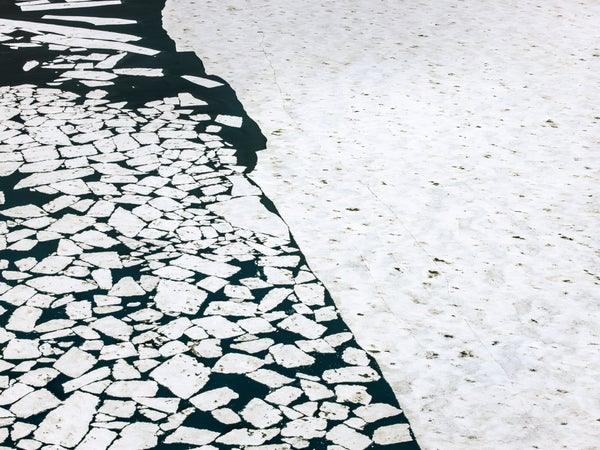
Climate change is profoundly transforming the way the Arctic looks. The region is warming more than twice as rapidly as the rest of Earth. Polar sea ice continues to shrink to record lows, and Greenland’s ice sheet—which holds enough water to raise global sea levels more than seven meters—is melting. Temperatures 30 to 50 degrees Fahrenheit above normal hit parts of the region this past winter. But very few people have witnessed these dramatic shifts in a visual way.
Several years ago New York City–based photographerDiane Tuft decided she had to visit the Arctic to see the vanishing polar environment for herself. “I needed to get there before it was gone,” she says. Tuft traversed the Arctic, traveling to Svalbard, Norway, to photograph mountain glaciers; to the North Pole on a Russian nuclear-powered icebreaker to observe the warming Arctic Ocean; and to Greenland to view its thawing ice sheet. In her new book, The Arctic Melt: Images of a Disappearing Landscape, the public can observe the changing Arctic through the artist’s eyes. “I hope it conveys that this is happening. It’s not theoretical,” she explains. “Scientists write a lot, but unless someone sees something visually, it’s not the same. How else will they know unless they can see it?”
Subscribe to Support Independent Journalism
Great science journalism requires human expertise, time, effort and creativity. And it costs money. That’s why I and the journalists here at Scientific American hope you’ll join our community.
When you subscribe, you are supporting staff and freelance journalists who are passionate about telling science stories that are true, important and compelling. Our editors and reporters are often experts in their fields, which means they understand the nuances of big discoveries and can untangle the breakthroughs from the hype. With a subscription, you are also supporting rigorous fact-checking to ensure the words we publish are precise and accurate. And you’re supporting original illustrations, graphics and photos that bring you closer to an advanced laboratory, an ice sheet in Antarctica or a space mission in orbit. You’re helping us craft other types of high-quality journalism as well: Our newsletters are carefully written, edited and curated by staffers you have or will come to know and love. Our Science Quickly podcast is based on original reporting, collaboration with editors and scientists and exacting production.
Subscriptions keep this engine running so we can continue to deliver thoughtful, rigorous and independent science journalism to you. In an era of viral misinformation, this work is crucial. If you value what we do, I hope you’ll consider joining us as a subscriber
Thank you,
Jeanna Bryner, Editor in Chief, Scientific American