
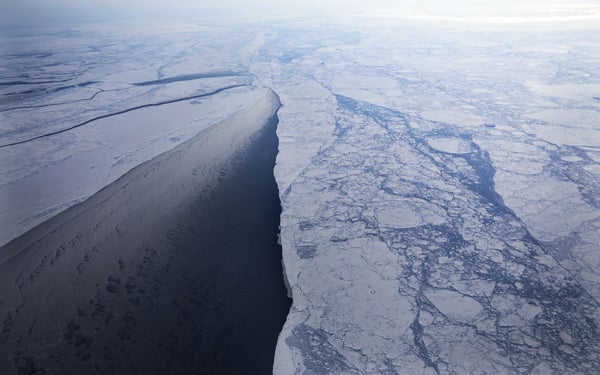
The Arctic is warming more than twice as fast as the rest of the planet, suggests a huge assessment of the region. The warming is hastening the melting of Arctic ice and boosting sea-level rise.
The report, compiled by more than 90 scientists, documents the myriad changes already under way across the Arctic because of climate change—from declining sea ice and melting glaciers to shifting ecosystems and weather patterns. From 2011 to 2015, the assessment finds, the Arctic was warmer than at any time since records began around 1900 (see 'Arctic warming').
Sea ice continues to decline, and the extent of snow cover across the Arctic regions of North America and Eurasia each June has halved as compared to observations before 2000.
On supporting science journalism
If you're enjoying this article, consider supporting our award-winning journalism by subscribing. By purchasing a subscription you are helping to ensure the future of impactful stories about the discoveries and ideas shaping our world today.
The findings come from the Snow, Water, Ice, and Permafrost in the Arctic report, a comprehensive assessment compiled every few years by the Arctic Monitoring and Assessment Programme, the scientific body that reports to the governments that make up the Arctic Council, a forum for issues affecting the region. The last assessment came out in 2011.
Observation to action
“The take-home message is that the Arctic is unravelling,” says Rafe Pomerance, who chairs a network of conservation groups called Arctic 21 and was a deputy assistant secretary of state for environment and development under US President Bill Clinton. “The fate of the Arctic has to be moved out of the world of scientific observation and into the world of government policy.”

Credit: Nature, April 28, 2017, doi:10.1038/nature.2017.21911
The report increases projections for global sea-level rise, which takes into account all sources of melting including the Arctic. Their new minimum estimates are now almost double those issued by the Intergovernmental Panel on Climate Change (IPCC) in 2013 for some emissions scenarios. In fact, the latest calculations suggest that the IPCC's middle estimates for sea-level rise should now be considered minimum estimates.
In one scenario, which assumes that carbon emissions rise slightly above the goals set by the 2015 Paris climate agreement—but still see a considerable reduction—sea levels would increase by at least 0.52 metres by 2100, compared with 2006, the Arctic report says. Under a business-as-usual scenario, the minimum increase would be 0.74 metres.
Although aggressive reductions in greenhouse-gas emissions will make a crucial difference by the end of the century, dramatic changes are still likely over the next few decades, says Morten Skovgård Olsen, who coordinated the assessment and leads the Danish Ministry of Energy, Utilities and Climate’s Arctic programme.
“The Arctic that you will have by mid-century will be very different from the Arctic that we see today,” he says.
This article is reproduced with permission and was first published on April 28, 2017.