The Pandemic’s Hidden Toll Is Revealed in Excess Death Counts

Many of the unexpected deaths in rural U.S. counties last year were not recorded as caused by COVID

US excess deaths graphic.

Amanda Montañez

Join Our Community of Science Lovers!

The official U.S. death toll from COVID has surpassed 600,000, but the true number is likely much higher. In a preprint study, global health professor Andrew C. Stokes of Boston University and his colleagues found that in 2020 in U.S. counties with significant excess deaths (deaths beyond the expected number), only 82 percent of them on average were attributed to COVID.* Some of the biggest gaps were in rural counties, particularly in the South and West. These gaps may reflect COVID deaths that were misattributed to other causes or indirect deaths resulting from the pandemic's social and economic impacts.

An acute shortage of COVID testing early on meant that many patients never got tested. Coroners or other elected officials who lack medical experience may not have recognized COVID as the cause of death or may have declined to list it for political reasons, Stokes and his team hypothesize. Some New England counties actually had negative excess deaths last year—fewer people died than usual—possibly the result of reductions in other causes of death while people stayed at home, the researchers say.
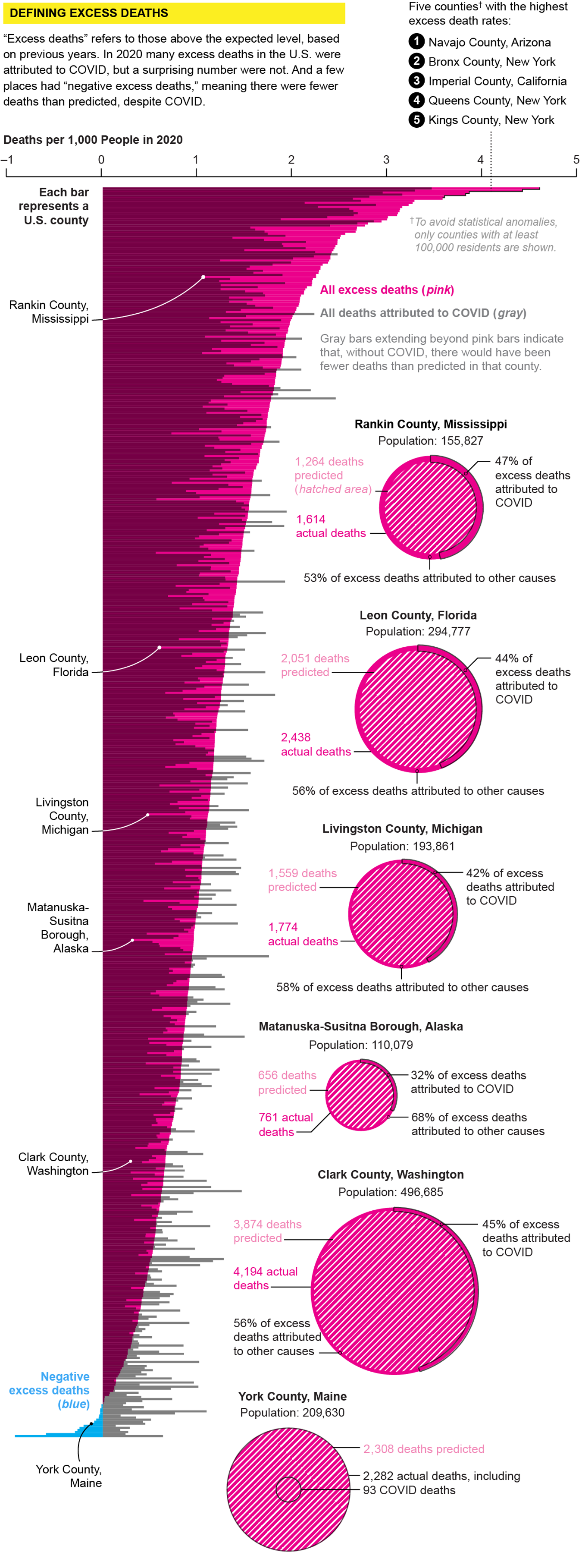
Credit: Amanda Montañez; Source: Calvin A. Ackley, Dielle J. Lundberg, Irma T. Elo, Samuel H. Preston and Andrew C. Stokes


On supporting science journalism

If you're enjoying this article, consider supporting our award-winning journalism by subscribing. By purchasing a subscription you are helping to ensure the future of impactful stories about the discoveries and ideas shaping our world today.


*Excess deaths were calculated using provisional mortality data reported as of June 3 and may be subject to change.

Tanya Lewis is senior desk editor for health and medicine at Scientific American. She writes and edits stories for the website and print magazine on topics ranging from COVID to organ transplants. She also appears on Scientific American’s podcast Science Quickly and writes Scientific American’s weekly Health & Medicine newsletter. She has held a number of positions over her nine years at Scientific American, including health editor, assistant news editor and associate editor at Scientific American Mind. Previously, she has written for outlets that include Insider, Wired, Science News and others. She has a degree in biomedical engineering from Brown University and one in science communication from the University of California, Santa Cruz. Follow her on Bluesky @tanyalewis.bsky.social

More by Tanya Lewis

Amanda Montañez is senior graphics editor and been at Scientific American since 2015. She produces and art directs information graphics for the Scientific American website and print magazine. Montañez has a bachelor's degree in studio art from Smith College and a master's in biomedical communications from the University of Toronto. Before starting in journalism, she worked as a freelance medical illustrator. Follow her on Bluesky @unamandita.bsky.social

More by Amanda Montañez
Scientific American Magazine Vol 325 Issue 3This article was published with the title “COVID's Hidden Toll” in Scientific American Magazine Vol. 325 No. 3 (), p. 84
doi:10.1038/scientificamerican0921-84

It’s Time to Stand Up for Science

If you enjoyed this article, I’d like to ask for your support. Scientific American has served as an advocate for science and industry for 180 years, and right now may be the most critical moment in that two-century history.

I’ve been a Scientific American subscriber since I was 12 years old, and it helped shape the way I look at the world. SciAm always educates and delights me, and inspires a sense of awe for our vast, beautiful universe. I hope it does that for you, too.

If you subscribe to Scientific American, you help ensure that our coverage is centered on meaningful research and discovery; that we have the resources to report on the decisions that threaten labs across the U.S.; and that we support both budding and working scientists at a time when the value of science itself too often goes unrecognized.

In return, you get essential news, captivating podcasts, brilliant infographics, can't-miss newsletters, must-watch videos, challenging games, and the science world's best writing and reporting. You can even gift someone a subscription.

There has never been a more important time for us to stand up and show why science matters. I hope you’ll support us in that mission.

Thank you,

David M. Ewalt, Editor in Chief, Scientific American

Subscribe