
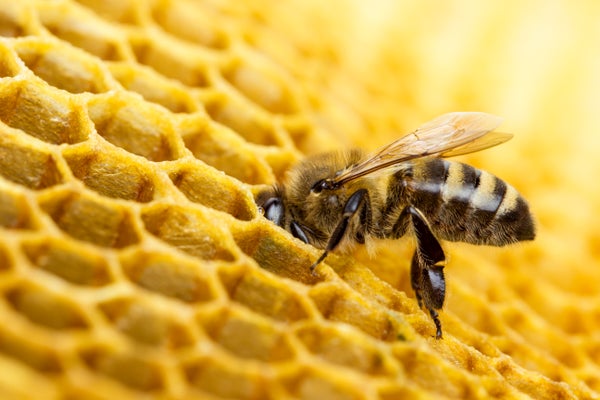
Charles Darwin described bees' ability to build perfect honeycombs as “the most wonderful of all known instincts.” Each hexagonal cell is so precisely constructed and so neatly arrayed that a comb is a visual treat. Now new research into how honeybees incorporate different cell sizes into a flawless-looking grid—and seamlessly merge combs built from multiple directions at once—reveals remarkable adaptability.
Adjacent honey storage cells are typically uniform in size, but bees must build some larger cells for rearing drones and smaller ones for workers. They also have to align and join comb grids being constructed from separate starting points. Understanding how bees accomplish all of this so elegantly “is an old quest,” says Auburn University behavioral ecologist Michael Smith.

Credit: Brown Bird Design; Source: “Imperfect Comb Construction Reveals the Architectural Abilities of Honeybees,” by Michael L. Smith, Nils Napp and Kirstin H. Peterson, in Proceedings of the National Academy of Sciences USA, Vol. 118; August 3, 2021
On supporting science journalism
If you're enjoying this article, consider supporting our award-winning journalism by subscribing. By purchasing a subscription you are helping to ensure the future of impactful stories about the discoveries and ideas shaping our world today.
For a study in the Proceedings of the National Academy of Sciences USA, Smith and his colleagues measured 19,000 comb cells from 12 colonies of Italian honeybees. Using automated image analysis, they examined the centers and vertices of these cells to find variations in their shapes and sizes. “We just couldn't extract the precise measurement of thousands of cells until we had this new automated method,” Smith says.
The researchers found that bees made clever adjustments to transition between sizes and merge combs as cleanly as possible. The insects utilized patterns of irregular shapes (mostly pairs of heptagons and pentagons) and manipulated comb cells' size and orientation so craftily that their ability can be considered “a true architectural skill,” the researchers write.
“The hexagonal grid structure of a honeycomb—constructed by a leaderless collective of hundreds of bees—lends itself to speculation that robotic, innate behavior must be at work,” says Queen Mary University entomologist Lars Chittka, who was not involved with the study. “But a simple robot does not have such a level of adaptability and rate of error recovery.”
Raghavendra Gadagkar, who studies insect behavior at the Indian Institute of Science, Bangalore, and who was also not part of the study, suggests that examining how bees coordinate comb building can help advance robotics. “Imagine,” he says, “if we could program such wits of honeybees in real-world robots.”