
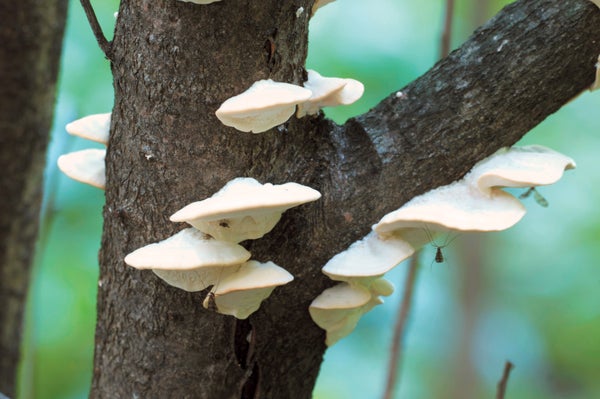
Ever bite into something so bitter that you had to spit it out? An ages-old genetic mutation helps you and other animals perceive bitterness and thus avoid toxins associated with it. But while most creatures instinctively spit first and ask questions later, molecular biologists have been trying to get a taste of what bitterness can tell us about sensory evolution and human physiology. A new study, published in the Journal of Agricultural and Food Chemistry, is the first analysis of how taste receptors respond to a mushroom’s bitter compounds—which include some of the most potently bitter flavors currently known to science.
The bitter bracket mushroom is nontoxic but considered inedible because of its taste. Researchers extracted its bitter compounds, finding two familiar ones—and three that were previously unknown. Instead of tasting these substances themselves, the scientists introduced them to an “artificial tongue” that they made by inserting human taste receptors into fast-growing embryonic kidney cells. One of the newfound bitter substances activated the taste receptors even at the lowest concentration measured, 63.3 micrograms per liter. That’s like sensing three quarters of a cup of sugar in an Olympic-sized swimming pool.
Humans have about 25 kinds of bitter taste receptors lining our mouths and throats, but these same receptors also grow throughout the body—in the lungs, digestive tract and even brain. Despite their ubiquity, they have been only partially explored. Four of our bitter receptors have no known natural activator. Finding activating compounds could illuminate the interactions that might have shaped those taste receptors’ evolution, says study lead author Maik Behrens, a molecular biologist at the Leibniz Institute for Food Systems Biology.
On supporting science journalism
If you're enjoying this article, consider supporting our award-winning journalism by subscribing. By purchasing a subscription you are helping to ensure the future of impactful stories about the discoveries and ideas shaping our world today.
Previous research focused on bitter compounds from flowering plants, which evolved well after animals gained bitter taste receptors. Behrens thought that mushrooms, being older, might even activate one of the four mystery receptors. The bitter bracket mushroom didn’t, but Behrens plans to keep looking—especially since this first chemical analysis of mushroom bitterness has already yielded previously unknown compounds.
Such research can also unlock information about taste receptors’ many functions in the human body. “Taste in your mouth does so much more than just perception,” explains University of Miami physiologist Nirupa Chaudhari, who was not involved in the study. Taste can trigger physiological reflexes such as insulin release and stomach acid production, she says, so knowing what activates bitter taste receptors could improve our understanding of bodily processes and disease. Chaudhari considers the new study a good first step toward expanding bitter taste research.
With the first analysis complete, researchers are now setting their sights on other mushrooms’ bitter secrets—compounds and activated receptors you can’t uncover by “simply chewing on a mushroom,” Behrens says.