
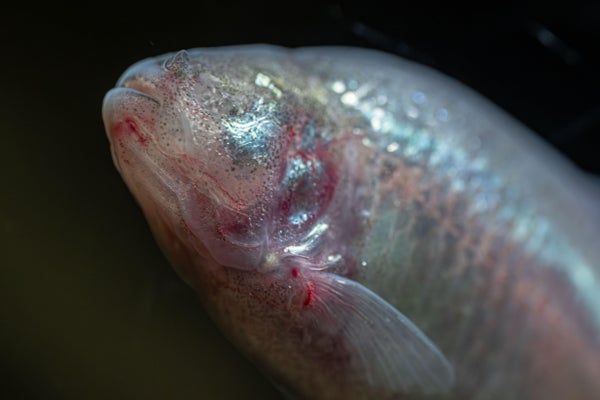
In eastern Mexico’s underground caverns and streams, a blind fish undergoes a peculiar adolescence: as it approaches maturity, taste buds begin to sprout under its chin and on top of its head, creeping toward its back.
“It’s a pretty wild amplification of the sensory system of taste,” says Josh Gross, an evolutionary geneticist at the University of Cincinnati and a co-author of a recent study on the cave fish in Nature Communications Biology. Gross and his team discovered that the new buds blossom around the time when the fish transition from eating larval crustaceans to gobbling up their adulthood staple: bat guano. Taste buds outside their mouths might be helping the fish detect bat droppings in the utterly dark, “food-starved” caves, Gross says.
Wandering taste buds aren’t unheard of elsewhere, especially in other fish. Some damselfish cultivate taste buds on their fins, and channel catfish have them across their midsections. And as alien as it may seem, many cells throughout the human body can taste, too. They’re just not sharing the flavors with your brain like taste buds do.
On supporting science journalism
If you're enjoying this article, consider supporting our award-winning journalism by subscribing. By purchasing a subscription you are helping to ensure the future of impactful stories about the discoveries and ideas shaping our world today.
Lora Bankova is a Harvard Medical School respiratory biologist who studies tuft cells, a cell type sprinkled within human mucous tissues like those lining your nostrils, throat and gut. These “rapid responder” cells trigger the immune system if they detect an outside threat, and many of them rely on built-in taste receptors (the same kinds found on taste-bud cells) to do so. Bankova notes that many potentially harmful bacteria communicate via signaling chemicals called lactones—which also happen to activate taste receptors attuned to bitter flavors, prompting tuft cells’ immune response. And it turns out that even environmental allergies may be a matter of taste: dust mites and several mold species can also set off a tuft cell’s taste receptors, Bankova says.
“Evolutionarily, taste receptors [have moved around] the body to protect us from the air we inhale and all the attacks we’re getting through the orifices,” Bankova says. “They’re in the inner ear, the urethra, everywhere something can get into your body.”
Such “extra” taste receptors aren’t just bouncers at the door—they taste test for our internal systems, too. Receptors for sweet tastes help to tune insulin production in the pancreas and make sure neurons in the brain have access to enough glucose. Sweet, bitter and umami receptors in the gut modulate digestion.
Gross says it’s still a mystery what taste receptors the bat guano activates in the blind cave fish. “There may be some sugar content if it’s a fruit bat, maybe some protein content if it’s a carnivorous bat,” he says. So far only the cave fish has signed up to sample it.