
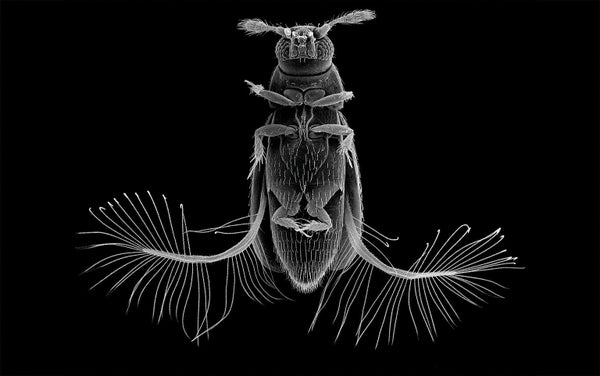
When it comes to insect flight, bigger is usually better. As wings shrink, air friction overwhelms flight power—that’s why dragonflies soar as houseflies sputter. But a beetle the size of a grain of sand flips this maxim on its head.
The featherwing beetle (Paratuposa placentis), less than half a millimeter long, is smaller than some single-celled amoebas. At this scale air becomes syrupy, and scientists once believed the beetles simply drifted wherever the wind blew them. But new research in Nature shows how they wield lightweight wings to keep pace with species three times their size.
As the name suggests, featherwing beetles sport bristled, featherlike wings. These porous appendages are light and produce less friction than the typical membrane-based wings that flies have, helping the beetle generate lift. Multiple insect lineages, including parasitic wasps, have evolved similar wings as they downsized—but these beetles use a previously unknown strategy to generate their outsized flight prowess, according to the new study’s authors.
On supporting science journalism
If you're enjoying this article, consider supporting our award-winning journalism by subscribing. By purchasing a subscription you are helping to ensure the future of impactful stories about the discoveries and ideas shaping our world today.
In 2017 the research team collected featherwing beetles from bits of fungi in a Vietnam jungle. To record the insects’ infinitesimal flight patterns, experimenters placed the creatures in a transparent chamber and filmed them with two high-speed cameras at nearly 4,000 frames per second during a battery of tests. They used these recordings to construct 3-D models of the diminutive beetle and calculate its aerodynamics.
The team found that instead of flapping their wings up and down, featherwing beetles loop them in a “remarkable” figure-eight pattern, says study co-author Dmitry Kolomenskiy, a physicist studying fluid mechanics at Moscow’s Skolkovo Institute of Science and Technology. After the bristled wings unfurl from their protective cases, known as elytra, they mirror each other as they move, clapping together both in front of and behind the insect—Kolomenskiy says the motion is reminiscent of an extreme version of swim strokes such as the butterfly. The elytra stabilize the beetle and its churning wings, preventing it from spinning.
The pattern’s resemblance to swimming particularly intrigues Arvind Santhanakrishnan, a mechanical engineer who studies tiny insects’ aerodynamics at Oklahoma State University. “Typically this type of paddling is seen in small aquatic crustaceans such as water fleas,” says Santhanakrishnan, who was not involved with the study. “It was quite surprising to see that a similar strategy was used by the tiny featherwing beetles to generate lift.”
Kolomenskiy and his colleagues hope to illustrate the flight patterns of other, similarly minuscule insects. They say their findings may influence how engineers shrink flying technology—although Kolomenskiy admits it would take a major engineering feat for a drone to approach the proportions of a featherwing beetle. “Probably not as small,” he says. “But that’s to be explored.”