
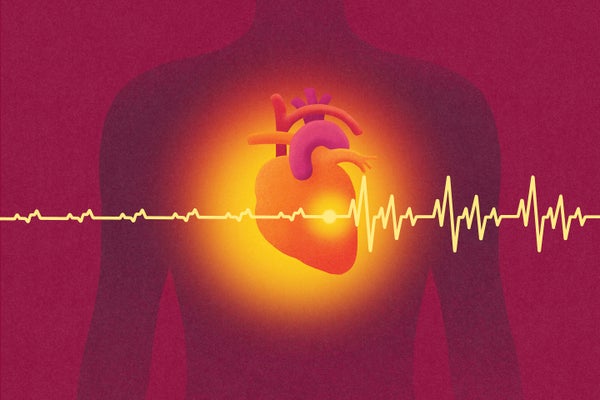
Temporary pacemakers can be used as a stopgap measure to regulate the heartbeat after surgery and in emergency situations. But the fact that they need to be surgically installed and removed also brings risk: moon walker Neil Armstrong famously developed fatal bleeding when surgeons removed his temporary pacemaker’s wires in 2012. Now researchers have developed a tiny temporary pacemaker that could eliminate some of that risk. Their device, just a few millimeters long, has no wires and needs minimally invasive placement. It can be injected into the body with a needle. And when its work is done, it simply dissolves.
Conventionally, temporary pacemakers comprise electrodes that are implanted in the heart muscle. These electrodes are connected to an external battery that delivers a pulse to control the heart’s rhythm and correct slow or irregular heartbeats. The new, less invasive pacemaker, which could be particularly useful in a newborn baby's tiny heart, “consists of two electrodes—conducting metal pads—that are designed to do two things,” says Northwestern University biomedical engineer John A. Rogers, one of the co-authors of an April 2 paper in Nature that describes the device. “One is that they inject current into the cardiac tissue to stimulate contractions that lead to an overall cardiac cycle.... [The other is that they] provide a power source for driving the operation of the pacemaker.”
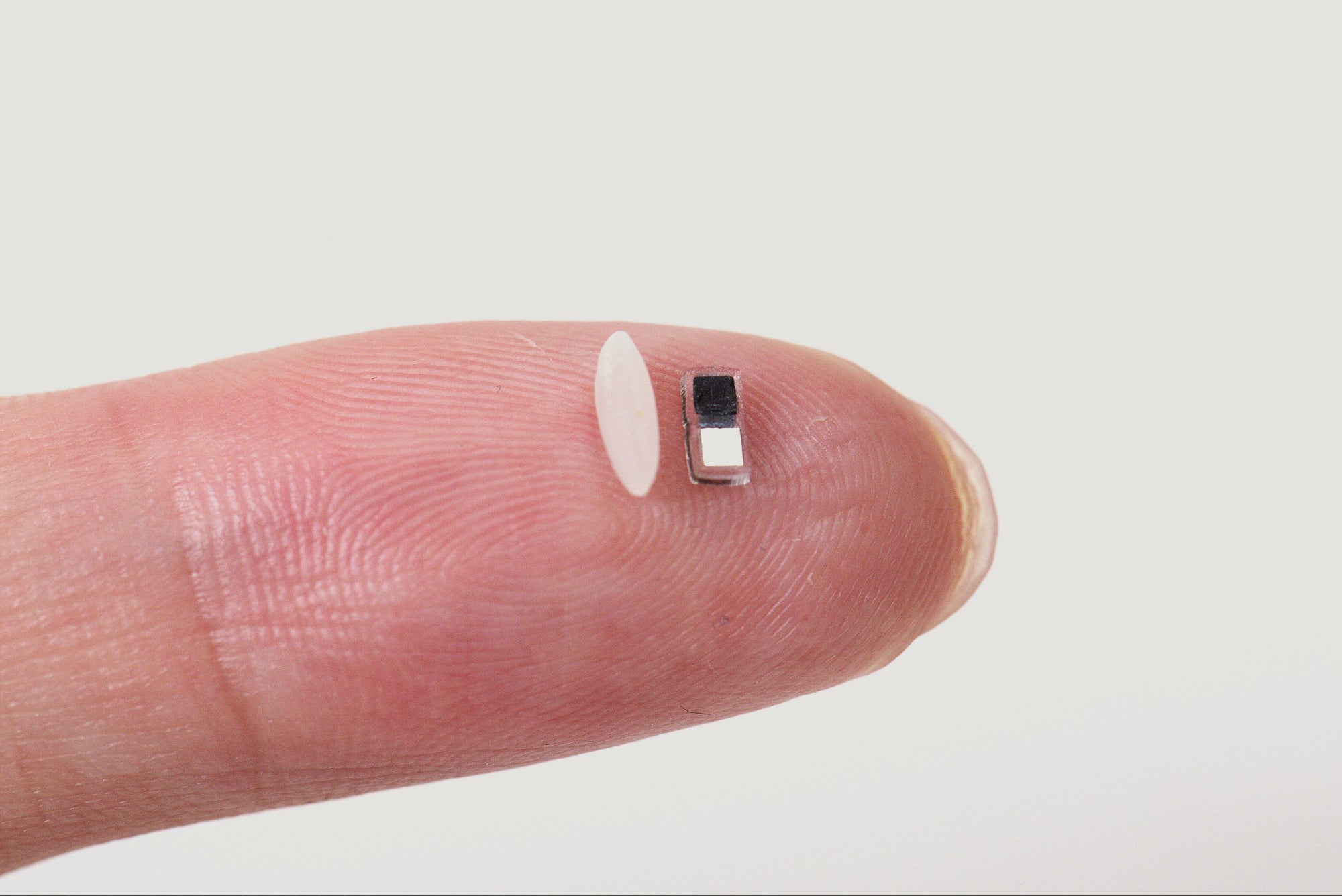
A temporary pacemaker like this one, smaller than a grain of rice, could be injected into the body to regulate heartbeats.
John A. Rogers/Northwestern University
On supporting science journalism
If you're enjoying this article, consider supporting our award-winning journalism by subscribing. By purchasing a subscription you are helping to ensure the future of impactful stories about the discoveries and ideas shaping our world today.
The mini pacemaker device does not have a separate battery. Instead its body functions as a simple type of battery called a galvanic cell—the two electrodes, made of different combinations of magnesium, zinc and molybdenum, react with the naturally occurring electrolytes in bodily fluids to produce an electric current.
On the side opposite of the electrodes lies a tiny light-activated switch that controls the battery’s operation. In the switch’s “on” position, an electrical pulse is delivered to the cardiac tissue; in its “off” state, nothing happens. The pacemaker is paired with a soft, flexible skin patch above the heart that monitors heart rate. When it senses an irregular or slow heartbeat, it flashes a light on and off to dictate the correct pacing. The pacemaker responds to near-infrared light—wavelengths that can penetrate deeply into biological tissues.
When the pacemaker’s job is done, it simply dissolves into the body. The device has a finite operating time of between a few days and about three weeks, Rogers says, depending on the choice of metals for the electrodes.
The current study is an advance on an earlier dissolvable pacemaker by the same team. The previous iteration used a technology called near-field communication instead of a galvanic cell; it ran on power beamed to an antenna, which made it much bigger. The extreme miniaturization is one of the advances in the new model, Rogers says. “What follows from that is that we can use multiple of these millimeter-scale pacemakers simultaneously at different locations of the heart [with the devices] operating in different wavelengths.”
The researchers are also looking at the possibility of integrating the devices with medical implants, such as replacement heart valves, that currently don’t have any kind of cardiac control mechanisms.
Thanh Nho Do, a biomedical engineer at the University of New South Wales in Australia, who wasn’t involved with the study, calls this pacemaker a breakthrough in miniaturization. It gives reliable and sustained pacing without external energy inputs, he says, and could significantly reduce procedural risks and patient discomfort.
Virginia Tech researcher Xiaoting Jia, who was also not involved in the project, says it has great potential for practical use in humans. “The team has performed comprehensive tests in animal models and in ex vivo settings [experiments outside the body]. The next important step would be to thoroughly evaluate the safety for application in humans and obtain [Food and Drug Administration] approvals for clinical use.” The researchers are working toward this via a new start-up company.
One key challenge, Do adds, is selecting suitable materials to balance functionality and safe degradation without triggering excessive immune reactions such as inflammation.