
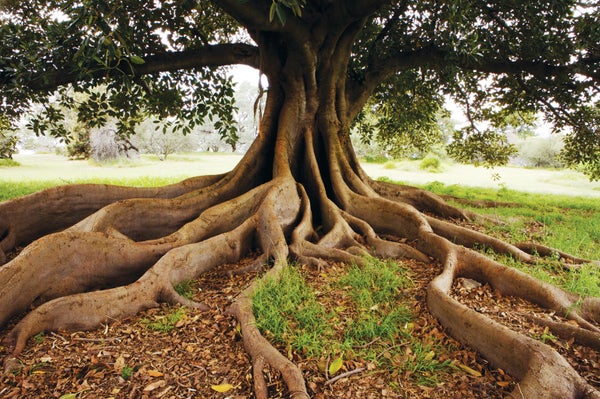
Naturalists have long noted isolated examples of tree roots boring far down through loose soil and into the unforgiving bedrock below—rare incursions that were deemed a mere curiosity. But in 2013 hydrologist Daniella Rempe probed deep into a northern California hillside and found tree roots extracting substantial amounts of moisture from pores and crannies in the rock, where groundwater had seeped in and become trapped. “We wanted to assess how big of a phenomenon this was,” says Erica McCormick, an ecohydrologist in Rempe’s laboratory at the University of Texas at Austin. So the team decided to map plants’ bedrock water use across the continental U.S.
The researchers combined reams of geologic data from 2003 to 2017 to determine where U.S. forests and shrublands overlie bedrock that roots could feasibly reach. They then used known rates of precipitation, evaporation and soil moisture capacity to calculate how much circulating water was unaccounted for—and thus likely came from stores deep inside the rock. This analysis, published in Nature, revealed that bedrock water is far from a last resort for many plants. At least 24 percent of the country’s trees and shrubs regularly tap water from this layer to satiate their thirst, even in years with normal rainfall. And in the hot, dry states of California and Texas, more than 50 percent of the water used by trees comes from bedrock.
Bedrock water may help some trees withstand dry conditions wrought by climate change. But current efforts to predict how forests will fare in a warming future do not typically include this moisture in their projections, says Texas State University ecologist Susan Schwinning, who was not involved with the new study. “The authors here show that this is not just a local, specialized phenomenon but should be looked at broadly,” she adds. The study researchers are now focusing on how plants are using bedrock water at their field sites as California faces severe droughts, Rempe says.
On supporting science journalism
If you're enjoying this article, consider supporting our award-winning journalism by subscribing. By purchasing a subscription you are helping to ensure the future of impactful stories about the discoveries and ideas shaping our world today.
But how do relatively soft roots manage to burrow into rock in the first place? Bedrock and soil layers are somewhat diffuse, Schwinning says. Percolating rainfall weathers the deep bedrock over time, she explains, creating delicate fractures that fingerlike root offshoots can grow into to soak up pooled water when needed. Microbes and fungi latch onto the roots, helping to increase their surface area and pull moisture from the tiniest cracks. “They find this beautiful home in the pores,” Rempe says. “There’s a whole world down there.”